Engineering Optimization: The Role of 2kW Fiber Laser Technology in Monterrey’s Aerospace Brass Fabrication
The aerospace manufacturing sector in Monterrey, Nuevo León, has seen an unprecedented surge in demand due to the global “nearshoring” trend. As Tier 1 and Tier 2 suppliers for Boeing, Airbus, and Bombardier expand their local footprints, the requirement for high-precision component manufacturing has reached a critical threshold. Among the most challenging materials in this supply chain are yellow metals, specifically brass and copper alloys, used in electrical connectors, bushings, and fuel system components.
Traditional mechanical stamping or CO2 laser cutting often falls short when processing brass due to material reflectivity and the need for tight tolerances. The introduction of the 2kW Fiber Laser Cutting Machine, equipped with a Plate-welded Heavy Duty Bed, represents a significant leap in engineering capability for Monterrey-based facilities. This guide explores the technical architecture of these machines and their specific advantages in high-precision brass applications.
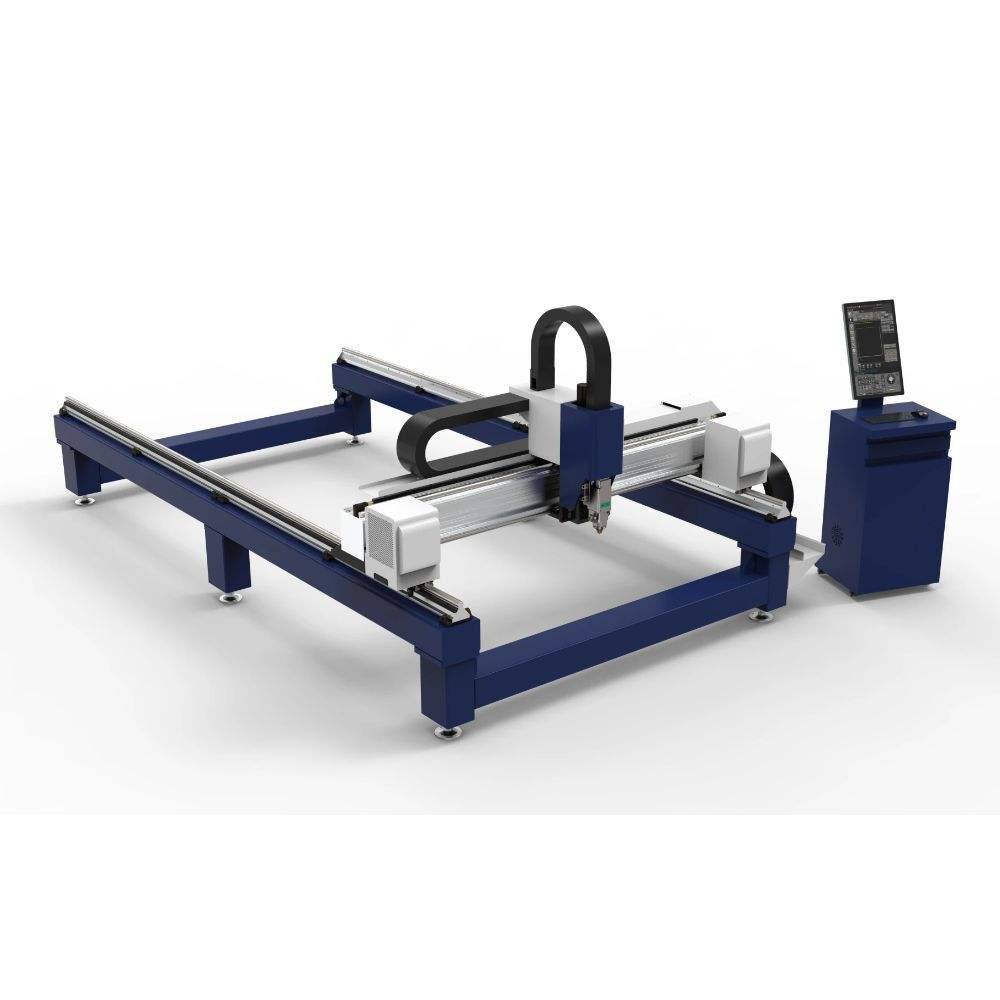
Structural Integrity: The Engineering Behind the Plate-welded Heavy Duty Bed
For aerospace engineers, the foundation of any CNC machine determines its long-term repeatability and accuracy. In the context of fiber lasers, the bed is subjected to high-frequency vibrations and rapid acceleration forces (often exceeding 1.2G).
The 2kW Fiber Laser utilizes a Plate-welded Heavy Duty Bed, a structural choice that offers distinct advantages over traditional cast-iron or thin-walled frames. This bed is constructed from high-tensile structural steel plates, often ranging from 12mm to 20mm in thickness. The manufacturing process involves several critical stages:
1. Stress Relief Annealing: After welding, the entire bed undergoes a high-temperature annealing process in an electric furnace. This removes internal stresses generated during the welding process, ensuring that the frame will not deform over 20+ years of operation.
2. Finite Element Analysis (FEA): The honeycomb-style internal structure is designed using FEA to optimize the weight-to-rigidity ratio. This ensures that the bed can absorb the kinetic energy of the high-speed gantry without transmitting vibrations to the cutting head.
3. Precision Machining: The guide rail and rack mounting surfaces are processed by large-scale Italian gantry milling machines in a single setup. This ensures a parallelism and straightness tolerance of less than 0.02mm.
In Monterrey’s industrial environment, where ambient temperatures can fluctuate significantly between day and night, the thermal mass of a heavy-duty bed provides essential stability. It resists the thermal expansion that can cause “drift” in precision components, a factor that is non-negotiable for aerospace-grade certifications.
Overcoming Reflectivity: 2kW Fiber Laser Dynamics in Brass Processing
Brass is a highly reflective material in the infrared spectrum. Historically, this made laser cutting difficult, as back-reflections could travel back through the delivery fiber and destroy the laser source. Modern 2kW fiber lasers have solved this through two primary mechanisms:
First, the 1.06μm wavelength of a fiber laser is absorbed much more efficiently by brass than the 10.6μm wavelength of a CO2 laser. This allows for a cleaner melt and faster piercing. Second, advanced laser sources are now equipped with optical isolators and back-reflection protection systems. These sensors detect reflected light and instantly modulate the beam or shut down the source to prevent damage.
A 2kW power rating is the “sweet spot” for many aerospace brass applications. While higher wattages exist, 2kW provides the optimal balance of power density and kerf width for materials between 1mm and 6mm.
Data-Driven Performance Metrics for Brass (C26000/C36000):
– 1mm Brass: Cutting speed of 18-22 m/min.
– 3mm Brass: Cutting speed of 4-6 m/min.
– 5mm Brass: Cutting speed of 1.2-2.0 m/min.
The use of Nitrogen (N2) as an assist gas is standard for these applications to prevent oxidation and ensure a bright, solder-ready edge finish. Oxygen (O2) can be used for thicker sections, though it results in a darker edge that may require post-processing.

Precision and Tolerance Control in Aerospace Components
Aerospace engineering demands tolerances that leave no room for error. When cutting brass bushings or shims, the 2kW fiber laser achieves a positioning accuracy of ±0.03mm and a repeatability of ±0.02mm. This is made possible by the integration of high-end motion control components:
– Servo Motors: High-inertia Yaskawa or Panasonic servo motors provide the torque necessary to maintain precision during rapid direction changes.
– Gear and Rack: Precision helical racks (Class M1 or better) ensure smooth power transmission and minimize backlash.
– Cutting Head: Auto-focus cutting heads, such as those from Raytools or Precitec, utilize capacitive sensors to maintain a constant standoff distance from the material, even if the brass sheet has slight undulations.
The Heat Affected Zone (HAZ) is another critical metric. Because the fiber laser beam can be focused to a spot size as small as 0.1mm, the energy is highly concentrated. This results in an extremely narrow HAZ, preserving the mechanical properties of the brass alloy—a vital requirement for parts that will be subjected to high-stress aviation environments.
Operational Economics and the Monterrey Market Advantage
Investing in a 2kW fiber laser in Monterrey offers a strategic advantage beyond mere technical specs. The local ecosystem is characterized by a “just-in-time” (JIT) manufacturing philosophy. Having an in-house laser cutting capability allows Monterrey shops to bypass the 2-4 week lead times associated with external job shops in the US or Central Mexico.
From a data-driven economic perspective, the fiber laser is significantly more efficient than previous technologies:
– Wall-plug Efficiency: Fiber lasers convert approximately 30-35% of electrical energy into laser light, compared to 8-10% for CO2 lasers.
– Consumable Costs: With no mirrors to align or gas mixtures for the resonator, the primary costs are limited to nozzles, protective windows, and assist gas.
– Maintenance: The solid-state nature of the 2kW source means a Mean Time Between Failures (MTBF) of over 100,000 hours.
For a factory owner in the Santa Catarina or Apodaca industrial parks, this translates to a lower Total Cost of Ownership (TCO) and a faster Return on Investment (ROI), typically achieved within 18 to 24 months depending on shift volume.
Advanced Software Integration and Industry 4.0
The modern 2kW fiber laser is not a standalone tool but a node in a connected factory. Most units are now equipped with CypCut or similar CNC control systems that support direct CAD/CAM integration. For aerospace engineers, this means the ability to import .DXF or .STEP files directly, apply nesting algorithms to minimize brass scrap (which is high-value material), and track production metrics in real-time.
Features such as “Leapfrog” positioning and “Fly-cutting” reduce non-productive time by optimizing the path of the cutting head between contours. In high-volume brass connector production, these software optimizations can increase throughput by as much as 15-20% without changing the hardware parameters.
Conclusion: Setting a New Standard for Monterrey Aerospace
As Monterrey continues to solidify its position as a global aerospace hub, the move toward specialized, high-rigidity fiber laser systems is inevitable. The combination of a 2kW power source—tailored for the unique challenges of brass—and a Plate-welded Heavy Duty Bed provides the stability, precision, and efficiency required to meet international aviation standards.
For engineers and factory owners, the decision to implement this technology is a move toward future-proofing their operations. By reducing waste, ensuring sub-millimeter accuracy, and capitalizing on the operational efficiencies of fiber optics, Monterrey’s manufacturing base can continue to compete and win on the global stage. The 2kW fiber laser is not just a cutting tool; it is a precision instrument designed for the rigors of modern aerospace excellence.













