The Evolution of Automotive Manufacturing in Monterrey: The Shift to Aluminum
The industrial landscape of Monterrey, Nuevo León, has undergone a radical transformation over the last decade. As the “Sultan of the North” cements its position as a global automotive hub—bolstered by the presence of Tesla’s upcoming Gigafactory, Kia, and a dense network of Tier 1 and Tier 2 suppliers—the demand for advanced material processing has surged. The industry is currently witnessing a decisive shift from traditional heavy steel components to lightweight Aluminum Alloys (primarily 5000 and 6000 series). This transition is driven by the global imperative for Electric Vehicle (EV) range extension and fuel efficiency.
For Monterrey-based factory owners and engineers, the challenge lies in processing these non-ferrous metals with high precision while maintaining a competitive cost-per-part. The 1.5kW Sheet Metal Fiber Laser, equipped with a specialized Tube-welded Standard Bed, has emerged as the engineering benchmark for this specific application. This guide analyzes the technical architecture of these systems and why they are optimized for the rigorous demands of the Mexican automotive supply chain.
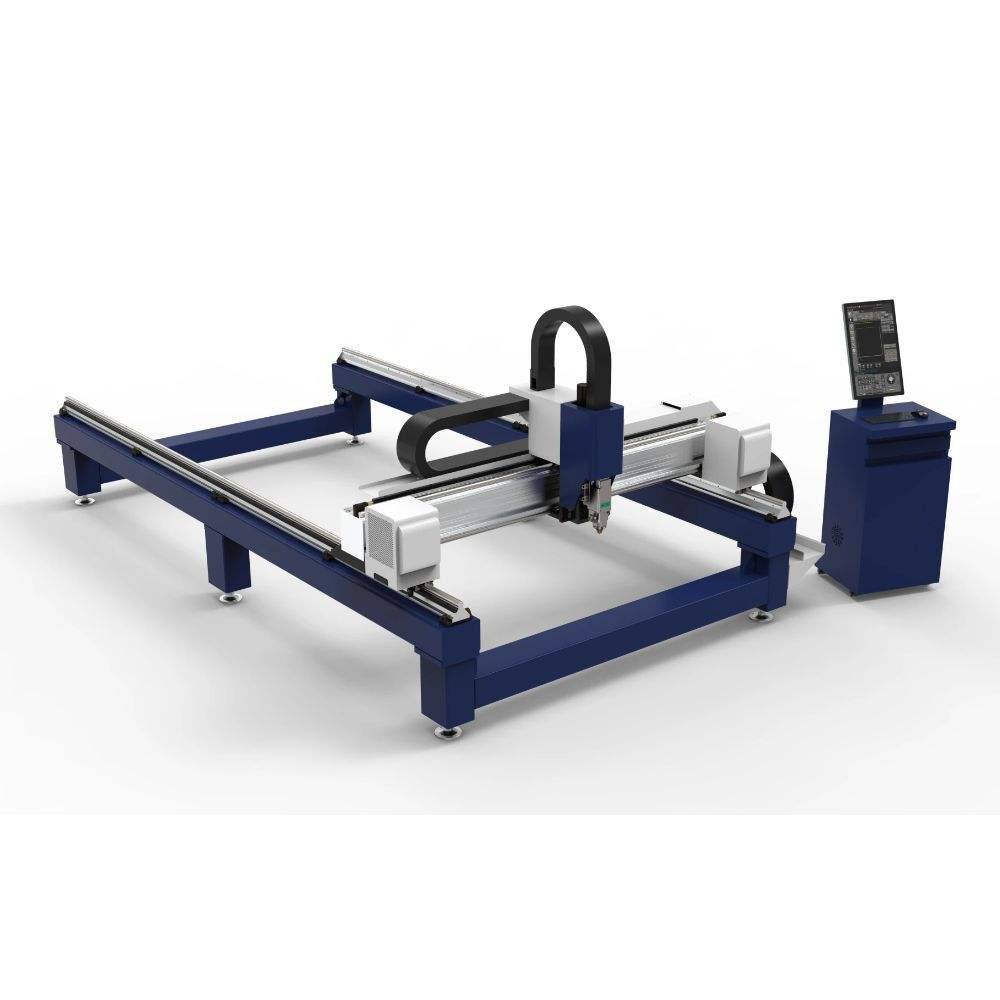
Technical Analysis of the 1.5kW Fiber Laser Source
In the realm of fiber optics, power density is more critical than raw wattage when dealing with thin-to-medium gauge aluminum. A 1.5kW laser source provides the optimal “sweet spot” for sheet thicknesses ranging from 0.5mm to 5.0mm, which covers approximately 85% of automotive interior brackets, heat shields, and electronic housings.
Unlike CO2 lasers, which suffer from high reflectivity when hitting aluminum, the 1.07-micron wavelength of a fiber laser is absorbed more efficiently by the material. At 1.5kW, the beam quality (M² factor) is typically maintained below 1.1, allowing for an incredibly small focal spot. This high energy concentration enables the laser to “pierce” the reflective surface of aluminum alloys instantly, preventing back-reflection damage to the resonator—a common failure point in older laser generations.
Data-driven performance metrics for 1.5kW on Aluminum (5052 Alloy):
– 1.0mm thickness: Cutting speeds up to 25 m/min.
– 3.0mm thickness: Cutting speeds up to 6 m/min.
– Kerf width: 0.08mm to 0.12mm.
– Positional Accuracy: ±0.03mm.
Structural Engineering: The Tube-Welded Standard Bed
The foundation of cutting precision is not the laser itself, but the machine bed. In Monterrey’s industrial environment, where factories often operate 24/7 in varying thermal conditions, structural stability is paramount. The Tube-welded Standard Bed is engineered to provide superior vibration damping compared to bolt-together frames or lighter aluminum extrusions.
The bed is constructed using high-quality industrial rectangular steel tubes. These tubes undergo a rigorous “stress-relief” process, including high-temperature annealing. This process eliminates the internal residual stresses caused by welding, ensuring that the frame does not warp or deform over years of high-speed gantry acceleration.
For engineers, the advantage is measurable in the “G-force” handling. A tube-welded bed provides the rigidity necessary to handle 1.2G to 1.5G acceleration without inducing harmonic vibrations that would otherwise result in “chatter” marks on the edge of the aluminum cut. This is particularly vital for Monterrey’s automotive sector, where ISO standards demand burr-free edges and tight geometric tolerances.
Precision Cutting of Aluminum Alloys: Overcoming Reflectivity
Aluminum is a “difficult” material for lasers due to its high thermal conductivity and high reflectivity. However, the 1.5kW system utilizes specific engineering strategies to master these properties:
1. Frequency Modulation: By using pulsed piercing and modulated frequency during the transition to continuous wave cutting, the system minimizes the Heat Affected Zone (HAZ). This prevents the “melting” effect often seen on the corners of 6061-T6 alloys.
2. Nitrogen Assist Gas: For automotive-grade aluminum, high-pressure nitrogen (10-15 bar) is used to blow away the molten material. Since nitrogen is inert, it prevents oxidation of the cut edge, leaving a bright, weld-ready finish that requires no post-processing.
3. Capacitive Height Sensing: Aluminum sheets, especially in thinner gauges, are rarely perfectly flat. The cutting head utilizes a high-speed capacitive sensor that maintains a constant standoff distance (typically 0.5mm) with a response time of less than 1ms. This prevents nozzle collisions and ensures a consistent focal point.
Operational Efficiency and ROI for Monterrey Tier 1 & 2 Suppliers
From a financial perspective, the 1.5kW fiber laser represents a significantly lower Total Cost of Ownership (TCO) compared to higher-wattage systems or traditional CNC punching.
Energy Consumption: A 1.5kW fiber laser system typically draws less than 15kW of total wall-plug power, including the chiller and dust extractor. In the context of Mexican industrial electricity rates (CFE), this efficiency directly impacts the margin per part.
Maintenance Intervals: Modern fiber sources are “fit and forget” components with a diode life exceeding 100,000 hours. Unlike CO2 lasers, there are no mirrors to align or gas blowers to service.
Material Utilization: The narrow kerf width allows for incredibly tight nesting. Using advanced CAD/CAM nesting software, Monterrey factories can achieve up to 92% material utilization, a critical factor given the fluctuating price of aluminum ingots on the London Metal Exchange (LME).
Thermal Stability in the Monterrey Climate
Monterrey is known for its extreme temperature fluctuations, ranging from 5°C in winter to 45°C in summer. These variations can cause thermal expansion in machine tools, leading to dimensional inaccuracies.
The Tube-welded Standard Bed addresses this through its mass and geometric design. The hollow sections of the tube-welded frame allow for better heat dissipation compared to solid plate frames. Furthermore, the high-end 1.5kW systems are equipped with dual-circuit industrial chillers. One circuit cools the laser source, while the second circuit specifically targets the cutting head optics. This ensures that even in a non-climate-controlled warehouse in Santa Catarina or Apodaca, the focal point remains stable throughout a 12-hour shift.
Integration with Automotive Industry 4.0
The modern 1.5kW laser is not a standalone tool but a node in a connected factory. For engineers in Monterrey, integration with ERP systems is essential. These machines feature:
– Real-time Monitoring: Tracking gas consumption, power usage, and cutting time per job.
– Remote Diagnostics: Allowing technicians to troubleshoot the CNC controller via the cloud, reducing downtime in the event of a software glitch.
– Automated Loading Compatibility: The tube-welded bed is designed with the structural integrity to support future upgrades to pallet changers or robotic loading arms, providing a scalable path toward full automation.
Conclusion: Selecting the Right Path for Monterrey’s Manufacturing Future
The selection of a 1.5kW Sheet Metal Laser with a Tube-welded Standard Bed is a strategic decision for any automotive-focused operation in Monterrey. It balances the high-precision requirements of aluminum processing with the rugged durability needed for the Mexican industrial environment.
By focusing on the structural integrity of the bed and the specific physics of 1.5kW fiber delivery, manufacturers can achieve tolerances that meet the most stringent OEM requirements. As the automotive industry continues its pivot toward electrification and lightweighting, having a machine optimized for aluminum is no longer an advantage—it is a necessity for survival in the competitive North American market.
For the engineers and factory owners of Monterrey, the 1.5kW fiber laser represents the intersection of precision, reliability, and economic viability, ensuring that the region remains at the forefront of global manufacturing excellence.













