Engineering Excellence: The 12kW Fiber Laser Strategy for Brass Fabrication in Puebla
In the industrial heart of Puebla, where the automotive and construction sectors demand rigorous precision, the elevator manufacturing industry stands as a pillar of specialized engineering. For factory owners and lead engineers, the transition from traditional mechanical shearing or lower-power CO2 lasers to high-power fiber laser technology is no longer an option—it is a competitive necessity. The 12kW Fiber Laser Cutting Machine represents the pinnacle of this evolution, specifically when tasked with the complexities of non-ferrous metals like brass.
Brass, prized in the elevator industry for its aesthetic appeal in cabin interiors, handrails, and control panels, presents unique challenges. Its high reflectivity and thermal conductivity require a power density that only a 12kW source can reliably provide. This guide explores the technical architecture of these machines, focusing on the structural superiority of the plate-welded heavy-duty bed and the nuances of high-precision brass processing.

The Physics of 12kW Power: Overcoming Brass Reflectivity
Brass is a copper-zinc alloy characterized by high reflectivity in the infrared spectrum. Standard low-power fiber lasers often struggle with “back-reflection,” where the laser beam bounces off the material surface and returns to the cutting head, potentially damaging the optical fiber or the resonator.
A 12kW power source changes the thermodynamic equation. At this wattage, the energy density is sufficient to instantaneously transition the brass from a solid to a molten state, significantly reducing the window of time where the material acts as a mirror. The 12kW system utilizes a shorter wavelength (approximately 1.06μm) which is absorbed more efficiently by brass compared to the 10.6μm wavelength of CO2 lasers.
For Puebla-based engineers, this means the ability to cut brass plates up to 20mm with a clean, burr-free finish. In elevator manufacturing, where decorative panels often require intricate geometric patterns (moucharaby styles or custom logos), the 12kW source ensures that the kerf width remains narrow (0.05mm to 0.1mm), maintaining the structural integrity of the delicate brass lattice.
Structural Integrity: The Plate-welded Heavy Duty Bed
The performance of a 12kW laser is only as good as the platform it sits upon. High-power cutting involves extreme accelerations and decelerations (often exceeding 1.5G to 2.0G). To maintain micron-level precision under these forces, the machine requires a Plate-welded Heavy Duty Bed.
Unlike lighter, bolt-together frames or even some cast-iron alternatives, a plate-welded bed is constructed from high-tensile steel plates, typically ranging from 16mm to 30mm in thickness. The engineering advantage lies in the internal “honeycomb” reinforcement structure. These internal ribs are strategically welded to distribute mechanical stress and dampen vibrations.
In the Puebla market, where humidity and temperature fluctuations can affect metal expansion, the plate-welded bed undergoes a rigorous thermal processing cycle. This includes:
1. **Stress-Relief Annealing:** The entire bed is placed in a high-temperature furnace (approx. 600°C) to eliminate internal stresses caused by welding.
2. **Vibratory Stress Relief (VSR):** Secondary aging to ensure long-term dimensional stability.
3. **Precision Machining:** The guide rail and rack seats are milled in a single pass using large-scale 5-axis CNC centers.
For an elevator factory, this translates to a machine life of over 20 years without structural deformation. When cutting a 3-meter brass door panel, the plate-welded bed ensures that the start point and the end point align perfectly, with zero “ghosting” or mechanical resonance artifacts on the cut edge.
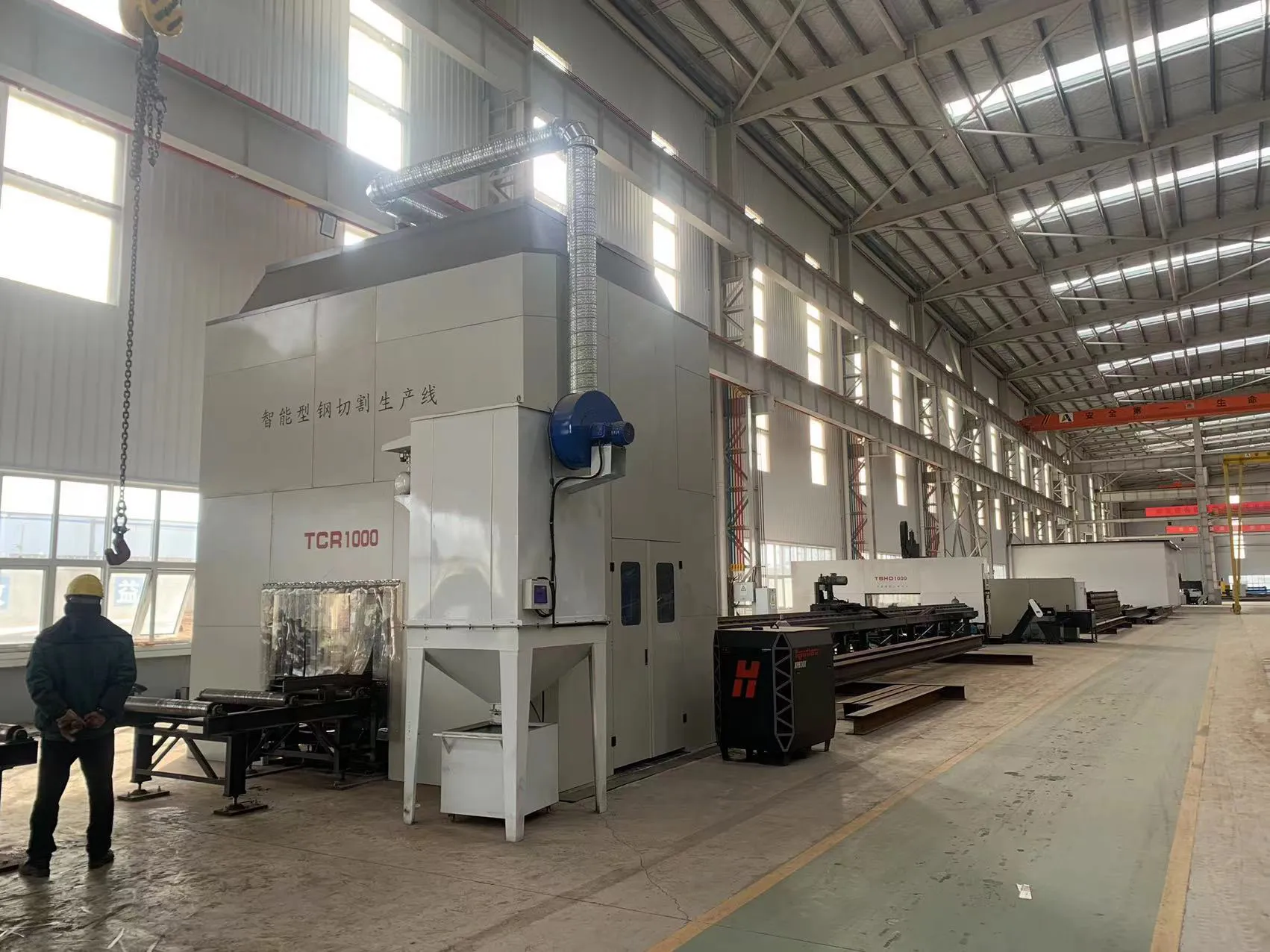
Precision Dynamics: High-Speed Cutting of Elevator Components
Elevator components—ranging from heavy structural brackets to thin decorative skins—require different cutting dynamics. The 12kW fiber laser utilizes an “intelligent cutting head” with auto-focus capabilities. This is critical for brass, as the focal point must be precisely maintained below the material surface to facilitate efficient melt expulsion.
**Gas Dynamics in Brass Cutting**
For Puebla’s high-altitude environment (approx. 2,135m above sea level), the atmospheric pressure affects gas flow. To achieve a “mirror finish” on brass, high-pressure Nitrogen (N2) is used as the assist gas. The 12kW power allows for “high-speed nitrogen cutting,” which prevents oxidation. The resulting edge is bright and requires no secondary polishing—a massive cost-saving for elevator factories producing gold-tone trim or Braille button plates.
**Accuracy Metrics:**
* **Positioning Accuracy:** ±0.03mm/m
* **Repetition Accuracy:** ±0.02mm
* **Maximum Acceleration:** 1.5G – 2.0G
These metrics ensure that when cutting 500 identical brass tactile buttons for a high-rise project in Angelópolis, the 500th piece is identical to the first.
Thermal Management and Optical Protection
A 12kW laser generates significant heat. In the context of cutting brass, which reflects a portion of that energy, thermal management becomes a dual-front battle.
First, the machine employs a dual-circuit water cooling system. One circuit cools the laser source (the resonator), while the second circuit cools the cutting head and the external optical path. This prevents thermal expansion of the lens, which would otherwise cause “focal shift,” leading to inconsistent cut quality over long production runs.
Second, for brass specialization, the cutting head is equipped with a “back-reflection isolator.” This optical component acts as a one-way valve, allowing the 12kW beam to pass through but trapping any reflected light before it can reach the sensitive fiber delivery system. This is a critical technical requirement for any Puebla factory intending to run 24/7 production cycles on reflective alloys.
The Puebla Advantage: ROI and Market Integration
Investing in a 12kW fiber laser with a heavy-duty bed offers a specific strategic advantage in the Puebla industrial corridor. With the proximity to major steel and automotive suppliers, elevator manufacturers can position themselves as high-tier subcontractors.
**Efficiency Gains:**
A 12kW laser cuts 3mm brass approximately 3 to 4 times faster than a 3kW or 4kW system. When calculating the “cost per part,” the higher initial investment is offset by the drastically reduced machine time and the elimination of secondary finishing processes. In the competitive elevator market of Mexico, being able to deliver custom brass interiors in 48 hours instead of a week is a decisive advantage.
**Maintenance in the Local Context:**
The plate-welded bed’s stability reduces the wear and tear on the linear motors and racks. In a heavy industrial environment like Puebla, where dust and vibration are common, a rigid bed protects the high-precision components from premature failure. Furthermore, the modularity of modern fiber lasers means that the laser source itself is maintenance-free for up to 100,000 hours, provided the cooling and gas filtration systems are maintained.
Technical Conclusion for Engineering Teams
For the elevator factory owner in Puebla, the 12kW Fiber Laser is not just a cutting tool; it is a precision instrument designed for the most demanding materials. The combination of a plate-welded heavy-duty bed provides the mechanical “anchor” necessary for high-G maneuvers, while the 12kW power density overcomes the physical hurdles of brass fabrication.
When specifying a machine for your facility, prioritize the following engineering benchmarks:
1. **Bed Weight:** Ensure the bed weight is proportional to the 12kW power (typically >8 tons for a 3015 model) to ensure vibration damping.
2. **Optical Path Protection:** Confirm the presence of specialized sensors for back-reflection monitoring when processing brass.
3. **Control Software:** Look for CNC systems (like CypCut or similar) that offer specialized “Brass Cutting Parameter Libraries” optimized for high-wattage sources.
By integrating these technical advantages, Puebla’s elevator manufacturers can achieve a level of finish and precision that meets global standards, ensuring that every cabin, door, and panel reflects the quality of Mexican engineering excellence.













