
Introduction to 6kW Tube Laser Technology in Puebla
The industrial landscape of Puebla, Mexico, has undergone a significant transformation over the last decade. As a primary hub for automotive manufacturing and aerospace engineering, the region demands high-precision, high-efficiency fabrication tools. Among these, the 6kW tube laser cutting system has emerged as a cornerstone technology, particularly for processing aluminum alloys. This guide explores the technical intricacies, operational advantages, and strategic importance of utilizing 6kW fiber laser technology within the unique economic context of Puebla.
Puebla’s manufacturing sector, anchored by giants such as Volkswagen de México and Audi, relies on a complex supply chain of Tier 1 and Tier 2 providers. These suppliers are increasingly moving away from traditional mechanical sawing and drilling toward integrated laser cutting solutions. A 6kW system provides the necessary power density to handle the high reflectivity of aluminum while maintaining the throughput required for just-in-time (JIT) production cycles common in the Bajío and central Mexican industrial corridors.
The Industrial Evolution of Puebla’s Manufacturing Sector
Historically, Puebla was known for its textile industry, but the shift toward heavy manufacturing and automotive assembly has necessitated a leap in metallurgical capabilities. Laser cutting has become the standard for precision components. The introduction of 6kW fiber lasers allows local fabricators to compete on a global scale, offering tolerances and finish qualities that meet stringent international standards. In Puebla, where the labor market is skilled but the competition is fierce, automation via high-power tube lasers provides a decisive competitive edge.
Technical Specifications of the 6kW Fiber Laser
A 6kW fiber laser source represents a significant upgrade over lower-wattage systems. In the context of tube fabrication, “6kW” refers to the peak output power of the ytterbium-doped fiber laser source. This power level is particularly effective for aluminum alloys, which possess high thermal conductivity and high reflectivity. The wavelength of a fiber laser (typically around 1.06 microns) is absorbed much more efficiently by aluminum than the 10.6 microns of traditional CO2 lasers.
The 6kW threshold allows for “high-speed” cutting regimes. For aluminum tubes with wall thicknesses ranging from 1mm to 8mm, a 6kW source can maintain feed rates that are 2x to 3x faster than a 3kW system. This speed does not just improve part-per-hour metrics; it also minimizes the Heat Affected Zone (HAZ), which is critical for maintaining the structural integrity of specialized aluminum alloys used in vehicle frames and aerospace brackets.
Power Density and Wavelength Advantages
The primary advantage of the 6kW system is its power density. When the laser beam is focused through a cutting head, the energy concentrated on the surface of the aluminum tube is immense. This allows the laser to “couple” with the material almost instantaneously, overcoming the natural tendency of aluminum to reflect light. Once the initial pierce is achieved, the 6kW of energy maintains a stable melt pool, which is then evacuated by high-pressure assist gas.

Processing Aluminum Alloys: Challenges and Solutions
Aluminum is notoriously difficult to process using thermal cutting methods. Its high thermal conductivity means that heat dissipates rapidly from the cut zone into the surrounding material, which can lead to warping or “dross” (resolidified metal) on the bottom edge of the cut. Furthermore, aluminum alloys—particularly the 5000 and 6000 series commonly used in Puebla’s automotive sector—have a low melting point but require high energy to initiate the phase change from solid to liquid.
To successfully perform laser cutting on aluminum, the 6kW system must be finely tuned. The use of high-pressure nitrogen as an assist gas is mandatory for a “clean” cut. Nitrogen acts as a mechanical force to blow the molten aluminum out of the kerf before it can react with atmospheric oxygen, preventing the formation of aluminum oxide. This results in a silver-bright finish that often requires no secondary deburring or cleaning before welding.
Overcoming High Reflectivity in Aluminum
Reflectivity is the “enemy” of the fiber laser. If the beam is reflected back into the cutting head, it can damage the optical sensors or even the fiber delivery cable. Modern 6kW systems used in Puebla are equipped with back-reflection isolation technology. This includes sensors that detect reflected light and instantly modulate the beam or shut down the system to prevent damage. When cutting 6061-T6 or 5052 aluminum, the 6kW power allows the operator to use a “power-piercing” technique that minimizes the duration of the reflective state during the initial hole entry.
Thermal Conductivity and Heat Management
Because aluminum conducts heat so well, cutting small features or closely spaced holes in a tube can lead to “overheating.” In a 6kW system, sophisticated CNC software manages this by utilizing “cool-cutting” pulses or adjusting the power ramp-up at corners. In the high-altitude environment of Puebla (approx. 2,135 meters above sea level), air density is lower, which can subtly affect the cooling of the machine’s internal components. Therefore, a robust industrial chiller is essential to keep the 6kW resonator and the cutting head at a stable operating temperature.
Applications in the Puebla Automotive and Aerospace Corridor
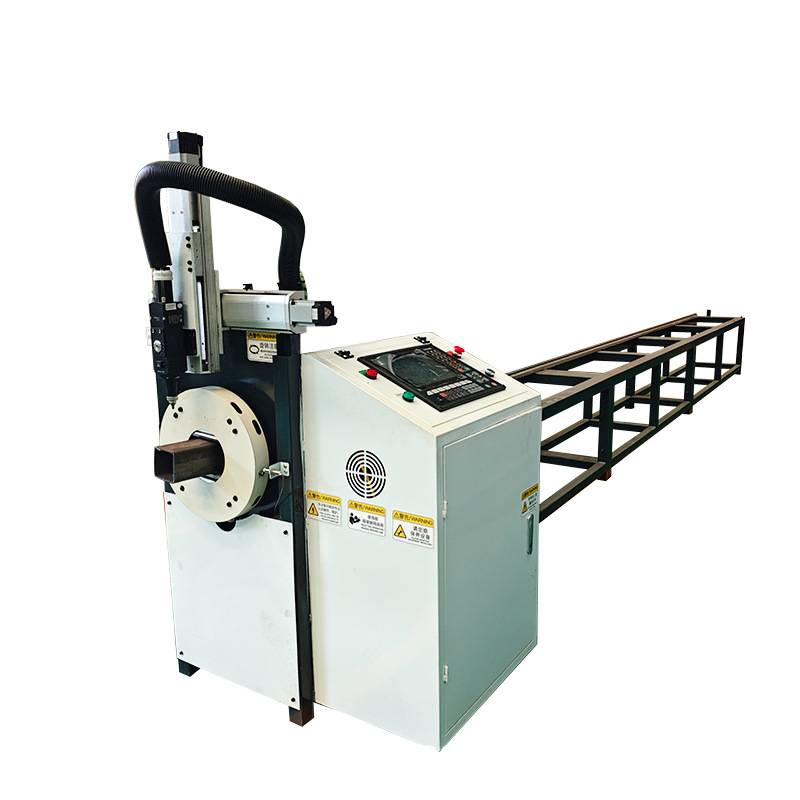
The application of 6kW tube laser cutting in Puebla is diverse. In the automotive sector, it is used for chassis components, engine mounts, and seat frames. Aluminum is favored for these parts to reduce vehicle weight (lightweighting) to meet fuel efficiency and emissions standards. The ability to cut complex geometries—such as fish-mouth joints, miter cuts, and interlocking tabs—directly onto the tube eliminates the need for manual jigging and secondary milling.
In the aerospace sector, which is growing around the Puebla-Queretaro axis, 6kW lasers are used for hydraulic lines and structural tubing. The precision of the laser cutting process ensures that the aerospace-grade aluminum (such as 7075) maintains its mechanical properties. The CNC-controlled rotation of the tube allows for 3D cutting paths that would be impossible with traditional machining, enabling engineers to design more complex and efficient fluid-transfer systems.
Structural Components and Lightweighting
Lightweighting is a critical trend in the Puebla industrial zone. By replacing steel components with aluminum alloy tubes, manufacturers can reduce the weight of a sub-assembly by up to 40%. However, aluminum’s lower structural rigidity compared to steel means that the precision of the joints is paramount. Laser cutting provides the “tight-fit” tolerances (often within +/- 0.1mm) required for high-strength robotic welding. This synergy between laser cutting and automated welding is a hallmark of the advanced manufacturing plants in San José Chiapa and Cuautlancingo.
Optimization Strategies for Tube Laser Cutting
To maximize the ROI of a 6kW system in a Puebla-based facility, optimization must occur at both the software and hardware levels. Nesting software is used to minimize “scrap” by placing parts as close together as possible on the raw tube stock. For aluminum, which is more expensive than carbon steel, reducing waste by even 5% can result in thousands of dollars in annual savings.
Furthermore, the “fly-cutting” technique can be employed for thinner aluminum tubes. This involves the laser head moving in a continuous path while the laser pulses at specific coordinates, rather than stopping and starting at every hole. This significantly reduces the cycle time, allowing a 6kW machine to process hundreds of tubes per shift.
Assist Gas Selection: The Role of High-Pressure Nitrogen
In Puebla, sourcing high-purity gases is straightforward due to the established industrial infrastructure. For aluminum laser cutting, Nitrogen at pressures of 15 to 20 bar is standard. The Nitrogen must be at least 99.99% pure. Any trace of oxygen will cause the aluminum to oxidize, creating a rough, blackened edge that is difficult to weld. Some advanced shops in Puebla are now installing Nitrogen generators to reduce the cost of bottled gas and ensure a continuous supply for their 6kW machines.
Nozzle Selection and Focal Position
The choice of nozzle is critical when working with 6kW of power. A double-layer nozzle is often used for aluminum to provide a more stable gas flow. The focal position—the point where the laser beam is most concentrated—is typically set “negative” (below the surface of the material) for thick aluminum. This helps to create a wider kerf at the bottom, allowing the high-pressure gas to evacuate the melt more effectively. Operators in Puebla must be trained to adjust these parameters based on the specific alloy and wall thickness of the tube.
Operational Maintenance for High-Output Systems
A 6kW tube laser is a significant investment, and its longevity depends on a rigorous maintenance schedule. In the dusty environments sometimes found in industrial parks, the filtration system of the laser must be checked daily. The optical path, including the protective windows and the focusing lens, must be kept pristine. Even a tiny speck of dust on the lens can absorb the 6kW energy, leading to “thermal shift” or the catastrophic failure of the lens.
Optical Path Integrity
For fiber lasers, the “optical path” is largely contained within the fiber cable, which is a major advantage over CO2 lasers. However, the cutting head remains a vulnerable point. Regular inspection of the ceramic ring and the nozzle is required. In Puebla, where the humidity can fluctuate, ensuring that the compressed air used for the pneumatic systems is dry and oil-free is essential to prevent contamination of the cutting head’s internal chambers.
Chiller Performance in Puebla’s Climate
The 6kW resonator generates a substantial amount of heat that must be dissipated. The water chiller is the “heart” of the machine’s cooling system. In Puebla’s temperate but high-altitude climate, the chiller must work efficiently to maintain a constant 20-25°C. Operators should use deionized water and specialized additives to prevent algae growth and corrosion within the cooling lines. A failure in the cooling system can lead to the laser source overheating, resulting in expensive downtime.
Economic Viability and ROI for Local Manufacturers
The decision to invest in a 6kW tube laser cutting system in Puebla is often driven by the “Total Cost of Ownership” (TCO). While the initial purchase price is higher than a 3kW or 4kW system, the 6kW machine’s ability to process aluminum faster and thicker means the “cost per part” is lower in high-volume scenarios. For a job shop in Puebla serving the automotive industry, the ability to take on diverse projects—from thin-walled aluminum cooling tubes to thick-walled structural frames—is invaluable.
Reducing Secondary Operations
The greatest economic benefit of laser cutting is the elimination of secondary operations. Traditional tube processing involves sawing, deburring, drilling, and often manual layout. A 6kW laser performs all these tasks in a single setup. For aluminum alloys, which are prone to “gumming up” traditional drill bits and saw blades, the non-contact nature of laser cutting is a massive advantage. By delivering a finished part directly from the laser to the welding station, Puebla manufacturers can significantly reduce lead times and labor costs, ensuring they remain competitive in the global marketplace.
In conclusion, the 6kW tube laser represents the pinnacle of current fabrication technology for aluminum alloys. In the industrial heartland of Puebla, this technology is not just a luxury but a necessity for companies aiming to meet the rigorous demands of modern manufacturing. By understanding the physics of the 6kW beam, optimizing gas and parameter settings, and maintaining the system for the local climate, fabricators can achieve unprecedented levels of precision and productivity.




























