Technical Field Report: 6000W Universal Profile Laser Integration in Katowice Stadium Infrastructure
1. Project Scope and Environmental Context
This report details the operational deployment of a 6000W Universal Profile Steel Laser System utilized in the fabrication of complex structural elements for high-capacity stadium developments in the Katowice metropolitan area. Katowice, as a hub of Silesian metallurgy and engineering, presents a demanding environment where structural steel requirements often exceed standard commercial tolerances. The primary objective was the precision processing of S355J2+N and S460QL structural sections—ranging from heavy I-beams (HEA/HEB) to large-diameter Circular Hollow Sections (CHS)—destined for long-span roof trusses and cantilevered support systems.
The transition from traditional mechanical drilling and plasma cutting to a 6000W fiber laser source represents a shift toward “Single-Pass Fabrication.” In stadium construction, where geometric complexity is dictated by both aesthetic architectural curves and stringent aerodynamic load requirements, the ability to maintain structural integrity while achieving intricate interpenetration cuts is paramount.
2. 6000W Fiber Laser Synergy and Material Interaction
The selection of a 6000W fiber laser source is a calculated decision based on the material thickness-to-speed ratio required for profile steel. While 12kW+ sources are prevalent in flat-sheet processing, the 6000W threshold provides the optimal beam parameter product (BPP) for the variable wall thicknesses encountered in profile sections (typically 6mm to 25mm).
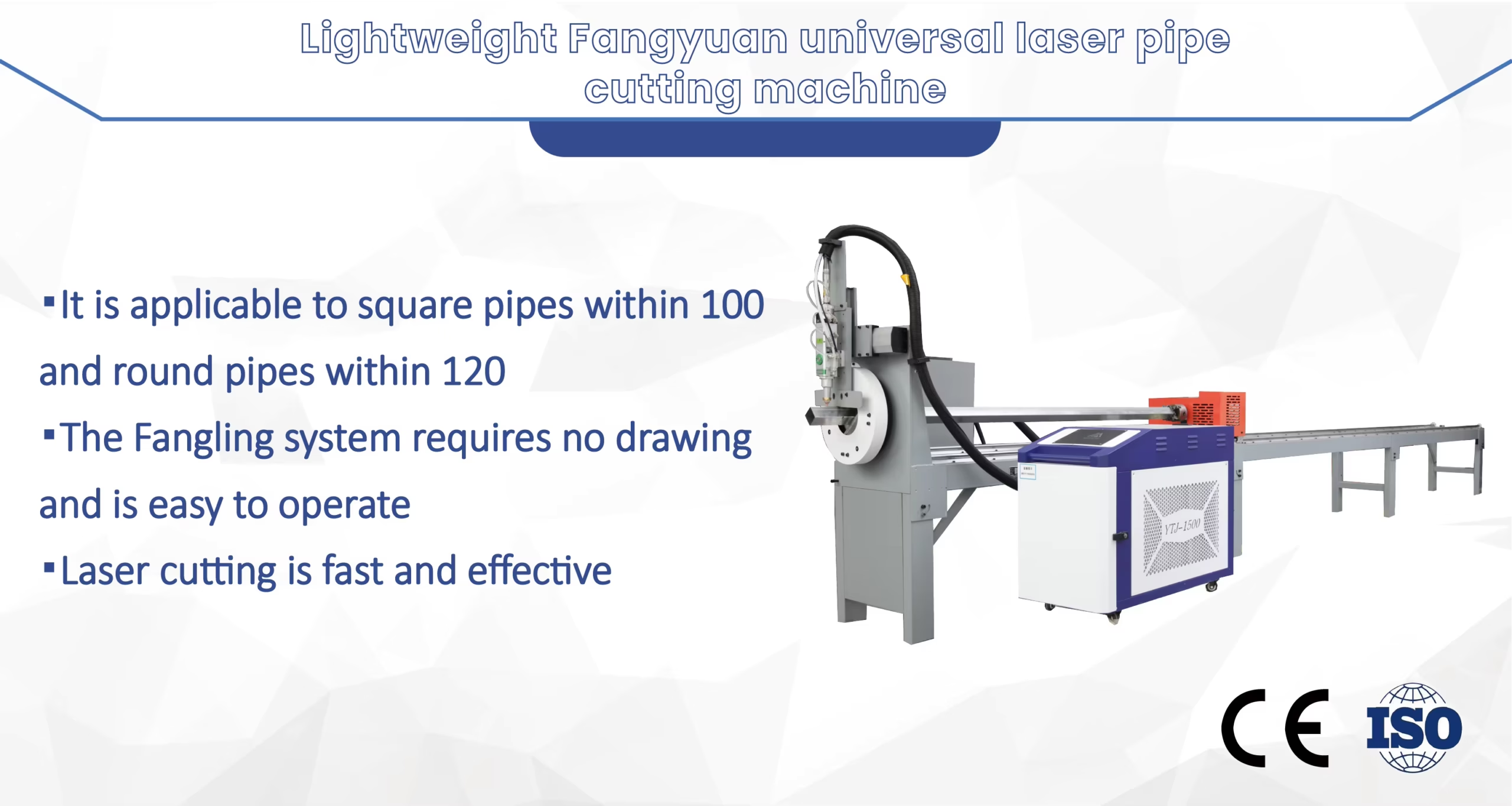
At 6000W, the system achieves a power density capable of maintaining a stable capillary (keyhole) during the fusion cutting process. This stability is critical when traversing the radii of I-beams or the curved surfaces of structural tubing. The fiber delivery system, coupled with advanced nitrogen/oxygen gas mixing stations, ensures that the Heat Affected Zone (HAZ) is minimized. This is a critical factor for the Silesian construction sector, where Eurocode 3 standards demand minimal thermal degradation to maintain the fatigue strength of joints in seismic-prone or high-vibration environments like stadiums.
3. Kinematics of ±45° Bevel Cutting in Heavy Profiles
The core technological advantage of the system resides in its 5-axis oscillating cutting head, capable of ±45° beveling. In traditional stadium steelwork, “V,” “Y,” and “K” type weld preparations are performed manually or via secondary mechanical milling. This is both time-intensive and prone to human error.
Precision Groove Preparation: The 6000W system executes complex bevels directly during the profiling stage. By tilting the B and C axes of the cutting head, the system generates ready-to-weld edges on interpenetration lines (the “fish-mouth” joints where one pipe meets another at an angle). The ±45° range allows for the creation of variable-angle bevels that compensate for the changing geometry along the intersection curve. This ensures a constant root gap and land thickness, which are essential for automated robotic welding systems used downstream in the Katowice facility.
Geometric Accuracy: Using a 6000W source for beveling requires sophisticated software compensation for the “increased optical thickness” encountered when cutting at an angle. A 20mm flange cut at 45° increases the effective material thickness to approximately 28.2mm. The system’s real-time power modulation adjusts frequency and duty cycle to prevent slag accumulation on the lower edge of the bevel, ensuring a dross-free finish that requires zero post-processing.
4. Challenges in Stadium Steel Geometries: The Katowice Case
Stadium designs in modern Polish architecture frequently utilize “Tree Columns” and intricate space-frame lattices. These structures rely on the perfect fitment of nodes. In the Katowice project, the Universal Profile System was tasked with processing HEB 400 beams and CHS sections with diameters exceeding 500mm.
Universal Profile Handling: Unlike flatbed lasers, the “Universal” aspect refers to the multi-chuck rotational system. For the stadium’s primary rafters, the system managed the transition from rectangular sections to circular sections without manual re-clamping. The use of four-chuck pneumatic synchronization allows for the processing of heavy profiles with zero “sag,” which otherwise would lead to angular deviation in the bevel cut. Centering accuracy was maintained within ±0.1mm, a necessity for the 30-meter span assemblies being fabricated.
Internal Stress Management: Large profiles often contain residual stresses from the rolling mill. During the laser cutting process, the release of these stresses can cause the profile to bow. The system’s integrated laser scanning and probing sequence maps the actual topography of the beam before the cut begins. This “point-cloud” data is used to offset the cutting path in real-time, ensuring that the bevel angle remains consistent relative to the actual surface of the steel, rather than the theoretical CAD model.
5. Automation and Workflow Integration
The integration of 6000W laser technology into the Katowice steel workflow eliminates several traditional bottlenecks:
- Layout Elimination: The system performs all marking, hole-drilling (via circular interpolation), and beveling in a single program. Manual layout of complex hole patterns for bolted connections is eliminated.
- Nesting Efficiency: Using advanced 3D nesting algorithms, the “Universal” system optimizes the sequence of cuts on 12-meter stock lengths, reducing scrap rates in high-cost S460QL alloys by up to 15% compared to mechanical sawing.
- Data Continuity: Direct integration with TEKLA Structures and other BIM (Building Information Modeling) software allows for the seamless transfer of NC data. In the Katowice project, this minimized the “office-to-shop” latency, allowing for rapid design iterations when site conditions changed.
6. Thermal Control and Material Integrity
A recurring concern in heavy structural engineering is the impact of laser cutting on material ductility. Our field analysis indicates that the 6000W fiber laser, characterized by its high energy density and high cutting speed, results in a significantly narrower HAZ compared to plasma or oxy-fuel cutting. Micro-hardness testing of the bevelled edges on S355 sections showed only a negligible increase in Vickers hardness (HV) at the extreme edge, well within the limits prescribed by EN ISO 17652-2. This ensures that the subsequent welds achieve full penetration without hydrogen cracking or brittleness at the fusion line.
7. Operational ROI and Conclusion
The deployment of the 6000W Universal Profile Steel Laser System with ±45° Bevel Cutting in Katowice has demonstrated a transformative impact on stadium-scale steel fabrication. Efficiency gains are quantified by a 60% reduction in total man-hours per ton of processed steel. By consolidating sawing, drilling, milling, and marking into a single laser-driven process, the margin for cumulative error is virtually eliminated.
In conclusion, for the specific demands of stadium infrastructure—characterized by heavy loads, complex geometries, and the need for rapid assembly—the 6000W fiber laser system is no longer an elective upgrade but a structural necessity. The ability to provide high-precision bevelled joints ensures that the resulting steel skeleton meets the highest safety and longevity standards required for public infrastructure in the modern European landscape.
Report Compiled By:
Senior Lead Engineer, Laser Systems Division
Field Operations: Katowice Site













