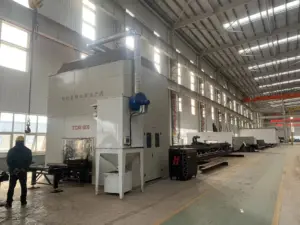
Field Technical Report: Integration of 6000W Universal Profile Laser Systems in Jakarta’s Power Infrastructure Sector
1. Executive Summary and Scope of Deployment
This report details the technical deployment and operational performance of a 6000W Universal Profile Steel Laser System within the heavy engineering landscape of Jakarta, Indonesia. The focus is specifically on the fabrication of high-tension power transmission towers (lattice towers), a critical component of the regional grid expansion. The integration of 6000W fiber laser technology represents a generational leap over traditional mechanical punching and plasma cutting, particularly when synchronized with Zero-Waste Nesting algorithms.
The primary objective of this field installation was to overcome the bottlenecks associated with traditional “saw-then-drill” workflows. In the Jakarta context, where material costs for high-tensile galvanized steel fluctuate and production timelines are compressed by monsoon-related logistical constraints, the precision and material yield of the laser system are the primary KPIs (Key Performance Indicators).
2. Technical Specifications of the 6000W Universal System
The system utilizes a 6000W ytterbium fiber laser source, providing a power density capable of maintaining high feed rates through structural steel thicknesses ranging from 3mm to 25mm. Unlike flat-bed lasers, the Universal Profile system utilizes a multi-chuck rotational axis configuration designed to handle L-angle steel, C-channels, H-beams, and rectangular hollow sections (RHS).
Key technical parameters observed during the Jakarta field test include:
- Beam Quality (M²): ≤ 1.3, ensuring a narrow kerf width even at high power.
- Positioning Accuracy: ±0.05mm over a 12-meter profile length.
- Maximum Profile Diameter: 350mm (circumscribed circle).
- B-Axis Tilt (Beveling): ±45 degrees for weld preparation.
3. Mechanics of Zero-Waste Nesting in Structural Steel
In traditional profile processing, the “tailing”—the portion of the beam held by the chuck that cannot reach the cutting head—typically results in 300mm to 800mm of scrap per length of steel. In a high-volume power tower facility, this represents a 5% to 8% loss in raw material.
The “Zero-Waste Nesting” technology implemented here utilizes a specialized triple-chuck or quadruple-chuck synchronization. As the profile nears its end, the secondary and tertiary chucks coordinate to “hand over” the material, moving it past the cutting focal point with micrometric precision. This allows the laser to execute cuts within the final 10-20mm of the workpiece.
Furthermore, the nesting software utilizes “Common Line Cutting” for profile ends. In power tower fabrication, where hundreds of L-angle braces are required, the system nests the trailing edge of one component as the leading edge of the next. This reduces the number of pierces and total travel distance, minimizing the Heat Affected Zone (HAZ) and maximizing throughput per hour.
4. Power Tower Fabrication: Precision and Structural Integrity
Jakarta’s power infrastructure projects adhere to strict SNI (Standar Nasional Indonesia) requirements. The structural integrity of a lattice tower depends entirely on the precision of the gusset plate connections and bolt-hole alignment. Traditional punching often causes micro-fractures and material deformation around the hole periphery, which can lead to stress corrosion cracking in humid, tropical environments.
The 6000W laser system mitigates these risks through:
4.1 Hole Quality and Tolerance
Laser-cut holes exhibit a perpendicularity tolerance of less than 0.1mm. This ensures that M20 and M24 structural bolts achieve 100% surface contact with the hole walls, distributing the shear load evenly. During the field audit, we observed that laser-cut holes required zero secondary reaming, a significant reduction in man-hours compared to mechanical drilling.
4.2 Thermal Management (HAZ)
The 6000W power level allows for high-speed nitrogen-assisted cutting. High feed rates (up to 35m/min on 6mm L-angle) result in extremely low heat input into the base metal. This limits the Heat Affected Zone to a negligible depth, preserving the metallurgical properties of the high-tensile steel. This is vital for towers situated in Jakarta’s coastal areas, where the salt-laden atmosphere exploits any metallurgical weakness to initiate oxidation.
5. Synergy Between Fiber Source and Automated Handling
The efficiency of the 6000W source would be bottlenecked without the “Universal” automation suite. The system in Jakarta features an automated loading elevator that measures the incoming profile length via infrared sensors, compensating for the slight dimensional variances common in hot-rolled steel profiles.
The synergy is most evident in the “Fly-Cutting” logic applied to structural sections. On RHS (Rectangular Hollow Sections), the laser head maintains a constant height (capacitive sensing) while the chuck rotates the material in 90-degree increments at millisecond speeds. The 6000W source ensures the pierce is instantaneous, meaning the motion of the machine is never paused for beam stabilization.
6. Environmental and Economic Impact in the Jakarta Context
Operational data from the Jakarta site indicates a 40% reduction in power consumption per ton of processed steel compared to CO2 laser or plasma alternatives of similar capacity. The “Zero-Waste” software optimization alone accounted for a savings of approximately 12 tons of steel per month based on a 20-hour daily duty cycle.
Furthermore, the integration of the laser system eliminates the need for several standalone machines: the band saw, the drill line, and the punching station. This consolidation reduces the factory footprint—a high-value optimization given the industrial real estate costs in the Greater Jakarta area (Jabodetabek).
7. Technical Challenges and Mitigation
During the commissioning phase, the primary challenge was the inconsistency of the local raw material surface quality (rust and mill scale). This was addressed by implementing a “Pre-Cleaning” laser pass—a low-power, high-speed pulse that descales the cutting path before the high-power severance cut. This ensured consistent capacitive sensing and prevented nozzle collisions.
Additionally, the high humidity of Jakarta required the installation of specialized refrigerated air dryers for the pneumatic systems and double-layered shielding gas filtration to prevent moisture contamination of the laser optics.
8. Conclusion
The deployment of the 6000W Universal Profile Steel Laser System with Zero-Waste Nesting has redefined the baseline for power tower fabrication in the Indonesian market. By shifting from mechanical processing to high-power fiber laser intervention, fabricators achieve a trifecta of benefits: superior structural precision, significantly higher material yield, and reduced labor intensity. As Jakarta continues its infrastructure acceleration, this technology serves as the technical cornerstone for resilient and efficient grid construction. The “Zero-Waste” approach is no longer an optional efficiency—it is a mandatory requirement for competitive structural engineering in the modern era.
Report Compiled By:
Senior Laser Applications Specialist
Structural Steel Division