The Industrial Evolution: Why 6000W Fiber Lasers are the New Standard in Haiphong
Haiphong has long been the industrial heartbeat of Northern Vietnam, but the recent push for national energy security and the expansion of the power grid has demanded a more sophisticated approach to steel fabrication. Traditionally, power tower components—mostly heavy-duty angle steel, C-channels, and gusset plates—were processed using hydraulic punching machines or CNC plasma cutters. While functional, these methods lacked the precision required for modern, high-tension bolt assemblies and suffered from significant material waste.
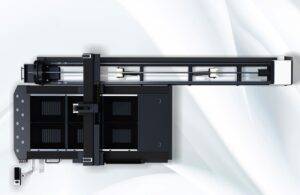
The introduction of the 6000W Universal Profile Steel Laser System changes the calculus. At 6kW, the laser sits at the “sweet spot” of the power-to-cost ratio for structural steel. While 12kW and 20kW machines exist, the 6kW oscillator provides the specific beam density required to slice through 12mm to 20mm structural carbon steel—the primary thicknesses used in power towers—with a Heat Affected Zone (HAZ) so minimal that it preserves the structural integrity of the steel’s grain. For Haiphong’s fabricators, this means parts move from the laser bed directly to the galvanizing tank without the need for secondary grinding or deburring.
Universal Profile Processing: Beyond the Flatbed
The “Universal Profile” designation is critical in power tower fabrication. Unlike standard laser cutters designed solely for flat sheets, a Universal Profile system is equipped with multi-axis capabilities or specialized rotary chucks capable of handling structural shapes. Power towers are primarily composed of L-shaped angle iron and U-shaped channels.
A 6000W system designed for this purpose utilizes a 3D cutting head or a synchronized heavy-duty rotatory axis. This allows the laser to cut bolt holes, notches, and bevels across the different faces of an angle bar in a single pass. In the context of Haiphong’s fabrication hubs, this replaces three separate machines: the band saw, the drill press, and the notch-puncher. By consolidating these processes into one laser cycle, the margin for human error is virtually eliminated, ensuring that every hole on a 10-meter tower leg aligns perfectly during field assembly in remote mountainous regions.
The Science of Zero-Waste Nesting in Structural Steel
In the high-volume world of power tower production, material costs often account for over 60% of the total project budget. Traditional nesting—the arrangement of parts on a raw sheet or beam—often leaves “skeletons” of waste that are sold for pennies on the pound as scrap. The “Zero-Waste” nesting philosophy integrated into these 6000W systems utilizes sophisticated CAD/CAM algorithms specifically tuned for structural geometries.
Zero-Waste nesting operates on several levels:
1. **Common Line Cutting:** The software identifies shared edges between two adjacent parts. The laser makes a single cut to separate them, reducing the total cutting path and saving both time and gas (Oxygen or Nitrogen).
2. **Chain Cutting and Bridging:** By linking parts together, the laser maintains a continuous “on” state, reducing the number of pierces. Each pierce is a point of potential waste and wear; minimizing them preserves the material.
3. **Remnant Management:** For profile steel, the software calculates the exact length of the beam required, often nesting different project components (e.g., small gussets inside the “V” of an angle iron) to ensure that the final “drop” is less than a few centimeters.
For a facility in Haiphong producing thousands of tons of lattice steel annually, moving from 85% material utilization to 97% via Zero-Waste algorithms translates directly into millions of dollars in saved raw material costs.
Precision Engineering for High-Tension Power Towers
Power towers are subjected to immense environmental stress, from the high winds of the Gulf of Tonkin to the weight of ice and the tension of kilometers of conductor cable. The precision of the 6000W laser is a safety imperative.
When a hole is punched mechanically, the steel around the hole undergoes plastic deformation, creating micro-fractures that can expand under stress. A 6000W fiber laser, however, uses a concentrated photon stream to vaporize the metal. Because the beam is so intense and the travel speed so high, the heat is dissipated before it can alter the molecular structure of the surrounding steel. This results in “perfect holes” with zero taper. For the 500kV lines being fabricated in Haiphong, this means the high-strength bolts fit with zero play, ensuring the vibration resistance of the tower over its 50-year lifespan.
The Haiphong Advantage: Logistics and Technological Synergy
Choosing Haiphong as the site for these advanced systems is a strategic masterstroke. As a logistics hub with deep-sea ports like Lach Huyen, Haiphong allows for the rapid import of high-grade coil and profile steel and the efficient export of finished tower sections.
Furthermore, the local labor force in Haiphong has undergone a rapid digital transformation. Operating a 6000W laser system requires “white-collar” technicians who understand CNC programming and nesting logic rather than manual laborers. This shift is elevating the industrial profile of the region, turning Haiphong from a low-cost assembly center into a high-tech manufacturing base that can compete with any European or East Asian facility.
The Role of Assist Gases in 6kW Cutting
An expert analysis of the 6000W system would be incomplete without discussing the role of assist gases. In Haiphong’s humid coastal environment, the choice between Oxygen (O2) and Nitrogen (N2) is critical.
* **Oxygen Cutting:** Generally used for thicker carbon steel, O2 creates an exothermic reaction that aids the 6kW beam, allowing for fast cutting of 20mm plates. However, it leaves a thin oxide layer.
* **Nitrogen or High-Pressure Air:** For the 6kW power bracket, many Haiphong fabricators are moving toward High-Pressure Air cutting. The 6000W of power is sufficient to blow away the molten metal using only compressed air, which is significantly cheaper than bottled gas. This “Air Cutting” method is particularly effective for the 6mm to 10mm bracing members of a power tower, further driving down the cost per part.
Digital Twin Integration and Industry 4.0
The 6000W Universal Profile systems being installed today are not isolated islands of machinery. They are fully integrated into the factory’s ERP (Enterprise Resource Planning) system. In Haiphong, this is manifesting as “Digital Twin” technology. Before the laser ever touches a beam of steel, the entire nesting plan is simulated in a virtual environment.
This integration allows for real-time tracking of every component. Each piece of the power tower can be laser-engraved with a unique QR code during the cutting process. This code contains data about the steel’s origin, the operator of the laser, and the specific tower the part belongs to. In the complex assembly of a 60-meter tower, this level of traceability is invaluable, ensuring that if a single part fails, the history of its production can be instantly audited.
Conclusion: The Future of Infrastructure Fabrication
The convergence of 6000W fiber laser power, universal profile versatility, and zero-waste nesting is more than just an incremental improvement; it is a reinvention of structural steel fabrication. In the context of Haiphong, this technology provides the bridge between Vietnam’s ambitious infrastructure goals and the global demand for sustainable, efficient manufacturing.
As the world moves toward more robust energy grids, the lessons learned in Haiphong’s laser-cutting facilities will become the blueprint for the industry. By minimizing waste, maximizing precision, and leveraging high-power fiber optics, fabricators are proving that the heavy-duty demands of power tower construction can be met with the finesse and efficiency of the digital age. The 6000W system is no longer just a tool; it is the fundamental engine of modern industrial growth in the heart of Northern Vietnam.