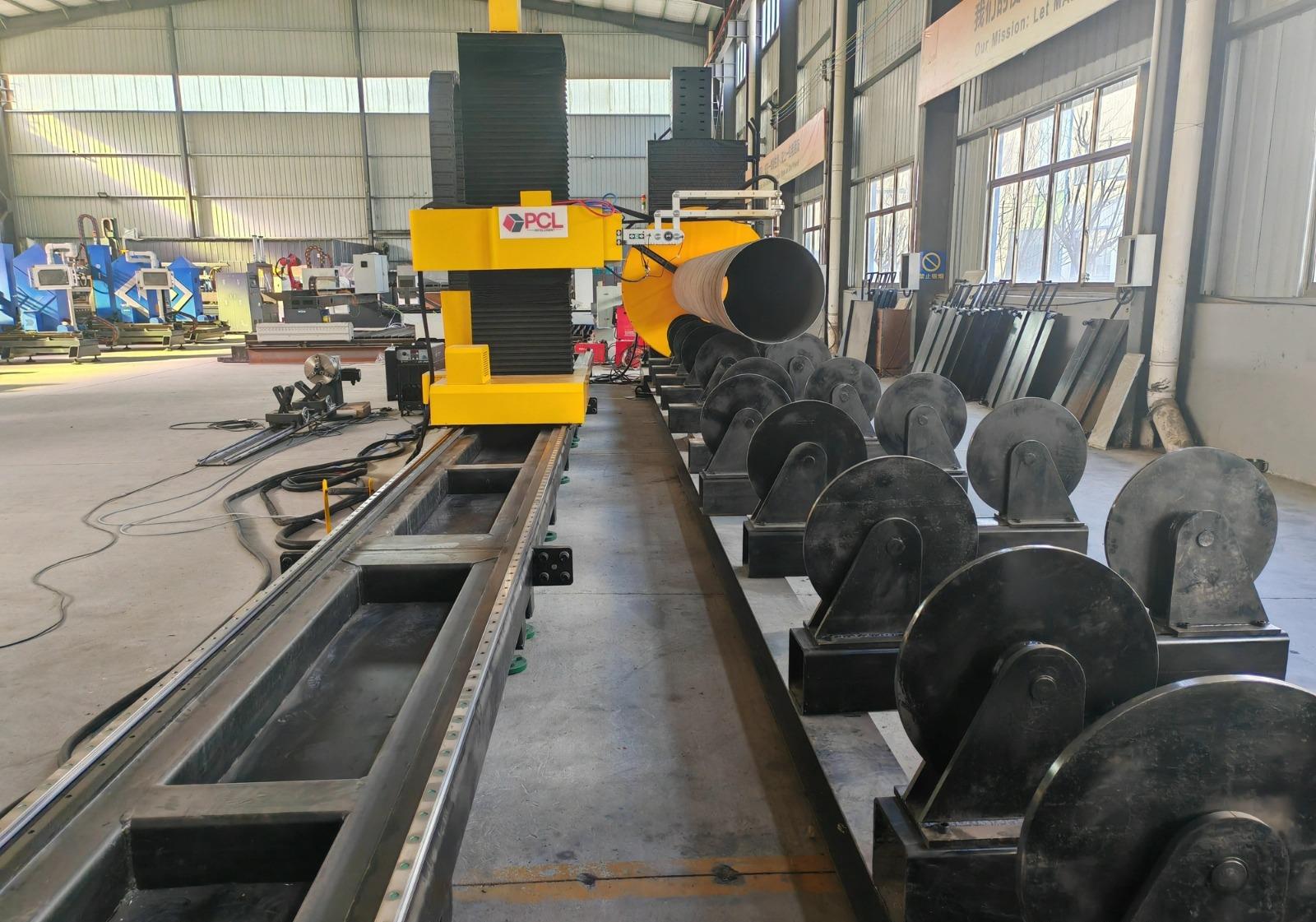
The 6000W Power Band: The Sweet Spot for Structural Steel
In the realm of fiber lasers, power selection is a strategic decision that balances speed, penetration, and capital investment. For modular construction—which primarily utilizes carbon steel thicknesses ranging from 6mm to 20mm—the 6000W (6kW) fiber laser serves as the industry’s “sweet spot.”
Unlike lower-wattage systems that struggle with heavy-walled I-beams or thick-gauge C-channels, a 6000W system delivers the high energy density required for high-speed nitrogen or oxygen cutting. At this power level, the laser beam can achieve a high feed rate on 12mm structural plates, significantly reducing the Heat-Affected Zone (HAZ). Minimizing the HAZ is critical in modular construction; it ensures that the metallurgical properties of the steel remain intact, preventing brittleness at the joints where structural loads are most concentrated. Furthermore, the 6000W threshold allows for “FlyCut” technologies, where the laser head moves in a continuous motion across holes and profiles, drastically reducing the cycle time per component compared to traditional plasma or mechanical sawing.
Universal Profile Processing: Beyond Flat Sheets
The term “Universal Profile” refers to a system’s ability to move beyond 2D flat-sheet cutting and handle 3D structural shapes, including square tubes, rectangular hollow sections (RHS), angle iron, and the H-beams ubiquitous in Ho Chi Minh City’s skyscraper and factory frameworks.
In modular construction, the frame is the chassis. A 6000W Universal Profile laser utilizes a multi-axis head (often a 5-axis configuration) and a sophisticated rotary chuck system. This allows the laser to perform complex bevel cuts and “fish-mouth” joints. For example, where two structural tubes meet at an angle, the laser can cut a precise 3D contour that allows the pieces to slot together with zero gap. This precision is impossible to achieve with manual band saws. In the context of HCMC’s rapid infrastructure projects, this means that structural skeletons can be “dry-fitted” at the factory in Binh Duong or Nha Be and then shipped to the city center for lightning-fast assembly without the need for on-site grinding or corrective welding.
The Science of Zero-Waste Nesting
In an era of fluctuating raw material costs, the “Zero-Waste Nesting” capability of these modern laser systems is a primary driver of ROI (Return on Investment). Advanced nesting software uses geometric algorithms to pack parts as tightly as possible on a given length of steel profile or sheet.
For modular construction, where thousands of similar brackets, plates, and struts are required, zero-waste nesting offers three distinct advantages:
1. **Common Line Cutting:** The laser cuts the shared boundary between two parts simultaneously, reducing the total cutting path by up to 30% and saving both time and assist gas (Oxygen or Nitrogen).
2. **Remnant Management:** The system automatically tracks “drops” or remnants, cataloging them in a digital library. When a smaller part is needed for a future module (such as a junction gusset), the software prioritizes these remnants over new stock.
3. **Bridge Cutting:** By creating small “micro-joints” or bridges between parts, the system ensures that small components do not fall through the slats or tilt and cause a collision with the laser head, while still maximizing the utilization of every square millimeter of the workpiece.
For fabricators in Ho Chi Minh City, where industrial land and material storage come at a premium, reducing scrap from the typical 15% down to less than 3% represents a massive boost in bottom-line profitability and environmental compliance.
Impact on Modular Construction in Ho Chi Minh City
Ho Chi Minh City is currently witnessing a transition toward “Industrialized Construction.” As the city expands vertically and into satellite districts, the traditional method of building—casting concrete on-site and manual steel fabrication—is being replaced by modular units. These units (pods for bathrooms, hotel rooms, or even entire apartment segments) are manufactured in controlled factory environments.
The 6000W Universal Profile laser is the heart of this factory environment. By utilizing “Tenon-and-Mortise” designs—a traditional woodworking concept now applied to steel via laser precision—modular components can be designed to snap together. This reduces the reliance on highly skilled on-site welders, who are increasingly difficult to find in the HCMC labor market. Instead, the “intelligence” of the build is moved upstream into the CAD/CAM laser programming phase. The resulting modules are lighter, stronger, and can be erected in a fraction of the time, minimizing the noise and traffic disruption inherent to urban construction in District 1 or District 7.
Technical Synergies: Beam Delivery and Gas Optimization
A 6000W system in a humid tropical environment like Ho Chi Minh City requires specific technical considerations that an expert must oversee. Fiber lasers are sensitive to ambient conditions; therefore, these systems are equipped with advanced chiller units and dust-sealed beam delivery paths.
Furthermore, the “Universal” aspect of these machines often includes automatic nozzle changers and focus adjustment. When switching from a 20mm H-beam flange to a 3mm partition plate, the laser automatically recalibrates its focal point and gas pressure. In modular construction, where a single module might require a mix of heavy structural members and light-gauge aesthetic cladding, this versatility is essential. We also see the rise of “Air Cutting” in HCMC—using high-pressure compressed air instead of expensive bottled Nitrogen for gauges up to 6mm. This further drives down the cost of modular units, making “green” and “fast” construction economically viable for the local market.
The Sustainability Paradigm and Vietnam’s Green Growth
Vietnam’s commitment to achieving net-zero emissions by 2050 has placed a spotlight on the construction industry, which is traditionally a high-carbon sector. The 6000W laser system contributes directly to these sustainability goals.
First, the energy efficiency of a fiber laser is roughly 30-40% higher than older CO2 laser technology. Second, the zero-waste nesting drastically reduces the carbon footprint associated with steel production and recycling. Finally, modular construction itself is inherently more sustainable; it allows for deconstruction and reuse. Because the laser-cut components are so precise, they can be bolted rather than permanently welded in many applications, allowing for the modular units to be disassembled and repurposed at the end of their lifecycle—a key tenet of the circular economy that the Vietnamese government is actively promoting.
Conclusion: The Future of Fabrication in HCMC
The deployment of 6000W Universal Profile Steel Laser Systems is more than just an upgrade in machinery; it is a fundamental shift in how Ho Chi Minh City builds its future. By marrying the brute force of 6kW fiber optics with the surgical precision of 3D profile cutting and the intelligence of zero-waste software, the fabrication industry is setting a new global standard for modular construction.
As HCMC continues to evolve as a South East Asian tech and manufacturing powerhouse, the ability to produce high-quality, low-waste, and easily assembled structural steel will be the differentiator. For developers and contractors, the message is clear: the future is modular, the precision is laser-driven, and the waste is a thing of the past. The 6000W laser is not just cutting steel; it is carving out the blueprint for a more efficient, sustainable, and rapid urban landscape in Vietnam.