
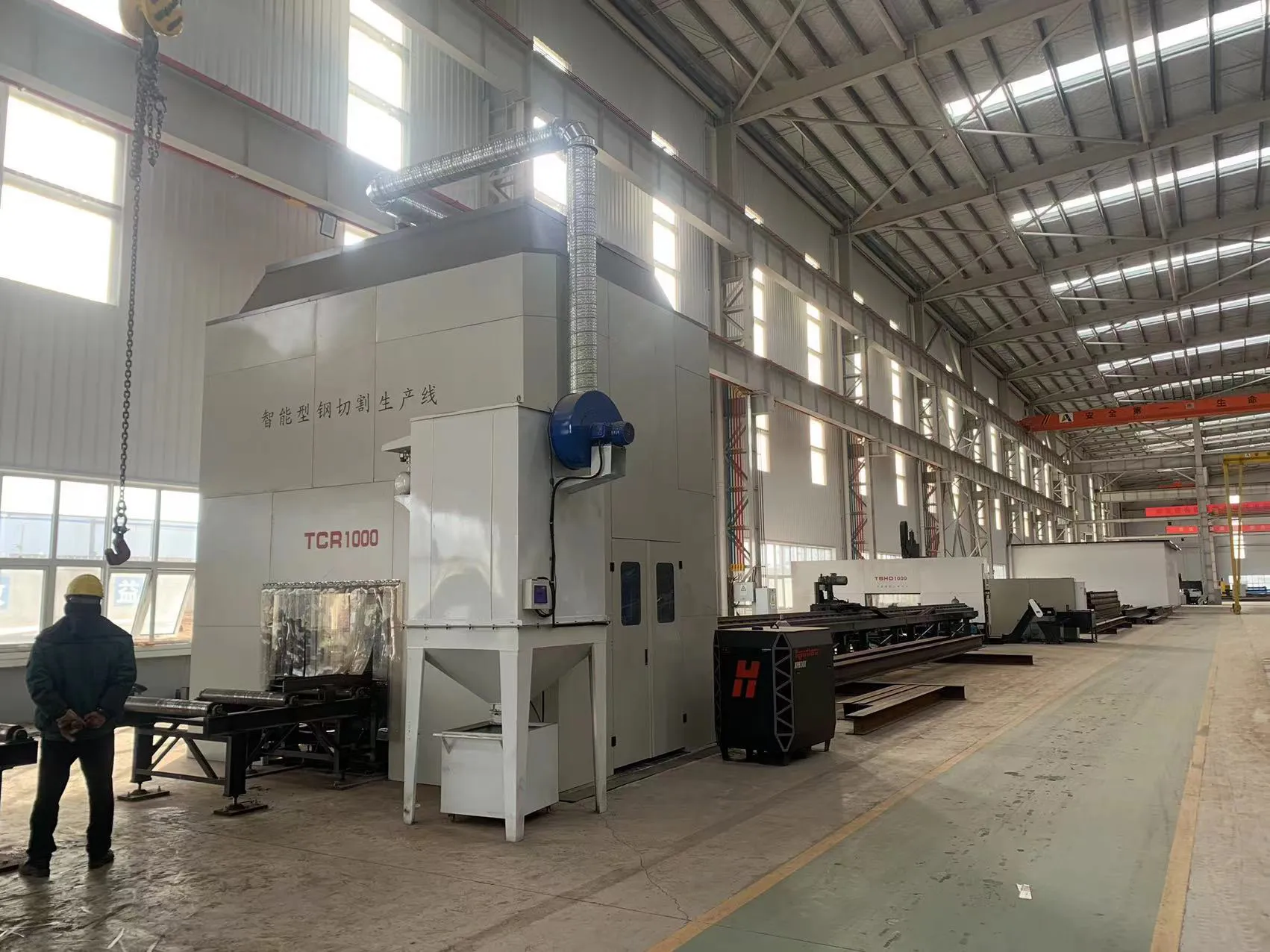
Technical Field Report: 6000W Universal Profile Steel Laser Integration in Heavy Mining Infrastructure
1. Executive Summary
This report outlines the technical performance and operational deployment of a 6000W Universal Profile Steel laser cutting System within the mining machinery manufacturing sector of Sao Paulo, Brazil. The primary objective of the deployment was to replace traditional mechanical sawing and plasma cutting processes with a high-brightness fiber laser source integrated with 3D robotic or multi-axis chuck systems. The analysis focuses on the implementation of “Zero-Waste Nesting” protocols and their impact on the structural integrity and production efficiency of heavy-duty vibratory screens, conveyors, and crushing unit frames.
2. Industrial Context: Sao Paulo’s Mining Machinery Manufacturing
The industrial corridors of Sao Paulo, particularly the ABC Paulista region and Sorocaba, serve as the primary fabrication hubs for Brazil’s mining sector. The equipment manufactured here—ranging from large-scale ore conveyors to primary crushers—demands structural components capable of withstanding extreme cyclic loading and abrasive environments.
Historically, the fabrication of these components relied on manual layout and plasma cutting of H-beams, I-beams, and C-channels. However, the requirement for high-tolerance bolt holes and complex interlocking joints (mortise and tenon) has driven the adoption of 6000W fiber laser systems. The high humidity and temperature fluctuations in the Sao Paulo region necessitate specific chillers and atmospheric controls for the laser resonators to maintain beam stability during long-duty cycles characteristic of mining infrastructure fabrication.
3. 6000W Fiber Laser Source and Beam Dynamics
The 6000W power rating was selected as the optimal threshold for processing structural steel profiles with web thicknesses ranging from 12mm to 25mm.
3.1. Power Density and Kerf Control: At 6000W, the power density is sufficient to maintain a stable melt pool even in carbon steels with higher impurity levels often found in structural grades (ASTM A36 or A572). The use of high-pressure oxygen (O2) as an assist gas allows for exothermic reactions that increase cutting speeds by up to 40% compared to 4000W systems in 20mm sections.
3.2. Beam Quality (M² Factor): The system utilizes a low M² factor beam, ensuring minimal divergence over the long focal lengths required for 3D profile cutting. This is critical when the cutting head must navigate the flanges and webs of I-beams where the distance between the nozzle and the material changes rapidly.
4. Universal Profile Processing Capabilities
The “Universal” designation of the system refers to its ability to handle a heterogeneous mix of profiles—including H, I, U, L, and RHS (Rectangular Hollow Sections)—without manual reconfiguration of the clamping mechanisms.
4.1. Multi-Axis Kinematics: The system employs a four-chuck architecture which provides superior rigidity compared to dual-chuck systems. This is essential for the 12-meter profiles standard in mining conveyor trusses. The ability to rotate the workpiece 360 degrees allows for precise bevel cuts (up to 45 degrees) for weld preparation, eliminating the need for secondary grinding operations.
4.2. Geometric Accuracy: In mining machinery, the alignment of long-span conveyor frames is critical. The laser system achieves a positioning accuracy of ±0.05mm per meter, a significant upgrade over the ±2.0mm tolerances typical of plasma-cut beams. This precision ensures that field-bolted connections in remote mining sites (such as the Carajás region) fit perfectly, reducing on-site rework costs.
5. Zero-Waste Nesting Technology: Analysis of Material Yield
One of the most significant advancements in this field report is the implementation of Zero-Waste Nesting. In traditional profile cutting, the “tail material”—the section held by the chuck—is often discarded as scrap, typically ranging from 200mm to 500mm per profile.
5.1. The “Zero-Tail” Mechanism: The system utilizes a synchronized movement between the cutting head and the multi-chuck array. As the laser reaches the end of the profile, the chucks pass the material through each other (overlapping), allowing the laser to cut within millimeters of the clamping zone. This reduces the remnant to less than 50mm, a negligible fraction in heavy industrial profiles.
5.2. Nesting Logic for Mining Trusses: The software algorithms optimize the sequence of cuts across multiple parts on a single raw beam. For a typical Sao Paulo-based fabricator processing 500 tons of steel monthly, the transition from a 5% scrap rate (plasma/saw) to a <1% scrap rate (Zero-Waste Laser) results in an annual material saving of approximately 24 tons of high-grade structural steel.
6. Impact on Structural Integrity and Metallurgy
Mining machinery is subject to intense vibration. The Heat Affected Zone (HAZ) created during the cutting process can be a site for crack initiation if not managed.
6.1. HAZ Reduction: The 6000W fiber laser, due to its high cutting speed, concentrates heat in a much narrower zone compared to oxy-fuel or plasma. Microstructural analysis of the cut edges on A572 Grade 50 steel reveals a HAZ depth of less than 0.2mm. This preserves the base metal’s ductility and fatigue resistance, which is vital for components like vibratory screen side plates.
6.2. Hole Quality and Fatigue Life: Mining frames require thousands of bolt holes. The laser’s ability to cut “true-hole” geometries (1:1 diameter-to-thickness ratio) with zero taper ensures better bolt-to-surface contact. This reduces the risk of bolt loosening under the harmonic vibrations typical of ore-processing equipment.
7. Operational Efficiency in the Sao Paulo Industrial Hub
The integration of this system into the Sao Paulo manufacturing workflow has highlighted several operational shifts:
- Elimination of Secondary Processes: The laser-cut edges are weld-ready. The removal of the “drilling and sawing” stations has reduced the footprint of the fabrication shop by 30%, allowing for more assembly space.
- Digital Twin Integration: The nesting software integrates directly with TEKLA and other structural BIM software used by Brazilian engineering firms. This allows for a seamless “design-to-cut” workflow, reducing human error in translating complex mining equipment geometries.
- Energy Efficiency: Despite the 6000W output, the wall-plug efficiency of the fiber laser resonator is approximately 35-40%, significantly lower in power consumption per meter cut than legacy plasma systems requiring high-volume compressed air and massive dust extraction.
8. Technical Constraints and Mitigation
While the system is highly effective, the Sao Paulo environment presents specific challenges. The local power grid in certain industrial zones can exhibit voltage instability. To mitigate this, the installation includes a dedicated industrial voltage stabilizer and a double-conversion UPS for the CNC controller to prevent “mid-cut” failures, which could scrap expensive heavy-gauge profiles.
Furthermore, the high carbon content in some locally sourced Brazilian steel requires fine-tuning of the frequency and duty cycle of the laser pulse (Pulse Width Modulation) to prevent dross accumulation on the lower edge of the flanges.
9. Conclusion
The deployment of the 6000W Universal Profile Steel Laser System with Zero-Waste Nesting represents a definitive shift in the fabrication of mining machinery in Sao Paulo. By combining high-power density with intelligent material management, manufacturers have achieved a 25% increase in throughput while simultaneously reducing material waste and improving the fatigue life of critical mining infrastructure. The synergy between the 6000W source and multi-axis structural processing provides the precision necessary for the next generation of automated mining equipment.
10. Technical Specifications Summary
| Parameter | Specification |
|---|---|
| Laser Source | 6000W Fiber (Ytterbium) |
| Profile Range | 80mm – 450mm (H-Beam/I-Beam) |
| Max Material Length | 12,000mm |
| Nesting Efficiency | >99% (Zero-Waste Protocol) |
| Positional Accuracy | ±0.05mm/m |




























