
1.0 Technical Overview: The Evolution of Structural Fabrication in Istanbul’s Industrial Hub
The industrial landscape of Istanbul, particularly the sectors concentrated in the Tuzla and İkitelli zones, has seen a significant shift toward high-precision heavy machinery manufacturing. As the primary gateway for mining equipment exports to Europe and Central Asia, Istanbul’s fabrication facilities are transitioning from conventional plasma and oxy-fuel methods to high-wattage fiber laser systems. This report analyzes the deployment of the 6000W Universal Profile Steel Laser System equipped with an Infinite Rotation 3D Head, focusing on its operational impact on mining machinery components.
Mining machinery—ranging from vibratory screens and crushers to heavy-duty conveyor frames—demands structural integrity capable of withstanding extreme cyclic loading. Traditional processing of H-beams, I-beams, and C-channels involved multiple setups: mechanical sawing, manual drilling, and manual beveling. The integration of a 6000W laser source into a specialized structural profile system collapses these operations into a single kinematic cycle, significantly reducing the Total Cost of Ownership (TCO) while elevating geometric precision.
2.0 Kinematics of the Infinite Rotation 3D Head
2.1 Mechanical Advantage and Degrees of Freedom
The core technological differentiator in this system is the Infinite Rotation 3D Head. Conventional 3D cutting heads are often constrained by “cable wrap” limitations, requiring the machine to “unwind” after reaching a 360-degree limit. This interruption breaks the continuity of the cutting path, particularly when processing complex intersections on thick-walled structural tubes or beams.
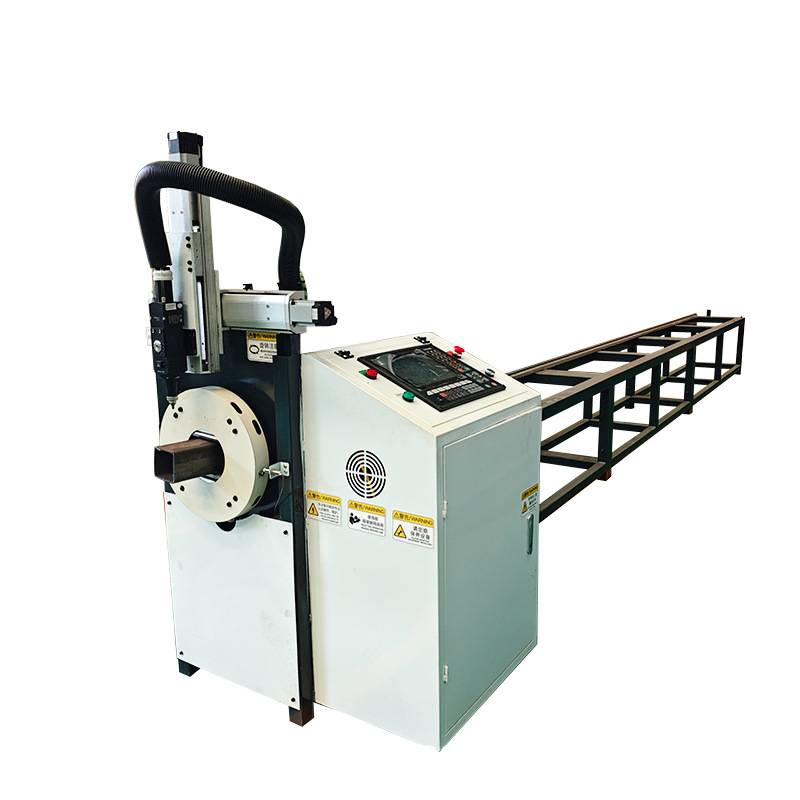
The infinite rotation capability utilizes advanced slip-ring technology or high-flexibility fiber delivery systems that allow the B and C axes to rotate without physical mechanical stops. In the context of Istanbul’s mining machinery production, this allows for continuous beveling (V, X, K, and Y joints) across all four faces of an H-beam. This continuity ensures that the heat-affected zone (HAZ) remains uniform, and the kerf quality is consistent, preventing stress concentration points that are common in interrupted cuts.
2.2 Precision Beveling for Weld Preparation
Mining equipment requires deep-penetration welds to survive high-vibration environments. The 3D head’s ability to achieve ±45-degree tilt with high angular accuracy is critical. For a 6000W system, the beam density allows for clean cuts on S355JR and S235JR structural steels—common grades in the Turkish market—up to 25mm thickness. By automating the beveling process directly on the laser system, the need for secondary grinding is eliminated. The precision of the 3D head ensures that the root face and bevel angle are consistent within ±0.1mm, a tolerance unattainable by manual plasma torches.
3.0 6000W Fiber Laser Synergy and Material Dynamics
3.1 Power Density and Throughput
The selection of a 6000W fiber laser source is strategic for the profile steel sector. While 12kW+ sources are available, the 6000W threshold provides the optimal balance between electrical efficiency and the ability to process the mid-to-heavy gauge steels (10mm to 20mm) that comprise 70% of mining frames. The high power density allows for “high-speed nitrogen piercing” and oxygen-assisted cutting, maintaining a high feed rate even when executing complex geometries on the flanges of I-beams.
3.2 Thermal Management in Profile Cutting
A significant challenge in structural laser cutting is the dissipation of heat in enclosed sections, such as the inner corners of C-channels. The 6000W system utilizes modulated pulse control to manage the thermal input. In Istanbul’s fabrication shops, where ambient temperatures can vary, the chiller systems integrated into the 6000W unit must be robust. The fiber laser’s beam quality (BPP) remains stable throughout long production runs, ensuring that the tail end of a 12-meter beam has the same dimensional accuracy as the leading end.
4.0 Application in Mining Machinery: Case Study Context
4.1 Heavy-Duty Vibratory Screen Frames
Vibratory screens are perhaps the most demanding components in the mining sector. They require precise bolt-hole alignments across large spans. Traditional punch or drill methods often suffer from “drift” over long distances. The Universal Profile Steel Laser System uses a multi-chuck (three or four-chuck) synchronization method to clamp and feed long profiles (up to 12000mm) through the cutting zone. This synchronization, coupled with the 3D head, allows for the simultaneous cutting of mounting holes and the complex profiling of the beam ends, ensuring that when the frame is assembled in the field, the stress distribution is perfectly symmetrical.
4.2 Conveyor System Modularization
Efficiency in the Istanbul mining machinery sector is often measured by the speed of modular assembly. Using the 6000W system, manufacturers are now implementing “tab-and-slot” designs for heavy profiles. The infinite rotation head cuts precise slots into heavy C-channels, allowing H-beams to be “locked” in place before welding. This reduces the reliance on heavy jigging and manual measurement, cutting assembly time by an estimated 40%.
5.0 Structural Automation and Workflow Integration
5.1 The Role of Universal Chucking Systems
The “Universal” aspect of the system refers to its ability to handle a diverse range of cross-sections without manual jaw changes. In a typical mining project, the BOM (Bill of Materials) includes L-angles for bracing and heavy H-beams for the main chassis. The automated chucking system detects the profile dimensions and centers the workpiece using laser sensors. This intelligence prevents the “bow and twist” inherent in lower-quality structural steel from affecting the cut path, as the system compensates for material deviation in real-time.
5.2 Software and CAD/CAM Synergy
Processing structural steel requires specialized nesting software that can handle 3D intersections (e.g., a round pipe intersecting an H-beam at an oblique angle). The control systems deployed in these Istanbul facilities utilize 3D kernels that automatically calculate the “unfolded” path for the 3D head. This removes the burden of manual G-code programming for complex bevels, allowing engineers to move from SolidWorks or Tekla designs directly to the cutting bed.
6.0 Technical Challenges and Mitigation Strategies
6.1 Managing Internal Reflections
When cutting I-beams, the laser must often fire toward the opposite flange. A 6000W beam, if not properly managed, can cause back-reflection damage or secondary marks on the internal surface of the profile. The system employs “anti-collision” and “reflection monitoring” sensors. Furthermore, the 3D head’s ability to approach the material at optimized angles mitigates the risk of the beam reflecting back into the fiber delivery system.
6.2 Slag Removal and Material Handling
In heavy structural cutting, slag (dross) accumulation inside the profile is a concern. The 6000W system utilizes high-pressure auxiliary gas (O2/N2) and optimized nozzle geometries to ensure that the molten metal is ejected cleanly. Automated loading and unloading systems—essential for the scale of operations in Istanbul—ensure that the machine remains in a “beam-on” state for the maximum possible percentage of the shift.
7.0 Conclusion: The Strategic Impact on the Istanbul Market
The deployment of 6000W Universal Profile Steel Laser Systems with Infinite Rotation 3D Heads represents a terminal point for traditional manual fabrication in the mining machinery sector. By solving the precision issues inherent in heavy steel processing and providing the kinematic freedom to execute complex weld preparations, this technology enables Istanbul-based manufacturers to compete on a global scale. The synergy between high-wattage fiber sources and automated structural processing results in a product that is not only cheaper to produce but structurally superior, meeting the rigorous safety and durability standards of the modern mining industry.
For the senior engineer, the data is clear: the transition to 3D laser profiling reduces secondary processing by 70-80%, improves weld integrity through superior fit-up, and provides the flexibility to iterate complex machinery designs without the overhead of traditional tooling.
















