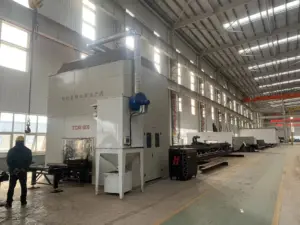
The Dawn of High-Power Fiber Lasers in Saudi Infrastructure
The skyline of Riyadh is a testament to one of the most ambitious urban developments in modern history. From the sprawling Riyadh Metro project to the expansive King Salman Park, the demand for structural steel is at an all-time high. In this context, the 6000W Universal Profile Steel Laser System has emerged as the cornerstone of modern bridge engineering.
Traditionally, bridge components—massive I-beams, H-profiles, and thick-walled tubes—were processed using a combination of band saws, radial drills, and plasma cutters. These methods, while functional, are labor-intensive and prone to human error. A 6000W fiber laser, however, brings a level of concentrated energy that can vaporize steel with micron-level precision. At 6kW, the system strikes a “sweet spot” for bridge engineering: it provides enough power to penetrate 25mm carbon steel with ease, while maintaining the beam quality necessary for intricate bolt-hole patterns and weight-reduction cutouts.
Understanding the Infinite Rotation 3D Head
The most significant technological leap in this system is the Infinite Rotation 3D Head. In conventional 5-axis laser cutting, the cutting head is often limited by internal cabling, requiring the machine to “unwind” or reset after a certain degree of rotation. For bridge engineers in Riyadh, time is the most expensive commodity. An “infinite” rotation head utilizes advanced slip-ring technology or specialized rotary joints to allow the head to spin indefinitely around the C-axis.
This capability is vital for “beveling.” Bridge structures rely heavily on welded joints that must withstand massive dynamic loads. To achieve full-penetration welds, the edges of the steel profiles must be beveled at specific angles (V, X, Y, or K-shaped joints). The 3D head can tilt up to 45 degrees while rotating, allowing the laser to create these complex weld preparations in a single pass. This eliminates the need for secondary grinding or manual beveling, ensuring that every joint is “weld-ready” the moment it leaves the laser bed.
Universal Profile Processing: Versatility Defined
Bridge engineering rarely relies on flat sheets alone. It is a world of three-dimensional geometry. The “Universal” aspect of this system refers to its ability to handle a vast array of profiles, including:
- H-Beams and I-Beams: The primary load-bearing members of any bridge.
- C-Channels and L-Angles: Used for bracing and secondary supports.
- Rectangular and Circular Hollow Sections: Increasingly popular in modern pedestrian bridge designs for their aesthetic appeal and torsional strength.
The system utilizes a sophisticated multi-chuck synchronization process. In Riyadh’s fabrication shops, these machines are equipped with heavy-duty automated loaders that can feed 12-meter profiles into the cutting zone. As the profile moves, the 3D head moves in concert with the rotation of the chuck, allowing the laser to cut on all four sides of a beam and even on the interior webs without repositioning the workpiece.
Impact on Bridge Structural Integrity and Safety
In bridge engineering, the Heat Affected Zone (HAZ) is a critical concern. When steel is cut, the heat can alter the molecular structure of the metal near the edge, potentially creating brittle points that lead to fatigue cracking over decades of use.
Compared to plasma cutting, a 6000W fiber laser has a significantly smaller HAZ. The high energy density allows for faster cutting speeds, meaning the heat is concentrated in a tiny area and dissipated quickly. Furthermore, the precision of laser-cut bolt holes is far superior to those made by plasma or manual drilling. In Riyadh’s bridge projects, where seismic considerations and extreme thermal expansion (due to the desert climate) must be accounted for, the perfectly cylindrical, burr-free holes produced by this system ensure that bolting assemblies fit with zero tolerance, distributing loads exactly as the architects intended.
Adapting to Riyadh’s Environmental Challenges
Operating high-tech fiber lasers in the heart of the Arabian Peninsula presents unique challenges, primarily heat and dust. A 6000W laser generates significant internal heat, and when combined with Riyadh’s summer temperatures exceeding 45°C, thermal management becomes paramount.
Modern systems installed in Riyadh are equipped with dual-circuit industrial chillers. These units maintain a constant temperature for both the fiber laser source and the 3D cutting head. Additionally, because the desert environment is prone to fine particulate dust, these systems feature pressurized optical paths and advanced filtration. The “Universal” system is often housed in a climate-controlled enclosure, protecting the sensitive fiber optics and linear motors from the abrasive sand that can otherwise degrade mechanical components.
Boosting Productivity for Vision 2030
The speed of the 6000W system is transformative. For a typical bridge girder requiring twenty 24mm bolt holes and four beveled edge preparations, traditional methods might take several hours of layout, drilling, and grinding. The 6000W laser system can complete the same task in under fifteen minutes.
This efficiency is a direct contributor to the Saudi government’s Vision 2030 goals. By localizing the fabrication of complex bridge components, Saudi construction firms no longer need to rely on imported pre-fabricated sections. They can import raw steel profiles and perform the high-value “smart” fabrication in-house in Riyadh. This not only reduces the carbon footprint associated with shipping but also fosters a highly skilled local workforce capable of operating the pinnacle of laser technology.
Software Integration: From CAD to Bridge Site
The hardware of the 6000W system is only as good as the software driving it. Bridge engineering involves complex BIM (Building Information Modeling) files. The Universal Profile Steel Laser System utilizes specialized CAM software that can import 3D models directly from platforms like Tekla Structures or AutoCAD.
The software automatically calculates the “nesting” for the profiles, ensuring that material waste is minimized. In the case of bridge construction, where high-grade structural steel is a significant cost factor, a 5% saving in material through optimized nesting can equate to millions of Riyals across a major project. The software also simulates the 3D head’s path to prevent collisions, a critical feature when navigating the narrow flanges of an H-beam with an infinite rotation head.
The Future: Automation and Beyond
As we look toward the future of bridge engineering in Riyadh, the 6000W Universal Profile Laser is just the beginning. We are already seeing the integration of AI-driven vision systems that can scan a raw steel beam, detect any slight warping or manufacturing defects, and adjust the cutting path in real-time to compensate.
The infinite rotation 3D head is also paving the way for more “organic” bridge designs. Modern architects are moving away from rigid, boxy structures toward flowing, curved aesthetics. Such designs require pipes and beams to be cut at strange, compounding angles that were previously impossible to manufacture accurately. With the 6kW power source and the 360-degree freedom of the 3D head, if it can be designed in software, it can be cut in the factory.
Conclusion
The deployment of the 6000W Universal Profile Steel Laser System with Infinite Rotation 3D Head in Riyadh is more than a technological upgrade; it is a fundamental shift in how Saudi Arabia builds its future. By combining the raw power of a 6kW fiber source with the geometric freedom of a 3D head, bridge engineers can now produce structures that are safer, more complex, and significantly more cost-effective. As Riyadh continues its journey toward becoming one of the most advanced cities in the world, this technology stands as the silent workhorse, carving the backbone of the Kingdom’s infrastructure out of solid steel.