The Dawn of High-Power Fiber Lasers in Charlotte’s Infrastructure
The skyline of Charlotte is currently defined by tower cranes and the steady roar of progress at Charlotte Douglas International Airport. Behind the scenes, the true transformation is happening in the fabrication shops that supply the “bones” of these massive structures. The transition from traditional plasma cutting and mechanical drilling to the 6000W fiber laser has been the single most significant leap in productivity for the local steel industry.
A 6000W fiber laser source provides the optimal “sweet spot” for airport construction. While 10kW or 20kW systems exist, the 6000W platform offers the best balance of beam quality (M2 factor) and operating costs for the structural gauges typically found in airport terminals. At 6kW, the laser achieves high-speed nitrogen cutting for thinner materials and high-integrity oxygen cutting for heavy-wall structural profiles up to 25mm thick. This power level ensures that the heat-affected zone (HAZ) is minimized, preserving the metallurgical integrity of the structural steel—a critical requirement for the high-load environments of an international airport.
The Engineering Marvel: Infinite Rotation 3D Head Technology
The most distinctive feature of this system is the 3D cutting head capable of infinite rotation. Traditional laser heads are often limited by internal cabling, requiring a “rewind” after a 360-degree turn. In a high-volume environment like the Charlotte airport project, these seconds of downtime add up to hours of lost productivity over a week.
Infinite rotation, facilitated by advanced slip-ring technology and specialized optical pathways, allows the head to maneuver around complex profiles—such as I-beams and RHS (Rectangular Hollow Sections)—without interruption. This is particularly vital for creating complex weld preparations. Airport structures often require V-type, Y-type, and K-type bevels to ensure full-penetration welds for seismic and wind-load resistance. The 3D head can tilt up to 45 degrees while simultaneously rotating, allowing it to “carve” these preparations directly into the beam ends during the initial cutting phase.
Universal Profile Processing: Beyond Flat Sheets
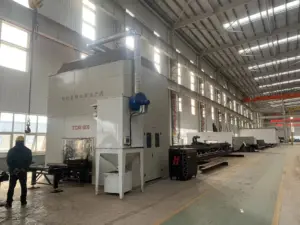
Airport architecture is rarely flat. The canopies at CLT, for example, involve sweeping curves and intersecting tubular supports. A “Universal” system implies that the machine is not limited to flat plate. It features a specialized rotary axis and a 4-chuck system that can support long-format structural steel, sometimes up to 12 meters in length.
When processing an I-beam, the 6000W laser must maintain a constant standoff distance despite the dimensional tolerances and “web-to-flange” variations inherent in hot-rolled steel. The 3D head utilizes high-speed capacitive sensors to map the surface of the profile in real-time. As the beam moves through the machine, the head adjusts its Z-axis and tilt angle instantaneously to compensate for any bowing or twisting in the raw material. This ensures that a bolt hole cut at one end of a 40-foot beam aligns perfectly with its counterpart on the construction site, reducing the need for “field fixes” that often plague large-scale infrastructure projects.
Meeting the Demands of “Destination CLT”
The $2.5 billion-plus “Destination CLT” investment program requires a level of logistical precision that traditional fabrication cannot match. The 6000W laser system addresses three critical bottlenecks in airport construction: speed, accuracy, and versatility.
First, speed is essential for maintaining the tight timelines of a functioning airport. Every hour a gate is closed for construction represents lost revenue. The fiber laser’s ability to cut through 12mm plate at speeds exceeding 2.5 meters per minute allows fabricators to move from raw material to finished assembly in a fraction of the time.
Second, the accuracy of the laser—often within ±0.05mm—is vital for the architectural aesthetics of the airport. Modern terminals feature “exposed structural steel,” where the skeleton of the building is part of the visual design. There is no room for sloppy cuts or grinding marks. The 6000W laser produces a “ready-to-paint” edge finish directly off the machine.
Third, the versatility of the 3D head allows for the creation of aesthetic perforations and complex joints that would be cost-prohibitive using manual methods. This allows architects in Charlotte to dream bigger, knowing that the fabrication technology can execute their vision without an exponential increase in labor costs.
The Impact of Fiber Laser Precision on Structural Integrity
In the context of aviation infrastructure, structural integrity is non-negotiable. The 6000W fiber laser operates at a wavelength of approximately 1.06 microns, which is more readily absorbed by steel compared to the 10.6 microns of older CO2 lasers. This leads to a more concentrated energy delivery and a narrower kerf (the width of the cut).
For the engineers overseeing the Charlotte airport expansion, this narrow kerf means more material is left intact, and the structural properties of the steel are less affected by thermal input. Furthermore, the 3D head’s ability to precisely cut bolt holes—rather than punching them—prevents micro-fractures around the hole circumference. In high-vibration environments, such as those near taxiways and runways, preventing these micro-fractures is essential for the long-term fatigue life of the steel structure.
Sustainability and Efficiency in Local Fabrication
Charlotte is increasingly focused on green building initiatives. The 6000W fiber laser system is significantly more energy-efficient than the plasma or CO2 systems it replaces. Fiber lasers typically boast a wall-plug efficiency of about 30-40%, whereas CO2 systems struggle to reach 10%. This reduction in energy consumption aligns with the broader sustainability goals of the City of Charlotte and the airport authority.
Additionally, the nesting software integrated with these 3D systems optimizes material usage on I-beams and tubes. By calculating the best “puzzle-piece” fit for various components, the system minimizes “drop” (scrap material). In an era where steel prices are volatile, the ability to squeeze an extra 5-10% of parts out of every ton of steel provides a significant competitive advantage to Charlotte-based contractors.
The Human Element: Skill Evolution in the Queen City
The introduction of such advanced machinery in Charlotte has also shifted the labor landscape. The role of the “fabricator” is evolving into that of a “technician/programmer.” Operating a 6000W system with an infinite rotation 3D head requires a deep understanding of CAD/CAM software and laser physics.
Local technical colleges and fabrication shops in the Charlotte-Mecklenburg area are now focusing on training the next generation of workers to manage these automated systems. This technological leap is not just building a better airport; it is building a more highly-skilled workforce that will sustain Charlotte’s position as a manufacturing hub in the Southeast for decades to come.
Conclusion: A New Standard for Aviation Construction
The deployment of the 6000W Universal Profile Steel Laser System with Infinite Rotation 3D Head is more than just a capital investment; it is a strategic necessity for the scale of construction currently seen in Charlotte. By merging high-power fiber laser technology with 5-axis geometric flexibility, the fabrication industry can now produce structural components that were previously thought impossible or too expensive to manufacture.
As travelers move through the newly expanded halls of Charlotte Douglas International Airport, they are surrounded by the precision of this technology. From the massive steel “trees” supporting the terminal roofs to the intricate glass-and-steel facades, the fingerprints of the 3D laser system are everywhere. In the intersection of high-power optics and heavy-duty structural engineering, Charlotte has found the tool it needs to build a world-class gateway for the 21st century.