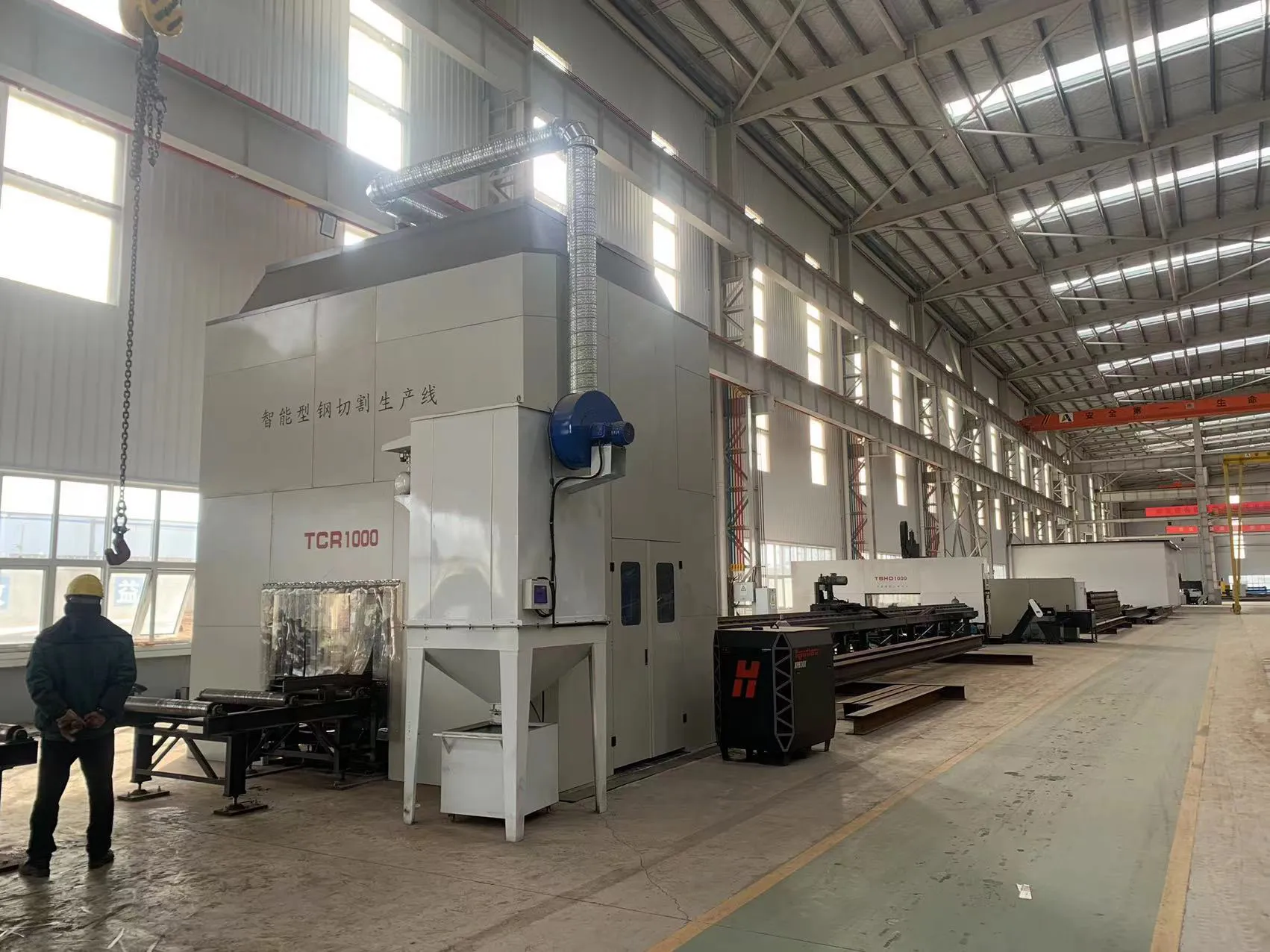
The Evolution of Heavy Fabrication in the Edmonton Hub
Edmonton has long been the heart of Canada’s industrial fabrication, traditionally serving the oil and gas sector with rugged, high-capacity manufacturing. However, as the global and local energy landscape shifts toward renewables, the demand for wind turbine infrastructure has surged. Wind turbine towers are colossal structures that demand a unique combination of scale and precision. The introduction of the 6000W Universal Profile Steel Laser System marks a sophisticated evolution in how Edmonton’s shops handle structural steel.
Unlike traditional plasma cutting or mechanical drilling, the 6000W fiber laser offers a level of thermal control and edge quality that significantly reduces post-processing time. In the context of wind towers—where structural integrity is non-negotiable due to the immense dynamic loads the towers must withstand—the ability to produce clean, dross-free cuts is a game changer.
The Power of 6000W: Why 6kW is the Strategic Choice
In the world of fiber lasers, power correlates directly to throughput and the maximum thickness of the material. A 6000W (6kW) system is often considered the “sweet spot” for structural steel fabrication. While 10kW or 20kW systems exist, the 6kW resonator provides the most efficient balance of capital investment and operational cost for the specific gauges found in wind turbine internals.
At 6000W, the laser achieves a high energy density that allows it to vaporize carbon steel almost instantly. This high-speed processing results in a smaller Heat Affected Zone (HAZ). For wind turbine components, a minimized HAZ is critical because it preserves the metallurgical properties of the high-strength steel, ensuring that the components do not become brittle or prone to stress fractures over the 25-year lifespan of a turbine. Furthermore, the 6kW power level allows for “nitrogen cutting” on thinner auxiliary components for a mirror-finish edge, or “oxygen cutting” for thicker structural plates and profiles, providing the versatility needed for a diverse range of tower parts.
Universal Profile Processing: Beyond Flat Sheets
The “Universal Profile” designation of this laser system is what truly sets it apart for wind energy applications. Wind turbine towers are not just empty shells; they are complex assemblies containing internal platforms, ladder systems, cable mounts, and structural reinforcements. These components are rarely made from flat plate alone; they require the processing of H-beams, I-beams, square tubing, and C-channels.
Traditional methods for processing these profiles involve multiple machines: a saw for length, a drill for bolt holes, and a milling machine for notches. The Universal Profile Laser consolidates these into a single process. Equipped with a 3D cutting head and a rotary axis, the system can rotate a heavy steel profile 360 degrees while the laser head tilts to perform complex bevels and intersections. This is particularly useful for the “fish-mouth” cuts required where internal bracing meets the curved inner wall of the tower, ensuring a perfect flush fit for welding.
Automatic Unloading: The Economics of Continuous Operation
In an industrial market like Edmonton, where skilled labor can be both expensive and scarce, automation is a necessity rather than a luxury. The “Automatic Unloading” feature of this 6000W system transforms the laser from a tool into a self-contained production cell.
For wind turbine tower production, the components are often heavy and awkward to handle. An automatic unloading system utilizes synchronized conveyors and hydraulic lift-arms to remove finished profiles and sort them into designated bins or onto pallets. This minimizes the “machine idle time” that usually occurs while a crane operator maneuvers a heavy beam off the cutting bed. By enabling “lights-out” manufacturing, Edmonton shops can continue to process secondary steel components overnight, ensuring that the primary assembly line for the tower sections never faces a bottleneck.
Precision Fit-Up and Welding Efficiency
In the construction of wind turbine towers, welding represents the largest portion of labor hours. The precision of a 6000W laser significantly reduces these hours. When structural profiles are cut with a tolerance of +/- 0.1mm, the “fit-up” during assembly is nearly perfect.
Furthermore, the 3D head of the Universal Profile system allows for automated beveling (V-cuts, Y-cuts, and K-cuts). In heavy steel fabrication, preparing an edge for a deep-penetration weld is usually a manual process involving grinders or specialized milling tools. The laser performs this beveling during the initial cut. For the massive flanges that connect tower segments, this precision ensures that the circumferential welds are uniform, reducing the likelihood of weld defects that would be flagged during ultrasonic or X-ray inspections.
Meeting the Challenges of the Alberta Environment
Operating high-precision fiber lasers in Edmonton presents unique environmental challenges. The significant temperature fluctuations between the humid summers and the extreme dry cold of winter can affect beam stability and machine calibration.
The 6000W systems deployed in this region are equipped with advanced climate-controlled resonators and high-capacity chillers that utilize specialized glycol blends to prevent freezing during shutdowns. Moreover, the dust and particulate matter common in heavy industrial zones are managed by high-efficiency filtration and dust extraction systems. This ensures that the sensitive optics of the laser remain pristine, maintaining beam quality even in the middle of a busy fabrication yard.
Impact on the Wind Energy Supply Chain
The presence of such advanced machinery in Edmonton strengthens the local supply chain. Previously, many of the complex internal components for wind towers were imported from overseas or from large-scale manufacturers in the United States. By localizing this capacity with a 6000W Universal Profile system, Edmonton-based companies can offer “Just-In-Time” (JIT) delivery to tower assembly sites across the Canadian Prairies.
This localization reduces the carbon footprint of the wind projects themselves by minimizing the logistics of transporting heavy steel components over long distances. It also allows for greater design flexibility; if a project requires a mid-production change to an internal bracket or a ladder mount, the adjustment can be made in the CNC software and cut within the hour, rather than waiting weeks for a new shipment to arrive.
The Future: Toward a Greener Industrial Core
As Alberta continues to diversify its economy, the role of high-tech manufacturing cannot be overstated. The 6000W Universal Profile Steel Laser System is a symbol of this transition. It represents a move toward high-value, high-precision manufacturing that supports the green energy infrastructure of the future.
For the wind turbine industry, the benefits are clear: faster production cycles, lower costs, and superior structural integrity. For the city of Edmonton, it reinforces its status as a premier hub for industrial innovation. By investing in fiber laser technology that combines power, versatility, and automation, local fabricators are not just cutting steel—they are carving out a central role in the global renewable energy economy.
In conclusion, the deployment of this technology is a masterstroke for wind tower production. The 6000W power source handles the thickness, the Universal Profile capability handles the complexity of the shapes, and the automatic unloading handles the throughput demands. Together, they create a formidable manufacturing solution that ensures Edmonton remains at the forefront of the industrial world.