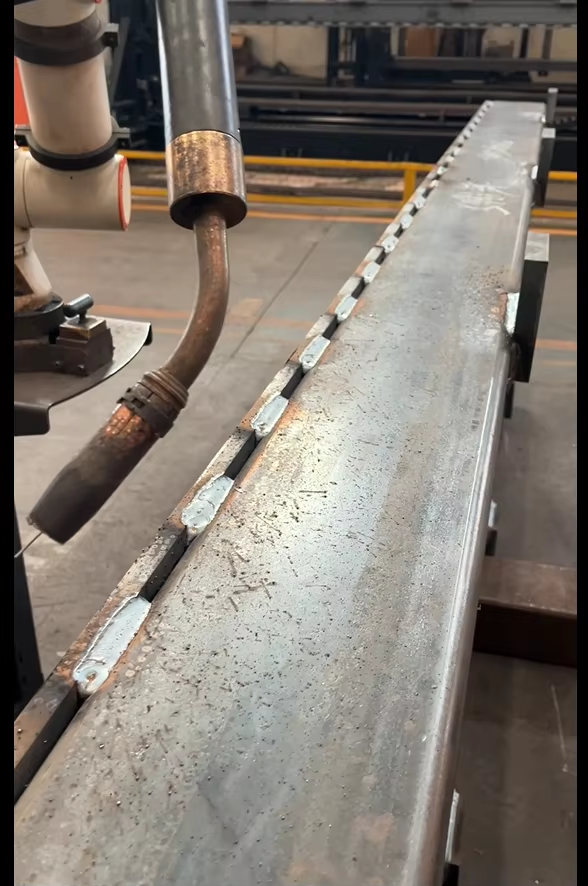
The Evolution of Offshore Fabrication in Houston
Houston, Texas, serves as the global epicenter for subsea engineering and offshore platform fabrication. For decades, the industry relied on oxy-fuel and plasma cutting for the massive structural components required for deep-water rigs. While effective for thickness, these legacy methods introduced significant thermal distortion and required intensive manual labor for weld preparation.
The introduction of the 6000W Universal Profile Steel Laser System marks the next evolutionary step. Unlike standard flatbed lasers, a “Universal Profile” system is designed to handle the three-dimensional geometry of structural steel—channels, angles, pipes, and beams. For Houston-based fabricators supporting the Gulf of Mexico’s energy transition, this means the ability to move from raw material to weld-ready component in a single setup. The 6000W power rating is particularly strategic; it offers the ideal balance between cutting speed, edge quality, and operating cost for the medium-to-heavy gauge steels (typically up to 25mm–30mm) most common in platform secondary structures and deck outfitting.
The 6000W Fiber Advantage: Precision Over Power
In the fiber laser world, more power isn’t always better, but 6000W is the “sweet spot” for structural steel. At this wattage, the laser density is high enough to achieve high-speed nitrogen cutting on thinner gauges and efficient oxygen-assisted cutting on heavy carbon steel.
For offshore platforms, the metallurgy of the cut is as important as the dimension. Fiber lasers produce a much narrower Heat Affected Zone (HAZ) compared to plasma. In the corrosive, high-stress environment of the ocean, a large HAZ can lead to premature fatigue cracking and hydrogen embrittlement. By using a 6000W fiber source, Houston fabricators ensure that the base metal’s crystalline structure remains largely unaltered, preserving the mechanical properties of high-strength offshore grades like AH36 or DH36.
Mastering the ±45° Bevel: The End of Secondary Processing
The most transformative feature of this system is the 5-axis 3D beveling head. In offshore construction, pieces are rarely joined at simple 90-degree angles. To ensure full-penetration welds capable of withstanding hurricane-force loads, structural members require complex bevels—V-grooves, Y-cuts, and K-cuts.
Traditionally, a Houston shop would cut a beam to length and then send it to a separate station where a technician would use a hand-held plasma torch or a mechanical milling machine to create the bevel. This introduces human error and doubles the handling time. The ±45° beveling head on a universal profile laser allows the system to cut the profile and the weld preparation simultaneously. Whether it is a “rat hole” for a beam intersection or a complex miter cut on a pipe, the laser executes the geometry with a tolerance of ±0.1mm. This precision ensures that when the components arrive at the assembly jig, the fit-up is perfect, reducing weld volume and significantly lowering the risk of weld failure during NDT (Non-Destructive Testing).
Universal Profile Capability: Beyond the Flat Sheet
Offshore platforms are skeletal masterpieces built from I-beams, H-beams, and large-diameter tubes. A “Universal Profile” laser system utilizes a sophisticated chuck and roller system to rotate and feed these long-form materials through the cutting zone.
In Houston’s heavy-fab yards, the ability to process a 40-foot I-beam with intricate bolt holes, cope cuts, and beveled ends in a single pass is a massive competitive advantage. The software behind these systems can “unfold” 3D CAD models from programs like Tekla or ShipConstructor, automatically generating the toolpath for the laser. This digital workflow eliminates the “layout” phase of fabrication, where dimensions were historically marked by hand. The result is a “Lego-like” assembly process on the shop floor, where components snap together with mathematical certainty.
Strategic Impact on Houston’s Offshore Supply Chain
The deployment of these systems in the Houston area directly impacts the economics of the Energy Corridor. Offshore projects are notorious for “fast-track” schedules where a delay of one week can cost millions in lost production.
By localizing high-precision laser beveling, Houston shops can bypass the bottlenecks of specialized machine shops. Furthermore, the efficiency of the 6000W fiber laser reduces electricity consumption by up to 50% compared to older CO2 technology, and the lack of “consumable” electrodes (as seen in plasma) lowers the cost per part. For Houston contractors bidding on global projects—from the South China Sea to the Brazilian pre-salt fields—this technology provides the margin needed to win contracts against lower-labor-cost regions while maintaining “Made in USA” quality.
Navigating Material Challenges: High-Strength Steels
Offshore platforms utilize specialized steels designed for low-temperature toughness and corrosion resistance. These materials can be sensitive to the thermal cycling of traditional cutting. The 6000W laser, with its high energy density, moves through the material so quickly that the bulk of the part remains cool to the touch.
Moreover, the system’s advanced sensing technology can account for the “mill tolerance” of structural steel. Beams are rarely perfectly straight. The laser’s touch-sensing or optical-sensing systems map the actual surface of the beam before cutting, adjusting the toolpath in real-time to ensure the bevel depth and hole placements are accurate relative to the actual material, not just the theoretical CAD model. This is critical for the large-scale integration of modules on a platform topside, where cumulative errors can lead to massive misalignments.
The Future: Automation and Industry 4.0
The 6000W Universal Profile Laser is more than a cutting machine; it is an IoT-enabled data node. In a modern Houston fabrication facility, these systems provide real-time feedback on cutting speeds, gas pressures, and power consumption. This data allows for predictive maintenance, ensuring the machine never goes down during a critical project push.
As Houston continues to pivot toward offshore wind energy in the Gulf, the demand for these systems will only grow. The monopiles and transition pieces for offshore wind turbines require the same high-precision beveling and structural integrity as oil and gas jackets. The 6000W laser is perfectly positioned to bridge this transition, providing the versatility to handle traditional carbon steels and the newer, high-performance alloys required for renewable energy infrastructure.
Conclusion: A New Standard for the Gulf Coast
The 6000W Universal Profile Steel Laser System with ±45° beveling is a definitive solution for the challenges of modern offshore fabrication. By integrating high-power fiber optics with multi-axis structural handling, it solves the most persistent problems in the industry: weld preparation time, dimensional accuracy, and material integrity. For Houston’s fabrication leaders, adopting this technology is not just an upgrade—it is a commitment to the precision and reliability that the next generation of offshore energy demands. In the relentless environment of the open sea, there is no room for error, and the precision of the fiber laser ensures that every cut, bevel, and hole is a testament to engineering excellence.