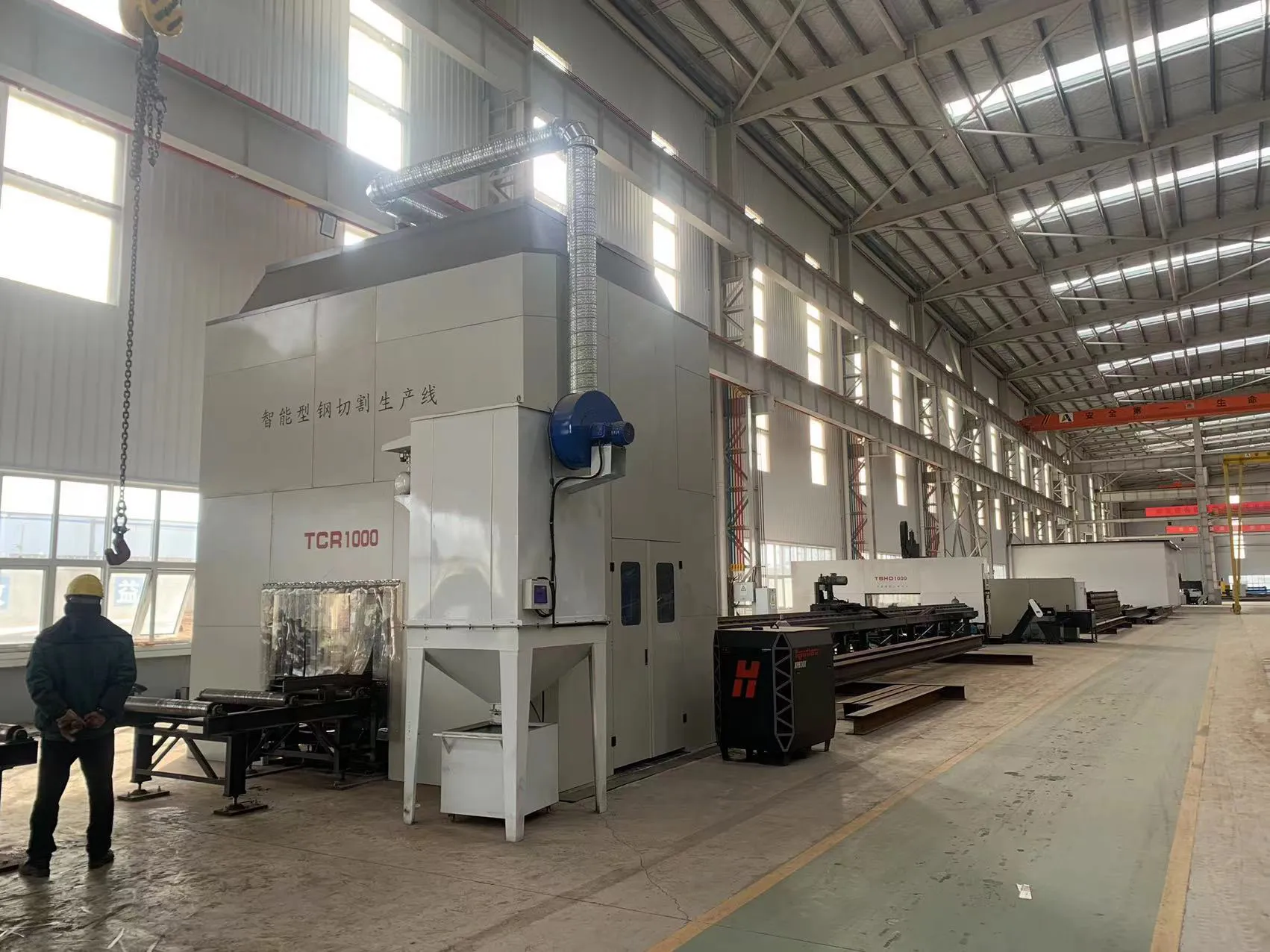
The Evolution of Structural Fabrication in Jakarta’s Infrastructure
Jakarta’s skyline and its critical transport gateways, notably the ongoing expansions at Soekarno-Hatta and upcoming satellite airport projects, demand a level of structural sophistication that traditional fabrication methods struggle to meet. In the past, profile steel—including H-beams, I-beams, C-channels, and large-diameter pipes—required a multi-stage process: mechanical sawing to length, manual layout marking, radial drilling for bolt holes, and laborious manual grinding for weld bevels.
The deployment of a 6000W Universal Profile Steel Laser System changes this dynamic entirely. As a fiber laser expert, I have observed that the primary bottleneck in airport construction is often the “weld-ready” state of structural members. With Jakarta’s humid tropical climate and seismic activity considerations, the precision of these welds is non-negotiable. The 6000W laser provides the necessary energy density to slice through thick-walled structural steel with a heat-affected zone (HAZ) so minimal that the metallurgical properties of the steel remain uncompromised, ensuring the safety and longevity of high-occupancy airport terminals.
The 6000W Power Threshold: Why It Matters
In the realm of fiber lasers, 6000W (6kW) is widely considered the “sweet spot” for structural steel profiles. While lower power ratings like 3kW are sufficient for thin-walled tubes, they lack the speed and penetration required for the heavy-duty H-beams (up to 20mm or 25mm wall thickness) common in airport skeletons.
At 6000W, the laser achieves a high feed rate that prevents the excessive heat buildup that can lead to material warping. In the context of Jakarta’s large-scale projects, where thousands of tons of steel are processed, the efficiency gain of a 6kW system over a 3kW system isn’t just double—it is exponential when considering the ability to maintain clean cuts through high-tensile structural grades. This power level ensures that the kerf remains narrow and the dross remains minimal, eliminating the need for secondary cleaning before the steel is sent to the assembly site.
The Technical Mastery of ±45° Bevel Cutting
The most significant feature of this system is the 5-axis 3D cutting head capable of ±45° beveling. In traditional construction, creating a V-groove or a K-groove on the end of an H-beam for a full-penetration weld requires a specialized bevelling machine or a worker with a plasma torch and a steady hand. Neither provides the accuracy required for the complex geometries found in modern airport architecture, which often features sweeping curves and non-orthogonal joints.
The ±45° beveling capability allows the laser to cut the profile and create the weld preparation angle simultaneously. This means a structural column can be pulled from the raw material stack, cut to a precise length, have its bolt holes “drilled” (lasered), and its ends beveled for a perfect 45-degree weld joint in a single automated cycle. This level of precision ensures that when the components arrive at the construction site in Jakarta, they fit together with sub-millimeter tolerances, significantly reducing the “on-site adjustment” time that often plagues large infrastructure projects.
Meeting Airport Construction Standards: Precision and Safety
Airport terminals are high-consequence structures. They must withstand immense wind loads, potential seismic shifts, and the constant vibration of taxiing aircraft. The precision of a laser-cut profile is vastly superior to plasma or oxy-fuel cutting. The 6000W fiber laser produces a surface finish that often negates the need for further machining.
Furthermore, the “Universal” aspect of the system means it can handle a diverse array of profiles. Whether it’s the rectangular hollow sections (RHS) used in the aesthetic facades of the terminal or the heavy H-beams used for the primary load-bearing structures, the system’s intelligent chucking and nesting software optimizes material usage. In a city like Jakarta, where logistics and material costs are high, reducing scrap by even 5-10% through advanced nesting algorithms provides a massive economic advantage to the contractor.
Addressing Jakarta’s Environmental and Operational Challenges
Operating high-end fiber lasers in Jakarta presents unique challenges, primarily related to the environment. The high humidity and ambient temperatures require the 6000W system to be equipped with high-efficiency, dual-circuit industrial chillers. These chillers must maintain the laser source and the cutting head at a constant temperature to prevent condensation, which can be fatal to sensitive optical components.
Moreover, the power grid in industrial zones around Jakarta can sometimes experience fluctuations. A professional-grade 6000W system for airport construction must be integrated with robust voltage stabilizers and uninterruptible power supplies (UPS) to protect the laser resonator. As an expert, I emphasize that the “system” isn’t just the laser; it’s the entire ecosystem of cooling, power regulation, and dust extraction that allows the machine to run 24/7 to meet the tight deadlines of an international airport expansion.
Digital Integration: BIM and the 6000W Laser
Modern airport construction relies heavily on Building Information Modeling (BIM). The 6000W Universal Profile Laser System is a native participant in this digital workflow. Software such as Tekla or Autodesk Revit generates complex 3D models of the airport’s steel skeleton. These models are exported directly to the laser’s CAM (Computer-Aided Manufacturing) software.
This seamless transition from “Digital Twin” to “Physical Component” minimizes human error. In Jakarta’s fast-paced construction environment, where multiple subcontractors work simultaneously, the ability to ensure that “Part A” from one supplier perfectly matches “Part B” from another is critical. The laser system’s ability to etch part numbers and assembly guides directly onto the steel profiles further streamlines the logistics of the construction site, acting as a “Lego-style” assembly kit for the structural engineers.
Economic Impact and Return on Investment (ROI)
While the initial investment in a 6000W bevel-capable laser is significant, the ROI for Jakarta-based airport projects is compelling. Consider the reduction in labor: one laser system can replace the output of three separate lines consisting of saws, drills, and manual grinders.
Additionally, the speed of assembly on-site is accelerated. Because the ±45° bevels are mathematically perfect, the welding process is faster and requires less filler material. There are fewer weld failures and fewer “re-dos.” For a project as massive as an airport, saving just a few minutes per beam adds up to thousands of man-hours saved over the duration of the project. This makes the 6000W Universal Profile Laser not just a piece of machinery, but a strategic asset for any Tier-1 construction firm in Indonesia.
Conclusion: Shaping the Future of Indonesian Aviation Hubs
As Jakarta continues to position itself as a central hub for Southeast Asian aviation, the infrastructure supporting this growth must be built with the highest technology available. The 6000W Universal Profile Steel Laser System with ±45° bevel cutting represents the pinnacle of structural fabrication.
By integrating high-power fiber laser technology with multi-axis motion control, the industry moves away from the “measure twice, cut once” manual era into the “model once, laser-perfect” digital era. For the engineers and developers building Jakarta’s future airports, this technology is the key to delivering structures that are safer, more complex in design, and completed ahead of schedule. The precision of the laser beam today is the foundation of the structural integrity that will carry millions of passengers tomorrow.