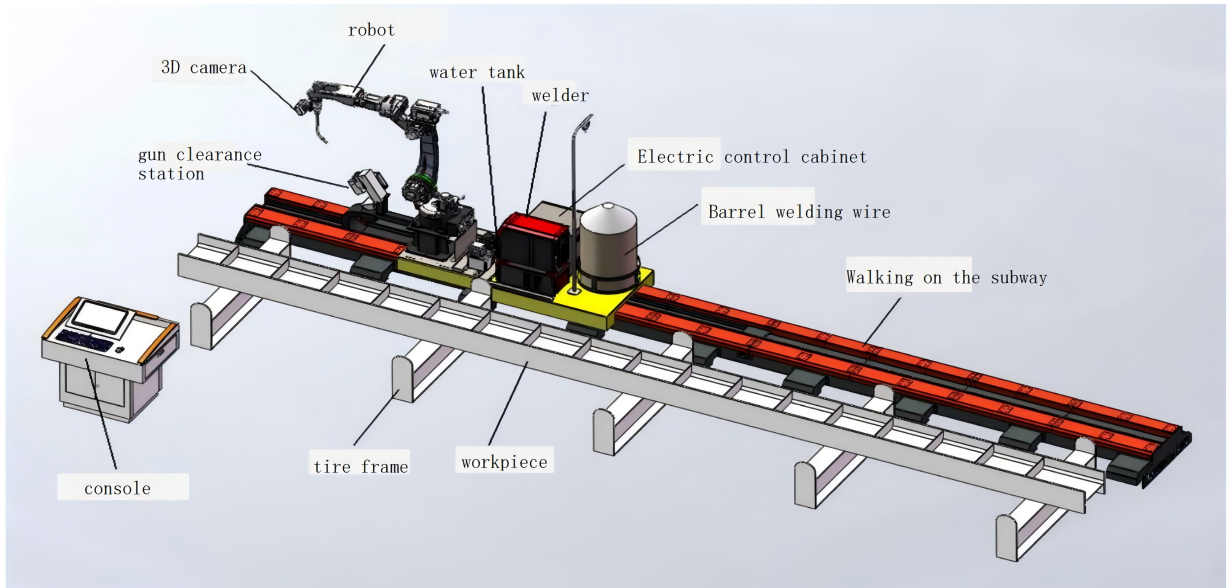
The Strategic Integration of 6000W Fiber Lasers in Rayong’s Industrial Landscape
Rayong has long been the cornerstone of Thailand’s heavy industry, serving as the primary hub for the Eastern Economic Corridor (EEC). As the nation pivots toward a modern railway infrastructure—encompassing high-speed rail links and urban mass transit expansions—the demand for high-strength structural steel components has surged. The introduction of the 6000W Universal Profile Steel Laser System is not merely an incremental upgrade; it is a disruptive leap forward.
A 6000W (6kW) fiber laser source offers the “sweet spot” for railway manufacturing. It provides enough power to penetrate thick-walled structural steel (up to 25mm-30mm) while maintaining the beam quality necessary for intricate cuts on thinner profiles. In the humid, high-throughput environment of Rayong’s fabrication shops, the fiber laser’s solid-state design offers a robust alternative to older CO2 technologies, boasting higher wall-plug efficiency and significantly lower maintenance requirements. For railway infrastructure, where material integrity and precision are non-negotiable, the 6kW fiber laser ensures a minimal Heat Affected Zone (HAZ), preserving the mechanical properties of the steel.
Mastering Universal Profile Steel: Beyond Flat Sheet Cutting
Railway infrastructure relies heavily on “Universal Profiles”—H-beams, I-beams, U-channels, and L-angles. Traditionally, processing these shapes involved a fragmented workflow: sawing to length, mechanical drilling for bolt holes, and manual grinding for weld prep. The 6000W Universal Profile Laser System consolidates these steps into a single automated process.
The “Universal” aspect of these systems refers to their ability to handle 3D geometries. Equipped with sophisticated rotary chucks and multi-axis heads, the laser can travel around the perimeter of a beam, cutting slots, holes, and complex notches with a positional accuracy often within ±0.05mm. This is critical for railway bridge girders and station frameworks where structural alignment is paramount. By using a laser to process these profiles, Rayong-based fabricators can ensure that every bolt hole aligns perfectly during site assembly, drastically reducing field rework and labor costs.
The ±45° Bevel Cutting Revolution: Streamlining Weld Preparation
Perhaps the most significant technological advancement in this system is the ±45° bevel cutting head. In heavy-duty railway applications, structural steel components are rarely joined with simple butt welds. They require specific edge geometries—V-grooves, Y-grooves, or K-grooves—to ensure full penetration welds that can withstand the dynamic loads and vibrations of passing trains.
The 5-axis beveling head allows the 6000W laser to tilt during the cutting process, creating precise angles up to 45 degrees. In a traditional shop, a worker would cut a steel plate or beam and then use a handheld plasma torch or a milling machine to create the bevel. This is time-consuming and prone to human error. The 6000W laser system performs the cut and the bevel simultaneously. Because the laser’s heat input is so concentrated, the resulting bevel is clean, slag-free, and ready for immediate welding. This capability is a game-changer for the production of rail bogie frames and longitudinal beams, where weld quality is a safety-critical metric.
Applications in Railway Infrastructure: From Tracks to Terminals
The versatility of the 6000W system allows it to touch every facet of railway development. In the context of Rayong’s contribution to the Thai-Chinese High-Speed Railway and the U-Tapao airport link, several key applications emerge:
1. **Rolling Stock Components:** The chassis and frames of rail cars require high-strength steel with complex cutouts for weight reduction without sacrificing rigidity. The 6kW laser handles these high-tensile alloys with ease.
2. **Catenary Mast Fabrication:** The overhead line equipment (OLE) requires thousands of steel masts and cantilever arms. The ability to rapidly process galvanized steel profiles with precision holes for electrical mounting is essential.
3. **Turnouts and Switch Components:** While some rail components are forged, many of the peripheral support structures and housing units are fabricated from heavy plate and profile steel, benefiting from the laser’s accuracy.
4. **Station Architecture:** Modern rail hubs in the EEC feature expansive steel-glass architectures. The 6000W system allows for the creation of aesthetically pleasing yet structurally sound “architectural steel” where the finish quality of the cut must be flawless.
Precision and Quality Control in the Rayong Context
Operating high-power lasers in a tropical industrial zone like Rayong presents specific challenges, notably humidity and ambient temperature fluctuations. Modern 6000W systems are equipped with advanced environmental controls, including dual-circuit chilling units that stabilize both the laser source and the cutting head optics.
For railway infrastructure, “traceability” and “repeatability” are the watchwords. The CNC software integrated into these systems allows for the direct import of BIM (Building Information Modeling) and CAD files. This digital thread ensures that the part produced in a Rayong factory is a perfect physical twin of the engineering design. Furthermore, the laser’s ability to “etch” part numbers and QR codes directly onto the steel profiles ensures lifetime traceability for maintenance and safety audits—a mandatory requirement for modern international rail standards.
Economic Impact: Why 6000W is the Catalyst for Local Growth
The shift to 6000W fiber laser technology is a strategic economic move for Rayong’s fabrication sector. Compared to plasma cutting—the traditional workhorse of heavy steel—the fiber laser offers a significantly lower cost-per-part on mid-to-thick materials. While the initial capital investment is higher, the speed of the 6kW source (often 2-3 times faster than a 3kW source on 12mm steel) results in a much faster Return on Investment (ROI).
Moreover, the reduction in secondary processes (grinding, cleaning, drilling) means that a single laser system can often replace three or four conventional machines. This frees up floor space in Rayong’s industrial parks and reduces the reliance on highly skilled manual welders for edge preparation, addressing the regional labor shortages in specialized trades. By adopting this technology, local Thai firms can compete on a global scale, bidding for international railway contracts that demand stringent European or Japanese manufacturing standards.
Environmental Sustainability in Rail Manufacturing
Sustainability is becoming a core pillar of infrastructure projects worldwide. Fiber lasers are inherently more “green” than their predecessors. A 6000W fiber laser has an energy conversion efficiency of approximately 35-40%, compared to the 10% efficiency of CO2 lasers. Additionally, the precision of laser cutting minimizes material waste through advanced nesting algorithms. In the railway sector, where thousands of tons of steel are processed, a 5% increase in material utilization translates to massive cost savings and a significantly reduced carbon footprint for the project. The lack of chemical consumables and the reduction in noise pollution compared to mechanical punching or plasma cutting also create a safer, cleaner working environment for the local workforce in Rayong.
The Path Forward: Industry 4.0 and Automation
The future of railway infrastructure in Rayong lies in the marriage of the 6000W laser with Industry 4.0. We are now seeing these systems integrated with automated loading and unloading towers and robotic sorting arms. For a universal profile system, this might involve automated conveyor systems that feed 12-meter H-beams into the machine and extract finished components without human intervention.
As a fiber laser expert, I view the installation of these systems in Rayong as a signal of Thailand’s industrial maturity. The ±45° beveling capability, combined with the raw power of a 6000W source, provides the technical foundation required to build the veins and arteries of a modern nation. Whether it is the support pillars for an elevated track or the intricate components of a high-speed locomotive, the precision of the fiber laser ensures that the future of Thai rail is built on a foundation of safety, efficiency, and technological excellence.