
Technical Field Report: 6000W Structural Laser Profiling and Zero-Waste Nesting in Heavy Steel Construction
1. Project Scope and Environmental Context
The following report evaluates the deployment of the 6000W Heavy-Duty I-Beam Laser Profiler in the context of large-scale stadium steel structures currently under construction in Dammam, Saudi Arabia. The region’s architectural demands require high-tensile structural steel (typically ASTM A572 Grade 50 or equivalent) configured into complex geometries to support long-span cantilevered roofing systems and seating rakers.
In Dammam’s industrial climate—characterized by high ambient temperatures and humidity—traditional mechanical drilling and plasma cutting often introduce significant thermal stress and mechanical inaccuracies. The shift to a 6000W fiber laser source, coupled with automated structural processing, aims to mitigate these variables while achieving the precision required for high-frequency bolted connections and complex weld preparations.
2. Technical Specifications of the 6000W Fiber Resonator
The 6000W fiber laser source represents the optimal power-to-precision ratio for structural I-beams with flange thicknesses ranging from 12mm to 25mm. While higher wattage sources exist, the 6000W threshold provides a focused beam diameter that minimizes the Heat Affected Zone (HAZ), preserving the metallurgical integrity of the structural steel.
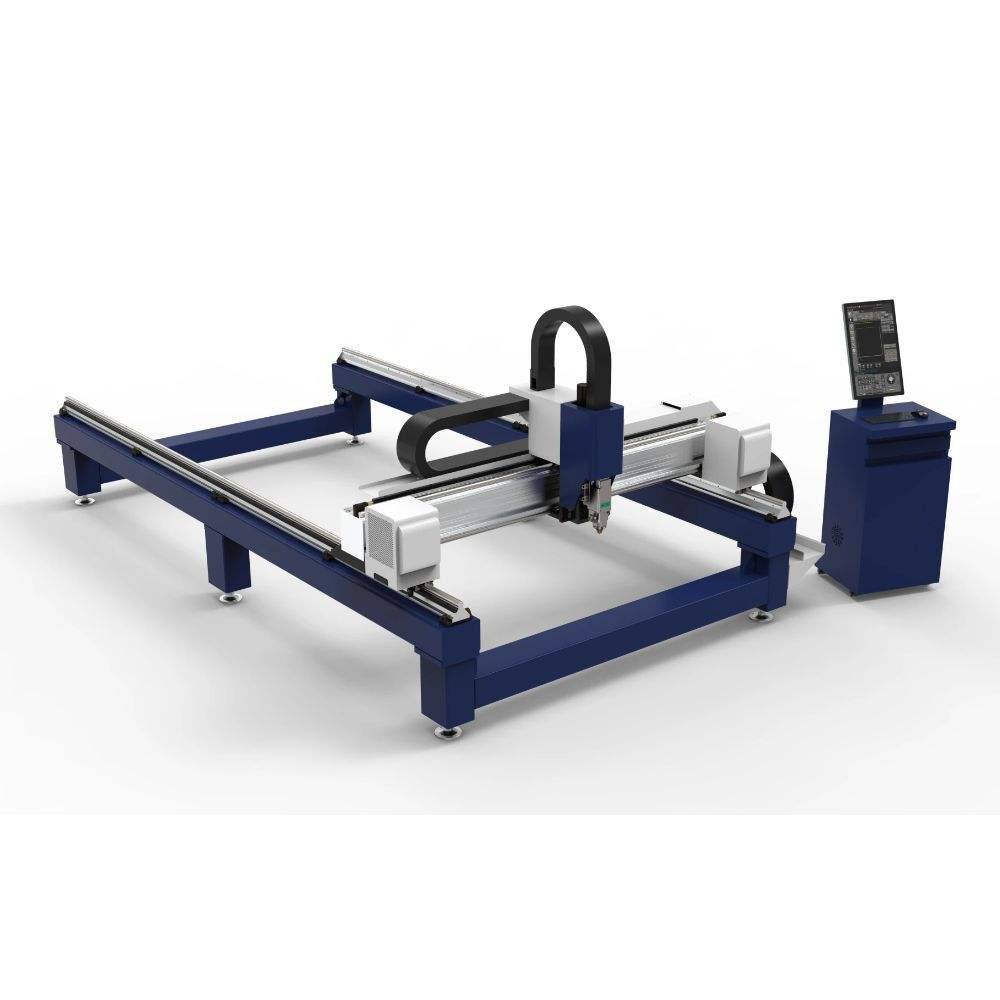
Key technical parameters observed during the field test include:
- Beam Quality (M²): ≤ 1.1, ensuring consistent energy density across varying focal lengths.
- Wavelength: 1.07 µm, facilitating high absorption rates in carbon steel.
- Dynamic Range: The ability to modulate power delivery based on the beam’s position relative to the I-beam’s web-to-flange transition (the fillet), which typically presents the highest challenge for uniform penetration.
3. Implementation of Zero-Waste Nesting (ZWN) Technology
In heavy-duty structural processing, material yield is the primary driver of project overhead. Conventional nesting for I-beams often results in “skeleton waste” or significant end-offcuts (drops) due to the constraints of the clamping chucks and the laser’s safety buffers.
The Zero-Waste Nesting (ZWN) algorithm utilized in this deployment employs a “pull-and-push” feeding logic integrated with a dual-chuck or triple-chuck synchronization system. By utilizing the following mechanisms, the profiler achieves nearly 99% material utilization:
3.1. Common-Line Cutting for Structural Sections
The ZWN software identifies adjacent part geometries and aligns them to share a single cutting path. In the context of stadium raker beams, which require repetitive lengths with specific bolt-hole patterns, common-line cutting reduces the total number of pierces and the total linear distance traveled by the laser head. This not only saves gas (Oxygen or Nitrogen) but also prevents the thermal buildup associated with redundant pierces in close proximity.
3.2. Tail-Material Processing
Standard profilers typically leave a 300mm to 500mm “dead zone” at the end of a beam because the chuck cannot hold the material safely during the final cut. The 6000W profiler in Dammam utilizes a specialized “over-travel” chuck design. This allows the laser head to process the beam beyond the final chuck position, reducing the remnant tail to less than 50mm. For a project requiring thousands of linear meters of I-beams, this represents a multi-ton reduction in scrap steel.
4. Structural Precision in Stadium Applications
Stadium structures in Dammam require exceptionally high tolerances due to the thermal expansion cycles typical of the Eastern Province. The precision of the 6000W laser is critical for two primary areas: Bolted Splices and Weld Preparations.
4.1. Bolt Hole Circularity and Tolerance
Traditional plasma cutting often results in a “taper” effect, where the bottom of the hole is narrower than the top. For friction-grip bolts used in stadium trusses, this is unacceptable. The 6000W laser, through high-speed frequency modulation, maintains a hole tolerance of ±0.1mm. This eliminates the need for secondary reaming or drilling on-site, drastically accelerating the assembly of the primary frame.
4.2. Automated Beveling for Weld Prep
The heavy-duty profiler features a 3D 5-axis cutting head capable of executing V, X, and K-type bevels on I-beam flanges. In stadium construction, where beams meet at non-orthogonal angles to form the stadium’s bowl shape, the ability to laser-cut precise bevels ensures that full-penetration welds can be achieved with minimal filler material and reduced grinding time.
5. Synergy with Automatic Structural Processing
The 6000W profiler is not a standalone unit but an integrated node within the Dammam facility’s BIM (Building Information Modeling) workflow. The synergy between the hardware and the automated logistics is defined by three pillars:
- Automatic Material Detection: The system utilizes 3D probing to detect the actual dimensions of the I-beam (including any mill-induced camber or sweep). The cutting path is then adjusted in real-time to match the actual geometry of the steel, rather than the theoretical CAD model.
- Automated Loading/Unloading: Given the weight of the sections (often exceeding 150 kg/m), hydraulic loading arms are synchronized with the laser’s control unit. This reduces idle time between cycles, allowing for continuous 24-hour operation—essential for meeting tight FIFA or international standard deadlines.
- Integrated Marking: The laser uses a low-power setting to etch assembly instructions, part numbers, and weld symbols directly onto the beam. This eliminates manual layout errors and ensures that the complex “puzzle” of a stadium roof is assembled correctly by the field crews.
6. Environmental and Operational Challenges in Dammam
Field observations indicate that the 6000W system must be supported by a high-capacity, dual-circuit industrial chiller. The ambient 45°C+ temperatures in Dammam can lead to beam instability if the resonator and optics are not maintained at a constant 22°C. Furthermore, the profiler’s housing must be pressurized with filtered air to prevent the ingress of fine silica dust, which can degrade the protective windows of the laser head.
The implementation of Nitrogen-assist gas for thinner web sections has shown to produce a “glaze-free” edge, which is superior for paint adhesion in the corrosive, salty coastal air of the Arabian Gulf. This reduces the risk of premature coating failure on the stadium’s exposed steelwork.
7. Conclusion and Efficiency Analysis
The deployment of the 6000W Heavy-Duty I-Beam Laser Profiler with Zero-Waste Nesting in Dammam provides a quantifiable leap in structural fabrication efficiency. The transition from manual/plasma methods to automated laser profiling has resulted in:
- 25% Reduction in Raw Material Waste: Directly attributable to ZWN algorithms and minimized tail-end remnants.
- 40% Increase in Assembly Speed: Due to the elimination of on-site corrections for bolt-hole misalignment.
- Superior Structural Integrity: Through the reduction of the HAZ and the precision of automated beveling.
For the large-scale stadium projects currently defining the landscape of Dammam, this technology is no longer an optional upgrade but a fundamental requirement for achieving the requisite engineering tolerances and economic viability. Future phases should look toward integrating 12000W sources as flange thicknesses increase, while maintaining the Zero-Waste Nesting protocols established in this report.
















