
The Dawn of High-Power Fiber Lasers in Structural Engineering
As a fiber laser expert, I have witnessed the evolution of photonics from niche laboratory experiments to the backbone of modern heavy industry. The 6000W (6kW) threshold is particularly significant. While lower power levels are sufficient for sheet metal, 6000W serves as the “sweet spot” for structural steel, such as I-beams, H-beams, and U-channels. At this power density, the laser can achieve a perfect balance between cutting speed and edge quality on thicknesses ranging from 10mm to 25mm—the primary gauge for modular frames.
The fiber laser’s 1.06-micron wavelength is absorbed more efficiently by carbon steel compared to the 10.6-micron wavelength of legacy CO2 lasers. This efficiency translates into a narrower heat-affected zone (HAZ), which is critical for maintaining the metallurgical integrity of structural I-beams. In Hamburg’s humid maritime environment, preventing micro-fractures and thermal distortion during the fabrication of modular units is not just a preference; it is a regulatory necessity for long-term structural safety.
Precision Profiling: Beyond Simple Cutting
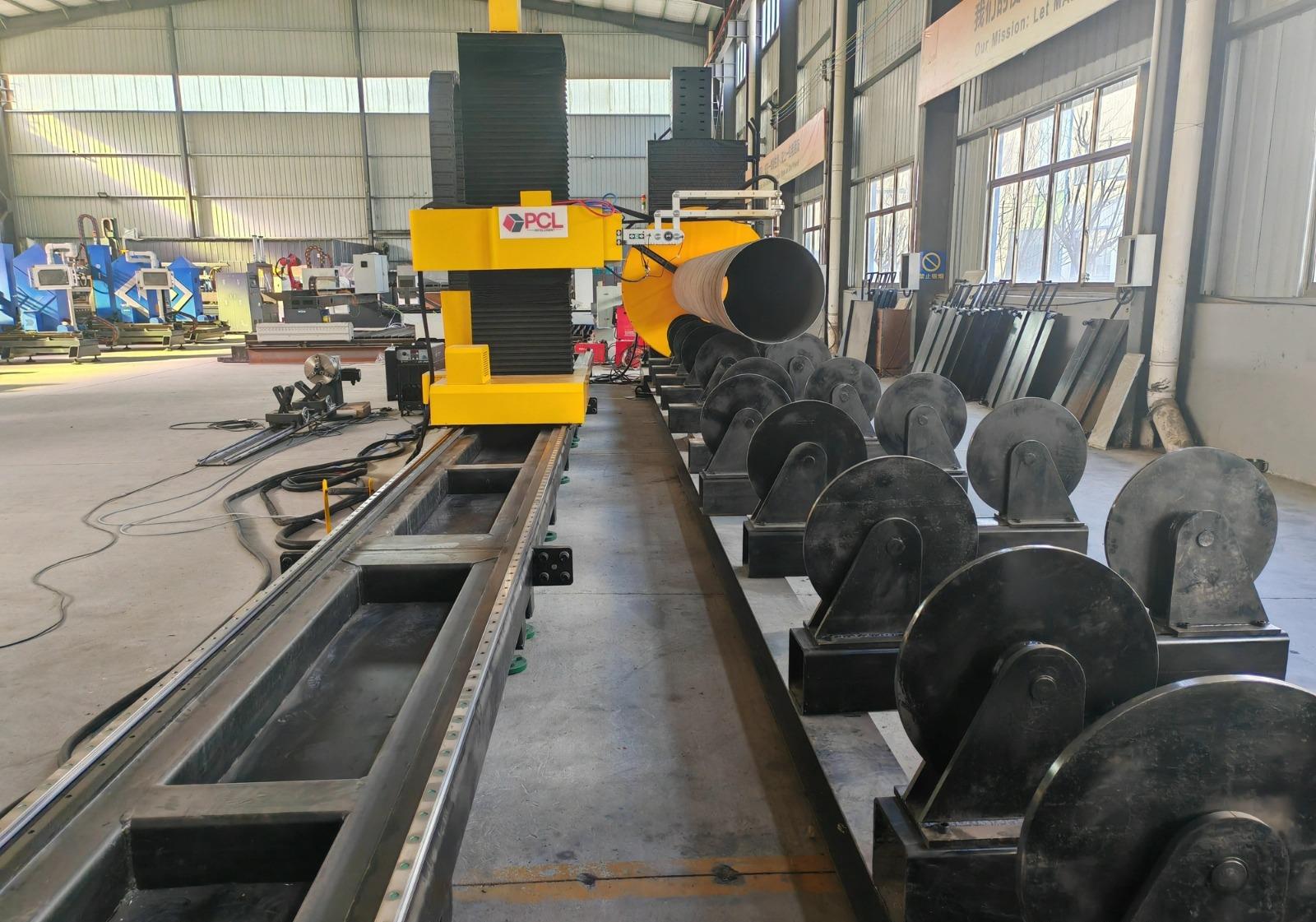
Processing an I-beam is significantly more complex than cutting a flat plate. An I-beam profiler must navigate the web and the flanges, often requiring a 3D cutting head with five or six axes of motion. The 6000W profiler utilizes a specialized “non-contact” sensing head that maintains a constant standoff distance even as it rounds the radius of the beam’s inner corner.
In the context of modular construction, “profiling” includes the cutting of bolt holes, utility pass-throughs, and complex miter joints. Traditional methods—drilling, sawing, and manual torching—are labor-intensive and prone to human error. A laser profiler executes these tasks in a single pass with sub-millimeter accuracy. This precision ensures that when modules are transported from a Hamburg factory to a construction site in the HafenCity district, they align perfectly, reducing the need for on-site welding and adjustments.
The Mechanics of Zero-Waste Nesting
One of the most persistent challenges in beam processing is the “tail-end” scrap. Conventional CNC machines require a minimum length of material for the chucks to grip, often resulting in 400mm to 800mm of wasted steel at the end of every 12-meter beam. In large-scale modular projects, this waste accumulates into tons of lost profit and a significant carbon footprint.
The “Zero-Waste Nesting” technology integrated into these heavy-duty profilers utilizes a multi-chuck system—typically three or four independent synchronized chucks. These chucks can pass the beam to one another like a relay race. As the laser nears the end of the beam, the secondary chucks maintain the grip closer to the cutting head, allowing the laser to process the material up to the very edge. When combined with nesting software that “interlocks” different parts within the beam’s length—such as cutting smaller connection plates from the gaps between larger structural members—the material utilization rate approaches 99%.
Hamburg: A Strategic Hub for Modular Construction
Hamburg is uniquely positioned to benefit from this technology. The city is a nexus of logistics and advanced manufacturing. As European cities move toward denser, more sustainable housing, modular construction (where 80% of a building is completed in a factory) is becoming the standard. The 6000W laser profiler allows Hamburg-based fabricators to produce “smart beams” that are ready for assembly the moment they leave the laser bed.
Furthermore, the “Green Port” initiatives in Hamburg demand that industrial processes reduce energy consumption. Fiber lasers are approximately 3 to 4 times more energy-efficient than CO2 lasers. By adopting 6000W fiber technology, local manufacturers can meet stringent German environmental standards (such as the DIN EN ISO 50001 energy management systems) while simultaneously increasing their throughput.
Overcoming the Challenges of Heavy-Duty Processing
Working with heavy-duty I-beams presents mechanical challenges that sheet metal lasers never face. An I-beam can weigh several tons. The profiler must be equipped with a robust automated loading and unloading system that can handle the inertia of a moving beam without sacrificing the precision of the laser’s focal point.
The 6000W power level requires sophisticated beam delivery. We use high-purity fused silica lenses and advanced cooling systems to prevent “thermal shift,” where the focus of the laser moves as the lens heats up. For a Hamburg fabricator, this means the first cut of the day is just as precise as the last cut of the shift, regardless of the ambient temperature or the thickness of the structural steel.
The Impact on Modular Assembly and Tolerances
In modular construction, the building is essentially a giant 3D puzzle. If the structural I-beam frame of Module A is out of square by even 3mm, Module B (the floor above) will not fit. This “tolerance stack-up” is the primary cause of failure in modular projects.
The 6000W laser profiler eliminates this risk. By using a single source of truth—the CAD/CAM file—the machine cuts the notches, holes, and bevels with a repeatability that manual labor cannot match. Furthermore, the laser can “mark” the beams with assembly instructions, QR codes for BIM (Building Information Modeling) tracking, and alignment lines. This transforms a simple piece of steel into a high-tech component that guides the assembly team through the manufacturing process.
Economic Feasibility and ROI
While the initial capital expenditure for a 6000W heavy-duty laser profiler is significant, the Return on Investment (ROI) is driven by three factors: speed, labor reduction, and material savings. In the Hamburg market, where skilled labor is expensive and in high demand, the ability of one laser operator to do the work of a five-person sawing and drilling team is revolutionary.
The “Zero-Waste” aspect adds a direct line to the bottom line. If a facility processes 5,000 tons of steel per year, a 5% reduction in waste via intelligent nesting saves 250 tons of steel. At current market prices, the machine effectively pays for its own laser source through material savings alone within the first few years of operation.
Future Outlook: Intelligence and Automation
Looking forward, the integration of Artificial Intelligence with 6000W profilers will further enhance the modular construction industry in Germany. We are already seeing “self-correcting” laser heads that use vision systems to scan the cross-section of an incoming I-beam. If the beam has a slight manufacturing warp (as many hot-rolled sections do), the AI adjusts the cutting path in real-time to ensure the holes and cuts are perfectly centered.
For Hamburg, this technology represents a bridge between its storied maritime past and its high-tech future. The same 6000W laser technology used to build modular apartment complexes can be adapted for ship-building components and offshore wind turbine foundations, making it a versatile asset in the city’s industrial arsenal.
Conclusion
The 6000W Heavy-Duty I-Beam Laser Profiler is more than just a cutting machine; it is a catalyst for a more efficient, sustainable, and precise construction methodology. By solving the age-old problem of material waste and the modern challenge of modular precision, this technology ensures that Hamburg remains at the forefront of the global construction revolution. As we continue to push the boundaries of what fiber lasers can achieve, the synergy between high-power photonics and structural engineering will only grow stronger, building a faster and greener world, one beam at a time.
















