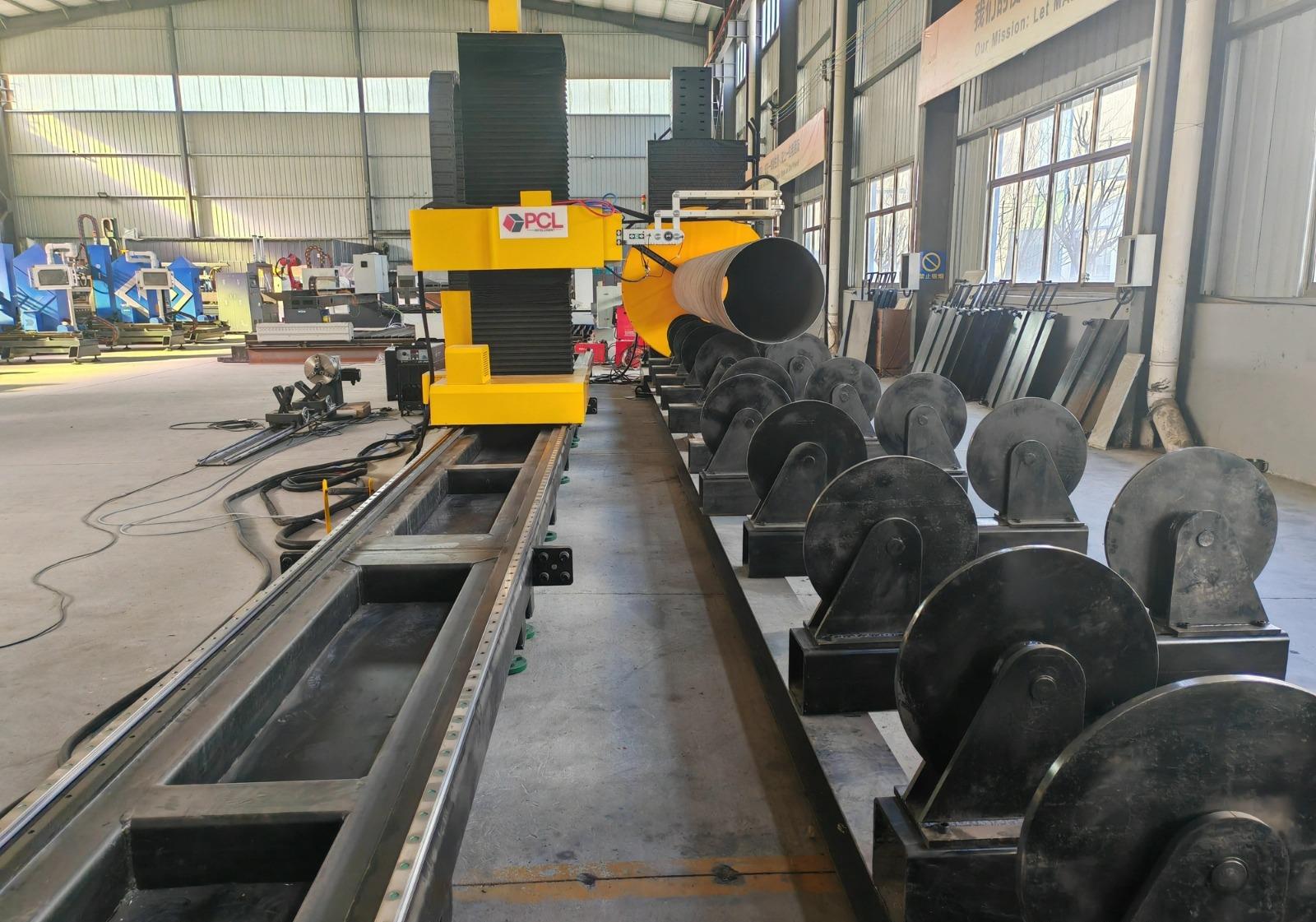
The Dawn of High-Power Laser Profiling in Dammam’s Industrial Hub
Dammam has long been the heartbeat of the Kingdom’s industrial sector, serving as a critical hub for oil, gas, and heavy manufacturing. As the demand for overhead cranes, gantry cranes, and specialized lifting equipment surges to support new construction and logistics projects, the limitations of traditional fabrication have become apparent. Conventional methods of processing large-scale structural members—such as mechanical sawing and manual layout—are too slow and prone to human error.
The introduction of the 6000W Heavy-Duty I-Beam Laser Profiler marks a paradigm shift. Unlike flat-bed lasers, this machine is engineered to handle the three-dimensional complexity of structural steel. A 6000W fiber laser source provides the optimal balance of power and precision, capable of slicing through thick-walled carbon steel with a speed and edge quality that requires no secondary finishing. In a city where time is money and quality is non-negotiable, this technology is becoming the cornerstone of the modern fabrication shop.
Technical Mastery: Why 6000W is the Industry Sweet Spot
In the realm of structural steel, thickness is the primary challenge. For crane girders and end carriages, the material often ranges from 12mm to over 25mm. A 6000W fiber laser is the “sweet spot” for several reasons. Firstly, it provides enough energy density to maintain a high feed rate on heavy sections, which minimizes the Heat Affected Zone (HAZ). A smaller HAZ is critical in crane manufacturing because it ensures that the structural integrity and metallurgical properties of the I-beam are preserved, preventing brittleness in load-bearing components.
Furthermore, the 6000W output allows for the use of compressed air or nitrogen cutting on medium thicknesses, reducing gas costs while delivering a weld-ready surface. When cutting I-beams, the laser must often travel through varying thicknesses and angles; the 6000W power reserve ensures that the beam maintains a clean “kerf” even when the geometry becomes complex, such as when cutting web-to-flange transitions.
Zero-Waste Nesting: The Economics of Efficiency
Perhaps the most significant advancement for Dammam’s crane manufacturers is the “Zero-Waste” or “Zero-Tailing” technology. In traditional beam processing, a significant portion of the material (often 500mm to 1000mm at the end of a beam) is lost because the machine’s chucks cannot hold the material close enough to the cutting head.
The Heavy-Duty I-Beam Profiler solves this through a multi-chuck system—typically involving three or four independent pneumatic chucks. These chucks work in a “leapfrog” fashion, handing off the beam to one another. This allows the laser to cut right up to the very edge of the material. When combined with AI-driven nesting software, the machine can intelligently sequence parts of different lengths and configurations from a single stock beam. For a large-scale crane project involving hundreds of tons of steel, reducing waste from 5% to near 0% translates into millions of Riyals in annual savings.
Precision Engineering for Crane Girders and Components
Cranes are complex assemblies where safety is paramount. Every bolt hole, every slot, and every bevel must be perfectly aligned to ensure the structural stability of the crane bridge and trolley. The 6000W I-Beam Profiler utilizes a 5-axis or 3D cutting head that can tilt and rotate, allowing for complex bevel cuts (V, X, or Y shapes).
This is a game-changer for weld preparation. In the past, workers in Dammam workshops would spend hours grinding edges to create the necessary bevels for deep-penetration welds. The laser profiler does this automatically during the cutting process. The precision of the laser—often within ±0.1mm—ensures that when the components are moved to the assembly floor, they fit together perfectly, reducing “re-work” and ensuring that the final crane structure meets stringent international safety standards (such as CMAA or FEM).
The Heavy-Duty Advantage: Built for the Rigors of the Eastern Province
The environmental conditions in Dammam—characterized by high humidity, extreme heat, and fine dust—require a machine that is built like a fortress. A “Heavy-Duty” profiler features a reinforced, heat-treated bed designed to support beams weighing several tons without deforming.
The motion system typically uses high-precision racks and pinions paired with Japanese or European servo motors to handle the massive inertia of moving heavy I-beams at high speeds. Furthermore, these machines are equipped with specialized filtration and cooling systems. The 6000W laser source is housed in a climate-controlled cabinet, and the water chillers are oversized to handle the ambient Saudi temperatures, ensuring that the machine can run 24/7 without thermal shutdown.
Streamlining the Workflow: From CAD to Finished Beam
The software integration of the 6000W I-Beam Profiler is what truly empowers the crane manufacturer. Most modern units are compatible with TEKLA or AutoCAD, common tools in structural engineering. The software automatically identifies the beam profile, calculates the optimal nesting path, and generates the G-code.
In a Dammam-based facility, this means a project can move from the engineering office to the factory floor in minutes. The machine can perform multiple operations in a single pass: it can cut the beam to length, “cope” the ends for interlocking joints, drill bolt holes for the end carriages, and mark part numbers for easy assembly. This multi-tasking capability replaces up to four separate traditional machines, drastically reducing the factory footprint and labor costs.
The Impact on Local Talent and the Economy
As Dammam continues to evolve into a global manufacturing powerhouse, the adoption of such high-tech machinery is fostering a new generation of skilled Saudi technicians. Operating a 6000W laser profiler requires a blend of traditional structural knowledge and modern digital fluency.
By investing in these heavy-duty systems, local crane manufacturers are not only becoming more competitive against international imports but are also contributing to the localization of technology. The ability to produce high-capacity cranes (up to 500 tons or more) locally in the Eastern Province, with the precision of fiber laser technology, strengthens the domestic supply chain and supports the massive industrial expansion in Jubail and Ras Al-Khair.
Maintenance and Longevity in a Desert Climate
Expertise in fiber lasers teaches us that the longevity of a 6000W system depends on the “purity” of its environment. In Dammam, the challenge is sand and salt air. The heavy-duty profilers used in this region feature fully enclosed bellows and pressurized optical paths to prevent dust from contaminating the lenses or the laser source.
A robust preventative maintenance schedule, focused on the laser’s optics and the mechanical alignment of the heavy-duty chucks, ensures that the machine remains an asset for 10 to 15 years. For the crane manufacturer, this long-term reliability is crucial for calculating the Return on Investment (ROI), which, given the productivity gains and waste reduction, is often achieved within the first 18 to 24 months of operation.
Conclusion: The Future of Lifting is Laser-Cut
The 6000W Heavy-Duty I-Beam Laser Profiler is more than just a cutting machine; it is a catalyst for industrial excellence. For crane manufacturers in Dammam, it offers a path to unmatched precision, drastic waste reduction, and the ability to meet the aggressive timelines of Saudi Arabia’s developmental goals. By embracing Zero-Waste nesting and high-power fiber laser technology, the region’s heavy industry is proving that it can compete on a global stage, building the cranes that will, quite literally, lift the future of the Kingdom.