The Strategic Importance of Rosario in Global Infrastructure
Rosario has long been the heartbeat of Argentina’s industrial and metallurgical prowess. Situated along the Paraná River, it serves as a critical nexus for logistics and heavy manufacturing. As the global demand for renewable energy and modernized power grids surges, the fabrication of high-voltage transmission towers—commonly known as power towers—has become a high-stakes industry. These structures must withstand extreme environmental stresses, requiring precision-engineered I-beams, channels, and angles.
The introduction of the 6000W Heavy-Duty I-Beam Laser Profiler into this region is not merely an incremental upgrade; it is a paradigm shift. Traditional methods of power tower fabrication involved a fragmented workflow: mechanical sawing, followed by CNC drilling, and finally manual beveling for weld preparation. By deploying a 6kW fiber laser, Rosario’s manufacturers can now condense these steps into a single automated cycle, drastically reducing lead times and enhancing the structural integrity of the final towers.
Decoding the 6000W Fiber Laser Engine
As an expert in fiber laser technology, I often emphasize that the “6000W” designation is more than just a power rating—it is the “sweet spot” for structural steel. While 10kW or 20kW lasers exist, the 6kW oscillator offers the most efficient balance of capital investment and operational cost for the thicknesses typically found in I-beams (ranging from 10mm to 25mm).
The 6000W fiber source delivers a high-brightness beam with a wavelength of approximately 1.06 microns. This allows for superior absorption in carbon steel compared to older CO2 technology. At this power level, the laser can achieve “high-speed fusion cutting,” which results in a heat-affected zone (HAZ) so minimal that it preserves the metallurgical properties of the high-tensile steel used in power towers. This is critical because power towers are subject to cyclic loading and wind-induced fatigue; any micro-cracking caused by inferior cutting methods could lead to catastrophic structural failure.
The Infinite Rotation 3D Head: A Kinematic Masterpiece
The defining feature of this profiler is the Infinite Rotation 3D Head. In traditional 2D laser cutting, the head remains perpendicular to the material. However, I-beams are complex three-dimensional objects. To prepare them for the heavy-duty welding required in power tower nodes, the edges must be beveled (angled).
The “Infinite Rotation” capability refers to the A and C axes of the cutting head. Unlike standard 3D heads that have “limit switches” (requiring the head to “unwind” after a certain degree of rotation), an infinite rotation head can spin continuously. This allows for:
1. **Complex Beveling (A, V, X, K joints):** Creating the perfect groove for deep-penetration welding in a single pass.
2. **Countersinking and Bolt Hole Precision:** Power towers are bolted together in the field. The 3D head can cut perfectly perpendicular holes even on the slanted inner flanges of an I-beam, ensuring that bolts align perfectly during assembly in remote locations.
3. **Contour Following:** Structural beams are rarely perfectly straight. The 3D head uses advanced capacitive sensors to maintain a constant standoff distance from the uneven surface of the heavy-duty steel, preventing collisions and ensuring uniform cut quality.
Overcoming Challenges in Heavy-Duty I-Beam Processing
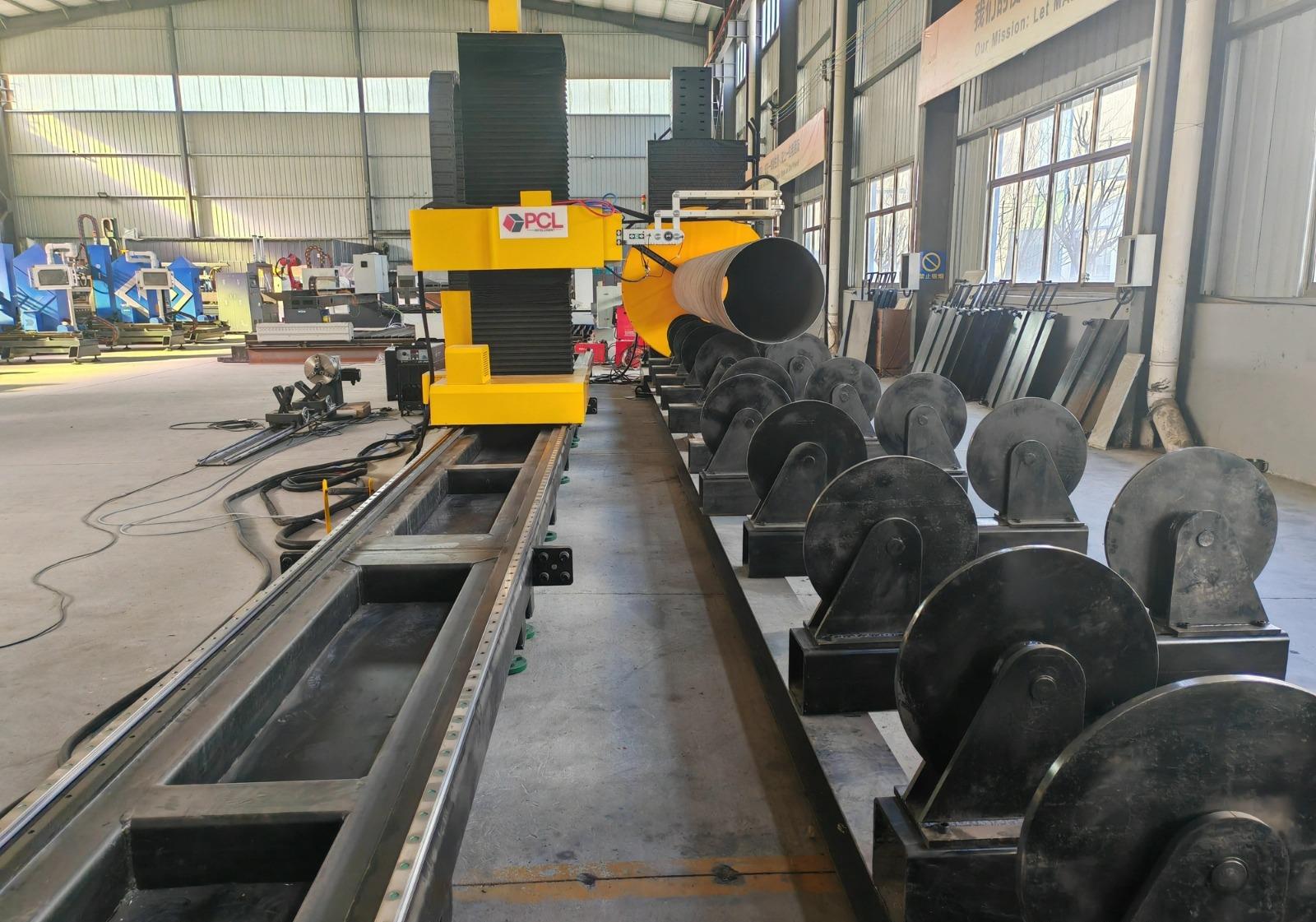
Processing an I-beam that may weigh several tons and span 12 meters requires more than just a powerful laser; it requires a robust mechanical ecosystem. The “Heavy-Duty” aspect of this profiler refers to the specialized “chuck” and “bed” system.
In Rosario’s fabrication shops, the machine utilizes a triple-chuck or quadruple-chuck system. These massive pneumatic or hydraulic grippers rotate the entire I-beam with synchronized precision. When the 3D head is cutting a web or a flange, the chucks must ensure zero slippage. Furthermore, the “zero-tailing” technology integrated into these heavy-duty systems ensures that material waste is minimized. In the context of large-scale power tower projects, where steel costs represent the majority of the budget, a 5% to 10% reduction in scrap can equate to hundreds of thousands of dollars in savings.
Precision Requirements for Power Tower Fabrication
Power towers are the backbone of the electrical grid. They must support massive cable weights and resist the “galloping” effect of high winds. The fabrication requirements are governed by strict international standards (such as ASTM or ISO equivalents).
The 6000W Laser Profiler meets these standards by providing:
* **Dimensional Accuracy:** Laser cutting offers tolerances within ±0.1mm, far exceeding the ±1.0mm or ±2.0mm typical of plasma cutting or manual drilling.
* **Clean Bolt Holes:** Mechanical drilling often creates burrs that must be removed. Laser-cut holes are clean and ready for immediate galvanization, a critical step for preventing rust in Rosario’s humid river-basin climate.
* **Structural Integrity:** Because the laser is a non-contact process, there is no mechanical stress applied to the beam during cutting, preventing the internal “spring-back” or warping that can occur with high-pressure mechanical punches.
The Role of Software and Industry 4.0
In the modern Rosario factory, the 6000W Laser Profiler does not operate in a vacuum. It is the physical manifestation of a digital workflow. Engineers use BIM (Building Information Modeling) and CAD/CAM software to design the towers. These designs are imported directly into the laser’s controller.
The software automatically nests the parts on the I-beam to minimize waste and calculates the complex kinematics of the 3D head. It also manages the “Common Line Cutting” (where one cut serves as the edge for two parts) and the “Lead-in/Lead-out” strategies to ensure that the entry point of the laser does not create a weak spot in the steel. This level of automation allows a single operator to oversee the production of components that would have previously required a team of ten.
Environmental and Economic Impact in the Santa Fe Region
The shift to 6000W fiber laser technology also aligns with global sustainability goals—a topic of increasing importance in Argentinian industry. Fiber lasers are remarkably energy-efficient, converting roughly 35-40% of electrical input into laser light, compared to the 10% efficiency of CO2 lasers.
Economically, the “Rosario Power Tower Project” (as many local initiatives are called) benefits from the “First-Time-Right” capability of the laser. In the past, if a hole was misaligned on a 15-meter I-beam, the entire piece might be scrapped or require expensive manual rework. The precision of the 3D head virtually eliminates these errors. Furthermore, the speed of the 6000W laser—cutting through 15mm steel at speeds exceeding 2 meters per minute—allows Rosario-based firms to bid on international contracts with aggressive timelines, positioning Argentina as a key exporter of infrastructure components to neighboring Brazil, Chile, and Uruguay.
Conclusion: The Future of Metal Fabrication
The 6000W Heavy-Duty I-Beam Laser Profiler with Infinite Rotation 3D Head is more than a piece of machinery; it is an industrial catalyst. For the fabricators of Rosario, it represents the bridge between traditional metalworking and the future of automated, precision-led manufacturing.
By mastering the complexities of the infinite rotation head and harnessing the raw power of the 6kW fiber engine, power tower manufacturers can ensure that the structures they build today will stand for the next century. As an expert in this field, I see this technology as the definitive solution for any region looking to modernize its infrastructure while maximizing its industrial output. The towers rising across the landscape of South America will soon bear the invisible mark of laser precision—a testament to the technological evolution occurring in the heart of Rosario.