The Evolution of Structural Fabrication in Edmonton’s Energy Corridor
Edmonton has long been the heartbeat of Canada’s industrial fabrication, serving as the gateway to the north and the primary manufacturing hub for the nation’s energy infrastructure. As the province pivots toward grid modernization and the expansion of renewable energy transmission, the demand for power towers—massive, complex structural assemblies—has skyrocketed. Traditional methods of fabricating these towers, involving manual layout, mechanical drilling, and conventional plasma cutting, are no longer sufficient to meet the tightening tolerances and aggressive timelines of modern projects.
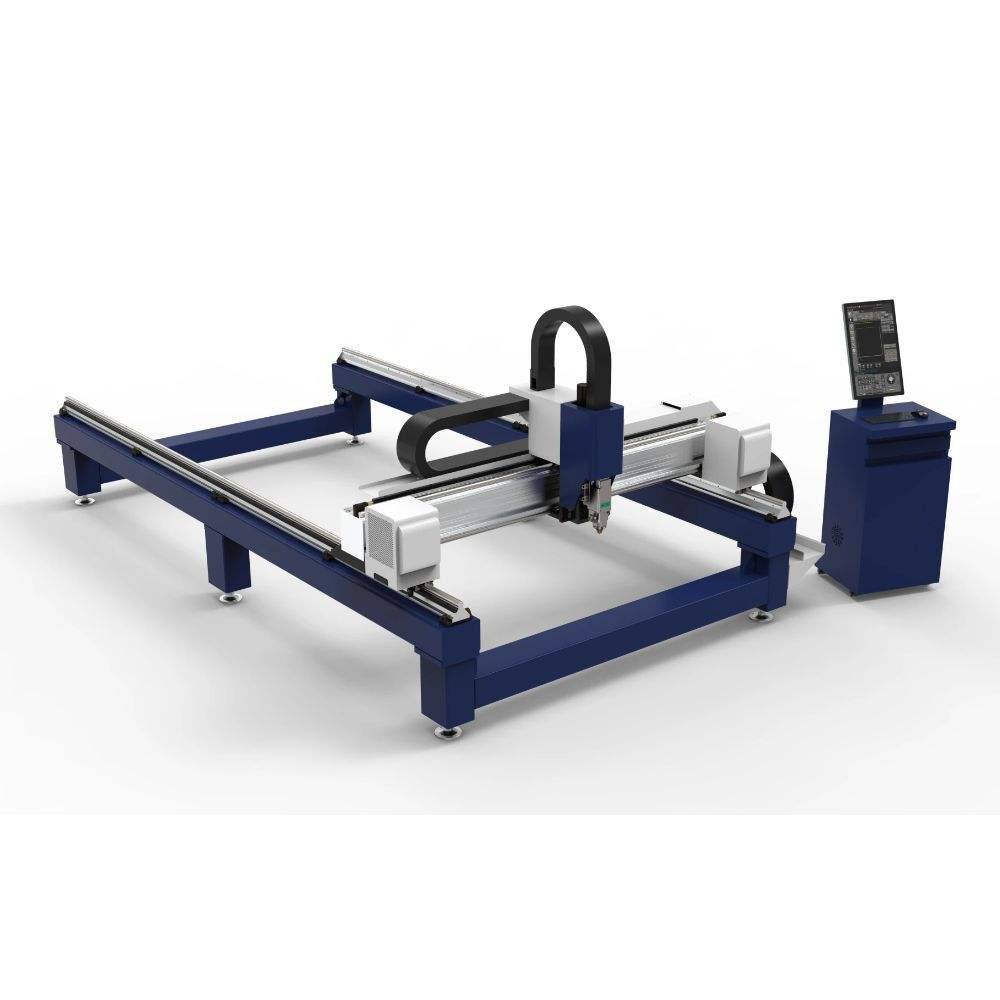
Enter the 6000W Heavy-Duty I-Beam Laser Profiler. As a fiber laser expert, I have witnessed the transition from CO2 to fiber, but the leap to dedicated structural profiling is the most significant advancement in decades. This machine is not merely a flat-bed laser adapted for beams; it is a ground-up solution designed to handle the torsional stresses and dimensional irregularities of heavy I-beams, H-beams, and channels.
The Power of 6000W: Why Fiber is King for Structural Steel
In the realm of structural steel, thickness is the primary challenge. A 6000W fiber laser source provides the optimal “sweet spot” for power tower components. While higher wattages exist, 6kW offers the most stable beam quality for the thick-walled sections typically found in transmission towers (ranging from 10mm to 25mm in many structural joints).
Fiber laser technology operates at a wavelength of approximately 1.07 microns, which is absorbed more readily by steel compared to the 10.6 microns of a CO2 laser. This leads to faster cutting speeds and a significantly smaller Heat Affected Zone (HAZ). For power towers, which must withstand extreme wind loads and ice accumulation in the harsh Alberta climate, maintaining the metallurgical integrity of the steel is non-negotiable. The 6000W source ensures that the edges are clean, dross-free, and ready for galvanization or welding without secondary grinding.
Infinite Rotation 3D Head: The “Secret Sauce” of Complexity
The defining feature of this profiler is the Infinite Rotation 3D Head. Traditional 3D laser heads are often limited by “cable wind-up,” meaning the head must periodically spin back in the opposite direction to prevent internal fibers and gas lines from tangling. In a high-volume production environment like an Edmonton shop, these seconds of “unwinding” time accumulate into hours of lost productivity.
An infinite rotation head utilizes advanced slip-ring technology and specialized fiber optics to allow the cutting torch to rotate 360 degrees indefinitely. This is crucial for:
1. **Complex Beveling:** Power towers require intricate weld preparations. The 3D head can perform V-cuts, X-cuts, and Y-cuts for seamless welding.
2. **Miter Cutting:** Creating the angled intersections of bracing members in a tower requires the laser to navigate the “flange-to-web” transition smoothly.
3. **Bolt Hole Precision:** Unlike plasma, which often produces a “tapered” hole (wider at the top than the bottom), the 5-axis 3D laser head can compensate for the beam angle to produce perfectly cylindrical holes, ensuring that high-strength bolts fit perfectly every time.
Heavy-Duty Engineering for Massive Profiles
An I-beam profiler is only as good as its motion system. In Edmonton’s heavy industrial shops, the material being processed is often 12 meters (40 feet) long or more. The “Heavy-Duty” designation refers to the machine’s bed and chuck system.
The profiler utilizes a series of high-torque pneumatic or hydraulic chucks that synchronize to move the beam through the cutting zone with sub-millimeter accuracy. Because I-beams are rarely perfectly straight (they often have slight “camber” or “sweep” from the mill), the laser system employs sophisticated touch-sensing or vision-mapping software. The 3D head “scans” the actual dimensions of the beam before cutting, adjusting the toolpath in real-time to ensure that holes and notches are placed relative to the actual geometry of the steel, not just a theoretical CAD model.
Streamlining Power Tower Fabrication
The fabrication of a transmission tower involves hundreds of unique parts. Historically, a beam would move from a saw to a drill line, then to a manual station for coping and layout, and finally to a welding station.
With the 6000W I-Beam Profiler, these processes are consolidated into a single “All-in-One” station. The laser performs the:
* **Cutting to length:** Replacing the band saw.
* **Hole processing:** Replacing the drill line (and doing it 10x faster).
* **Coping and Notching:** Allowing for complex “birdsmouth” joins where different beams intersect.
* **Part Marking:** The laser can etch part numbers, heat numbers, and assembly marks directly onto the steel, eliminating the need for manual stamping or tagging.
For an Edmonton-based fabricator, this consolidation reduces the footprint required in the shop and significantly lowers the “cost per part” by reducing material handling—the most expensive part of structural fabrication.
The Alberta Context: Cold Weather and Energy Reliability
Operating a high-power laser in Edmonton requires specific considerations. Our seasonal temperature swings can affect the stability of the laser resonator and the gas pressure. These heavy-duty profilers are equipped with industrial-grade chillers and climate-controlled cabinets for the electronics.
Furthermore, the power grid in Alberta is undergoing a massive transformation. With the push toward net-zero and the interconnection of remote wind and solar farms, the province requires thousands of kilometers of new transmission lines. Local fabricators equipped with 6000W 3D profilers have a competitive edge in bidding for these provincial infrastructure projects. They can produce towers that are not only cheaper and faster but also structurally superior due to the precision of laser-cut joints.
Software Integration: From Tekla to Torch
In the world of structural engineering, *Tekla Structures* is the gold standard for 3D modeling. The modern 6000W I-Beam Profiler integrates directly with this software. A project manager in an Edmonton office can export a DSTV or STEP file directly to the machine’s CNC controller.
The nesting software then optimizes the cuts on a 40-foot beam to minimize scrap. In an era of fluctuating steel prices, the ability to save even 3% in material waste can result in tens of thousands of dollars in annual savings. The expert-level control systems also manage “Lead-in” and “Lead-out” strategies, ensuring that the piercing of the steel doesn’t leave a “crater” that could serve as a stress-riser in the structural member.
Conclusion: The Future of the Edmonton Fabrication Shop
The 6000W Heavy-Duty I-Beam Laser Profiler with Infinite Rotation 3D Head is more than a machine; it is a strategic asset. For Edmonton companies involved in power tower fabrication, it represents the transition from traditional “blacksmithing” to high-tech manufacturing.
As a fiber laser expert, my advice to fabricators is clear: the precision of the laser and the versatility of the infinite rotation head are the new requirements for entry into the high-tier energy sector. By eliminating secondary processes, ensuring perfect bolt-hole geometry, and providing the flexibility to handle any structural shape, this technology is the cornerstone of the next generation of Alberta’s industrial strength. The towers of tomorrow will be built by the lasers of today.