The Industrial Evolution of Charlotte’s Bridge Infrastructure
Charlotte has long been recognized as a logistical and manufacturing powerhouse in the Southeast. With the expansion of regional transit systems and the continuous upgrading of North Carolina’s highway corridors, the demand for high-integrity structural steel has never been higher. In bridge engineering, the stakes are elevated; every cut, hole, and bevel must adhere to stringent safety protocols.
The introduction of the 6000W Heavy-Duty I-Beam Laser Profiler into the Charlotte market addresses a specific bottleneck: the slow, multi-stage processing of massive structural members. Traditionally, I-beams and H-columns required separate stations for cutting to length, drilling bolt holes, and manual grinding for weld preparations. The fiber laser profiler changes this dynamic by bringing all these capabilities into a single, high-speed CNC environment.
The Power of 6000W Fiber Laser Technology
In the realm of fiber lasers, the 6000W power rating is often considered the “sweet spot” for structural steel fabrication. While lower power units (1kW–3kW) are excellent for sheet metal, bridge engineering requires the ability to slice through thick flanges and webs of heavy-duty I-beams.
A 6000W source provides enough energy density to maintain a stable “keyhole” during the cutting process, even in carbon steels exceeding 25mm in thickness. The advantage of fiber over traditional CO2 lasers is the wavelength—approximately 1.06 microns—which is more readily absorbed by steel. This leads to faster cutting speeds and a significantly smaller Heat Affected Zone (HAZ). For bridge components, minimizing the HAZ is critical to preventing the micro-cracking and material embrittlement that can lead to premature fatigue failure in high-stress environments.
The Engineering Marvel of the Infinite Rotation 3D Head
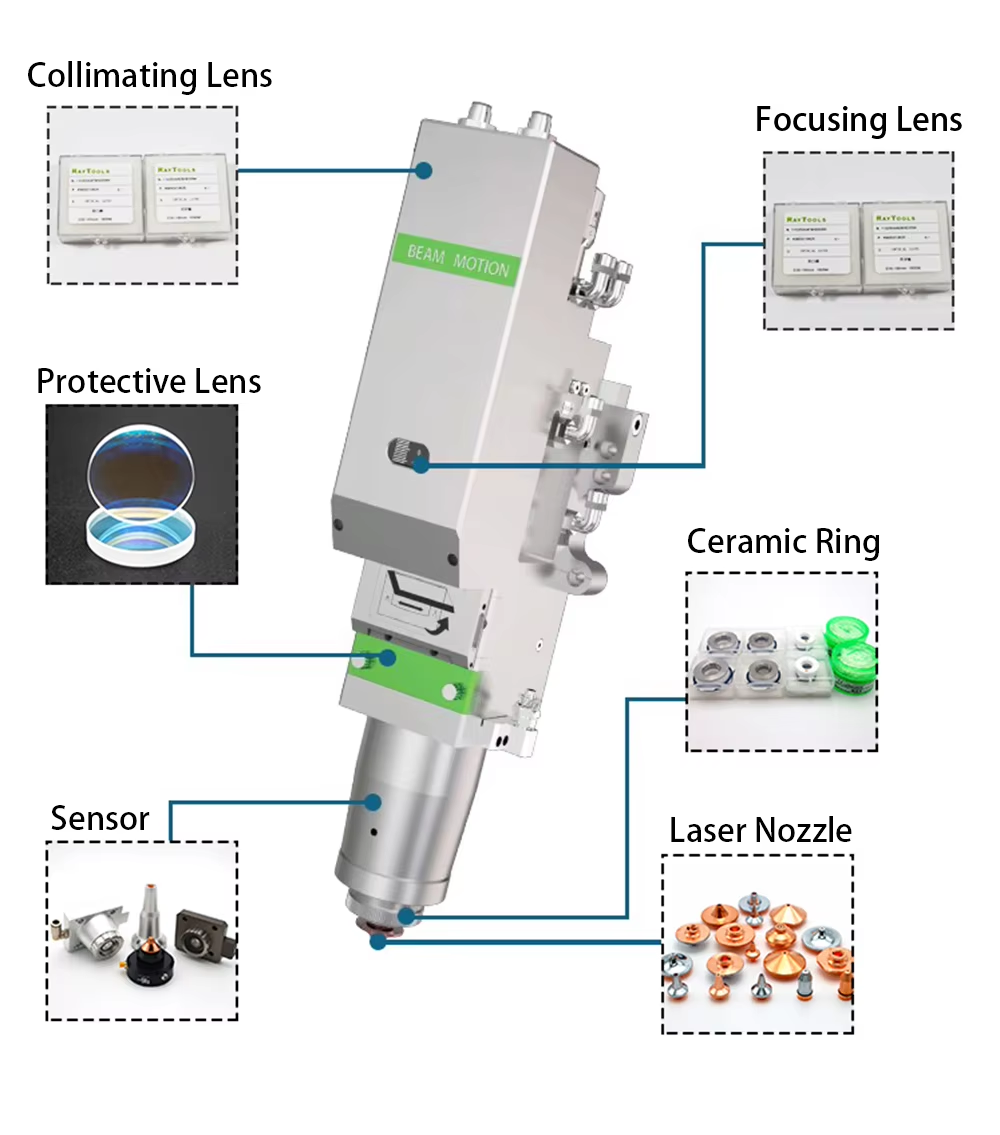
Perhaps the most transformative component of this system is the 3D cutting head with infinite rotation capabilities. In standard 3-axis or even 5-axis systems, the movement of the cutting head is often limited by cables and hoses, requiring the head to “unwind” after a certain degree of rotation.
“Infinite rotation” technology utilizes specialized rotary joints and slip-ring assemblies for gas and power delivery, allowing the head to spin continuously. In the context of I-beam profiling, this is revolutionary. It allows the laser to transition seamlessly from a vertical cut on the web to a complex bevel on the flange without stopping.
For bridge engineering, this means the laser can perform “K-cuts,” “V-cuts,” and “X-cuts” for weld preparation in a single pass. The precision of the 3D head ensures that the bevel angle is consistent across the entire length of the beam, which is nearly impossible to achieve with manual torches. This level of accuracy ensures a perfect fit-up during field assembly, reducing the amount of on-site welding and grinding required at Charlotte construction sites.
Optimizing I-Beam Profiling for Structural Integrity
Bridge engineering relies heavily on the I-beam’s ability to distribute load. Any deviation in the geometry of the beam can compromise the structural calculations. The heavy-duty profiler is designed with a reinforced bed and sophisticated clamping systems that handle the immense weight of bridge-grade steel—often beams that are 12 meters or longer.
The profiler’s software integrates directly with BIM (Building Information Modeling) and CAD/CAM platforms. In Charlotte, where complex bridge geometries are becoming more common, the ability to import a 3D model and have the laser automatically calculate the optimal cutting path is invaluable. The laser can execute intricate coping cuts where one beam meets another at an oblique angle, ensuring that the load path remains continuous and the joint is as strong as the base metal.
Enhancing Bolt Hole Quality and Fatigue Resistance
One of the most labor-intensive aspects of bridge fabrication is the creation of bolt holes. Traditional mechanical drilling is slow and requires constant tool replacement. Plasma cutting, while faster, often leaves a tapered hole with a hardened edge that is unsuitable for high-strength friction-grip bolts.
The 6000W laser, controlled by a high-precision CNC, produces holes with near-zero taper and exceptional surface finish. Because the laser process is non-contact, there is no mechanical stress applied to the beam during the cut. This preserves the material’s grain structure around the hole, which is a vital factor in the fatigue life of the bridge. When Charlotte engineers specify laser-cut holes, they are opting for a component that is less likely to develop stress-concentration cracks over its 75-year lifespan.
Economic Impact on the Charlotte Fabrication Sector
The adoption of this technology in Charlotte is not merely a technical upgrade; it is an economic necessity. The regional competition for infrastructure contracts is fierce. A 6000W laser profiler can replace up to three traditional machines and significantly reduce the headcount required for secondary operations.
By utilizing nesting software specifically designed for structural shapes, fabricators can minimize “drops” (scrap metal). Given the rising cost of steel, the ability to squeeze an extra bracket or gusset plate out of the end of a beam can save tens of thousands of dollars over the course of a large-scale project like a highway overpass or a rail bridge. Furthermore, the speed of the 6000W laser allows Charlotte firms to bid on larger projects with tighter deadlines, knowing they have the throughput capacity to meet demand.
Environmental and Safety Advantages
Bridge engineering is also moving toward greener construction methods. Fiber lasers are significantly more energy-efficient than CO2 lasers or plasma systems. They require no expensive laser gases and have a high wall-plug efficiency.
From a safety perspective, the automated nature of the I-beam profiler removes workers from the immediate vicinity of heavy lifting and thermal cutting. Modern systems in Charlotte are equipped with fully enclosed cabins or advanced light-curtain sensors, ensuring that the high-power 6000W beam is contained. This reduces the risk of workplace injuries and helps local firms maintain high safety ratings, which are often a prerequisite for government-funded bridge projects.
Future Outlook: Laser Technology in North Carolina Infrastructure
As we look toward the future of bridge engineering in Charlotte, the role of the 6000W laser profiler will only expand. We are seeing the beginning of “smart” fabrication, where sensors on the laser head can detect variations in the steel’s thickness or composition and adjust the cutting parameters in real-time.
The infinite rotation 3D head is also paving the way for more creative bridge designs. Architects and engineers are no longer limited by what can be manually fabricated. We are seeing more curvilinear structures and complex trusses that were previously too expensive to produce. In Charlotte, the result will be more iconic, durable, and cost-effective infrastructure that can handle the growing pains of a booming metropolitan area.
Conclusion
The 6000W Heavy-Duty I-Beam Laser Profiler with Infinite Rotation 3D Head represents the pinnacle of modern structural fabrication. For Charlotte’s bridge engineering community, it offers a pathway to higher quality, lower costs, and enhanced safety. By mastering the intersection of high-power fiber optics and multi-axis robotics, local fabricators are not just building bridges—they are building the future of the Queen City with surgical precision and industrial strength.