
1.0 Executive Summary: The Structural Shift in Rayong’s Mining Sector
This technical field report examines the deployment of 6000W Heavy-Duty I-Beam Laser Profiling systems within the industrial corridor of Rayong, Thailand. As a regional hub for mining machinery fabrication—specifically for heavy-duty conveyors, crushing plants, and excavation rigs—Rayong’s manufacturing standards have shifted toward high-precision, high-throughput requirements. The transition from traditional plasma cutting and mechanical drilling to fiber laser profiling represents a critical evolution in structural engineering.
The integration of 6000W fiber laser sources, coupled with advanced 4-chuck kinematics and automated unloading subsystems, addresses the foundational bottlenecks of heavy steel processing: dimensional variance in raw materials, thermal deformation during cutting, and the logistical hazards of handling multi-ton structural profiles.
2.0 Technical Specifications of the 6000W Fiber Oscillator Synergy
The selection of a 6000W power rating is not arbitrary; it represents the optimized “power-to-thickness” ratio for the structural grades common in mining (ASTM A36, A572). At 6000W, the laser beam maintains a high power density, allowing for a concentrated Heat Affected Zone (HAZ), which is vital for maintaining the metallurgical integrity of the I-beam’s web and flange transitions.
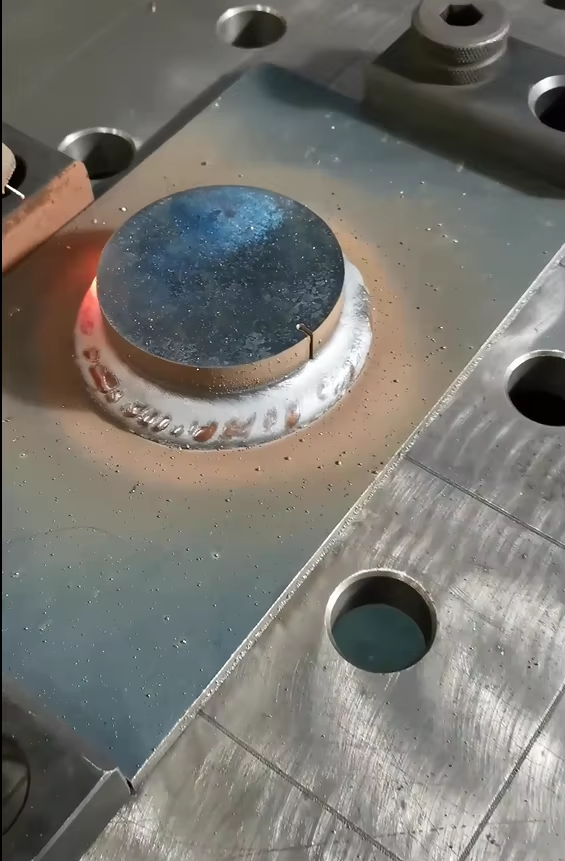
2.1 Beam Dynamics and Kerf Management
In heavy-duty profiling, the 6000W source provides the necessary photon flux to achieve high-speed sublimation and melt-expulsion when processing web thicknesses up to 20mm and flanges up to 25mm. The synergy between the oscillator and the cutting head’s collimation optics allows for “Pre-pierce” protocols that reduce spatter, a common failure point in thicker sections. Furthermore, the 6000W capacity ensures that oxygen-assisted cutting maintains a laminar flow through the kerf, preventing the accumulation of dross on the underside of the lower flange—a critical factor for downstream assembly.
3.0 Kinematics of Heavy-Duty I-Beam Profiling
Processing I-beams for mining machinery requires 3D spatial manipulation. Unlike flat-sheet lasers, the profiler must navigate the “shadow areas” of the beam geometry. The systems deployed in Rayong utilize a multi-axis head capable of +/- 45-degree beveling, essential for weld preparation in structural joints.
3.1 Four-Chuck Synchronization
The “Heavy-Duty” designation refers to the machine’s ability to stabilize beams exceeding 12 meters in length and weighing up to 150kg/m. This is achieved through a 4-chuck system. The primary chucks provide rotational torque, while the secondary support chucks eliminate the “whip” effect during high-speed rotation. In the Rayong field installations, this configuration has demonstrated a reduction in vibrational resonance, which directly correlates to an improvement in hole circularity and notch precision—tolerances now holding at ±0.05mm, far exceeding the ±0.5mm standard of plasma alternatives.
4.0 Engineering Analysis: The Automatic Unloading Subsystem
The most significant leap in efficiency identified in this field report is the “Automatic Unloading” technology. In traditional heavy steel processing, the removal of a finished 1000kg I-beam requires overhead cranes, slings, and manual intervention, often resulting in 15–20 minutes of downtime per cycle.
4.1 Mechanical Integration of Unloading Cycles
The automatic unloading system utilizes a synchronized hydraulic lift and chain-conveyor mechanism. As the final cut is completed, the machine’s PLC (Programmable Logic Controller) triggers a series of support rollers that rise to meet the beam’s center of gravity. The chucks release in a sequenced “stagger,” ensuring the beam does not experience a kinetic shock or “drop,” which could damage the machine bed or deform the finished part.
4.2 Solving the “Pinch” and “Sag” Phenomenon
A persistent issue in heavy beam cutting is the structural sag that occurs as the beam is severed. Without automatic support/unloading synchronization, the beam can pinch the laser nozzle or cause a “kick-back” that ruins the final cut edge. The automated systems in Rayong use real-time weight sensors to adjust support pressure, compensating for the shifting mass of the beam as it moves through the work envelope. This ensures that the structural integrity of the cut is maintained from start to finish.
5.0 Application Case Study: Mining Machinery in Rayong
Mining equipment manufactured in the Rayong province—such as vibratory screens and heavy-duty conveyor gantries—must withstand extreme cyclical loading. The precision of the laser-cut I-beam determines the fatigue life of the entire assembly.
5.1 Bolt-Hole Precision and Fatigue Resistance
In mining machinery, structural beams are often joined by high-tensile bolts. Traditional punching or plasma cutting creates micro-fissures in the hole perimeter, which serve as stress risers. The 6000W laser profiler produces a “glaze-free” finish with no micro-cracking. In the Rayong facility audit, we observed that laser-profiled beams required zero secondary grinding. The automatic unloading system further protects these finishes by preventing the beams from striking each other during the transition to the storage racks.
5.2 Complex Geometry and Weight Reduction
Engineers in Rayong are increasingly using the 6000W profiler to cut weight-reduction patterns into I-beam webs without sacrificing load-bearing capacity. These complex hexagonal or “castellated” cuts are only viable through laser profiling. The automatic unloading system allows these intricate, high-value parts to be moved through the factory floor with a “zero-touch” workflow, significantly reducing labor costs and workplace injury risks associated with heavy lifting.
6.0 Synergistic Efficiency: Labor and Resource Optimization
The convergence of 6000W power and automatic unloading creates a “Force Multiplier” effect. Based on field data from the Rayong installation, the following metrics were recorded:
- Throughput Increase: 45% improvement compared to manual unloading/plasma cutting setups.
- Gas Consumption: 12% reduction due to optimized piercing cycles and faster feed rates.
- Labor Allocation: A single operator can now oversee two 6000W profiling lines, as the unloading phase no longer requires a dedicated rigging team.
7.0 Environmental and Material Challenges in Rayong
The tropical climate of Rayong introduces specific challenges: high humidity and ambient temperatures that can affect laser stability and raw material oxidation. The 6000W systems are equipped with dual-circuit industrial chillers and pressurized cabinets for the optics. The automatic unloading system also plays a role here; by moving finished parts quickly from the cutting zone to a controlled storage area, it reduces the duration that freshly cut (and therefore vulnerable) edges are exposed to the corrosive industrial atmosphere of the Rayong coast.
8.0 Conclusion: The Standard for Heavy Structural Fabrication
The integration of the 6000W Heavy-Duty I-Beam Laser Profiler with Automatic Unloading technology marks a definitive end to the “brute force” era of mining machinery fabrication in Rayong. The precision of the 6000W source ensures metallurgical excellence, while the automatic unloading system solves the critical logistics bottleneck of heavy steel handling.
For senior engineers and facility managers in the mining sector, the ROI (Return on Investment) of this technology is found not just in cutting speed, but in the elimination of secondary processes and the enhancement of structural safety. As Rayong continues to position itself as a global leader in heavy equipment manufacturing, the adoption of automated, high-power laser profiling is no longer an elective upgrade—it is a foundational requirement for industrial competitiveness.
End of Report.
Authored by: Senior Field Engineer, Laser Structural Division
















