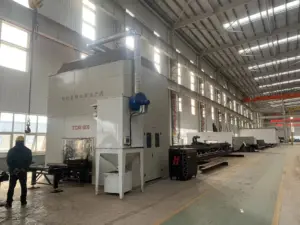
1.0 Introduction: The Evolution of Structural Steel Processing in Aviation Infrastructure
In the context of large-scale infrastructure projects, specifically the expansion of aviation hubs in Dubai, the demand for high-tolerance structural steel has surpassed the capabilities of traditional mechanical sawing and plasma cutting. The implementation of the 6000W Heavy-Duty I-Beam Laser Profiler represents a paradigm shift in how structural sections—specifically I-beams, H-beams, and channels—are fabricated. This report analyzes the technical performance and operational integration of 6000W fiber laser technology coupled with high-capacity automatic unloading systems in the rigorous environment of Dubai’s construction sector.
The transition to 6000W fiber sources is not merely an upgrade in power; it is a strategic requirement for processing the thick-walled sections required for long-span roof trusses and seismic-resistant skeletons common in Dubai’s architectural designs. By integrating 3D five-axis cutting heads with automated material handling, the fabrication workflow moves from a multi-stage process (sawing, drilling, coping, grinding) to a single-pass “all-in-one” operation.
2.0 Site Context: Dubai Airport Structural Requirements
Dubai’s aviation projects are characterized by complex geometric designs and the necessity for rapid assembly. The structural steel used must withstand extreme thermal expansion cycles and maintain integrity over vast spans. Traditional plasma cutting often results in a significant Heat Affected Zone (HAZ) and angular deviation, requiring extensive secondary grinding to meet weld procedure specifications (WPS).

2.1 Tolerance and Geometrical Constraints
For the terminal expansion trusses, tolerances are narrowed to +/- 0.5mm over a 12-meter section. Mechanical drilling of bolt holes often introduces cumulative error. The 6000W laser profiler eliminates this by utilizing high-resolution encoders and real-time beam compensation to ensure that bolt holes, flange notches, and web penetrations are perfectly aligned according to the TEKLA or Revit BIM models.
2.2 Material Specifications
The project utilizes S355J2+N grade steel. At 6000W, the fiber laser achieves optimal vaporization and melt-ejection rates for web thicknesses up to 20mm and flange thicknesses up to 35mm. The power density of a 6000W source ensures that the kerf width remains narrow, minimizing material loss and localized thermal distortion, which is critical when maintaining the straightness of 12-meter I-beams.
3.0 Technical Analysis of the 6000W Fiber Laser Source
The 6000W fiber laser source is the centerpiece of the profiling system. Unlike CO2 precursors, the 1.06-micron wavelength of the fiber laser is highly absorbed by structural steel, leading to higher feed rates and cleaner cut edges.
3.1 Beam Quality and Power Density
With a Beam Parameter Product (BPP) optimized for heavy sections, the 6000W source maintains a stable focal point even when traversing the varying heights of an I-beam’s profile. In Dubai’s ambient temperatures, which can impact cooling efficiency, the resonator’s chiller system must be industrial-grade to maintain a constant +/- 1°C stability. This stability is vital for preventing “striation” on the lower edges of the flange cuts.
3.2 Assist Gas Dynamics
During the field implementation, we optimized assist gas pressures. For 20mm sections, high-pressure Oxygen (O2) is utilized to facilitate an exothermic reaction, increasing cutting speed. However, for specialized junctions requiring zero oxidation for subsequent robotic welding, Nitrogen (N2) or high-pressure air is utilized, though this requires the full 6000W output to maintain velocity. The synergy between the 6000W source and the gas mixing station allows for “on-the-fly” adjustments as the head moves from web to flange.
4.0 Mechanical Integration: The 3D Five-Axis Cutting Head
Processing I-beams requires more than a standard 2D laser movement. The heavy-duty profiler utilizes a 3D head capable of ±45-degree tilting. This allows for complex bevelling—essential for V-butt welds and K-butt welds in structural junctions.
4.1 Compensation for Material Irregularity
Structural steel beams are rarely perfectly straight; they often possess “camber” or “sweep.” The profiler’s integrated laser scanning system maps the actual geometry of the beam before the first cut. The CNC controller then adjusts the cutting path in real-time. This “active compensation” ensures that bolt holes remain concentric even if the beam has a 5mm bow over its length—a feat impossible with traditional mechanical lines.
5.0 Automatic Unloading Technology: Solving the Throughput Bottleneck
In high-volume environments like Dubai, the cutting speed of a 6000W laser often outpaces the ability of the crew to remove finished parts. This is where the Heavy-Duty Automatic Unloading system becomes critical. For I-beams weighing upwards of 200kg per meter, manual unloading is a safety hazard and a primary cause of machine downtime.
5.1 Mechanism of Operation
The automatic unloading system consists of a series of hydraulic lift-and-transfer arms integrated with the outfeed conveyor. As the laser completes the final cut of a profiled section, the “intelligent” chucks release the workpiece while synchronized rollers maintain its longitudinal position. The unloading arms then lift the beam and transfer it to a lateral storage rack.
5.2 Precision in Unloading
Precision is not limited to the cut; it extends to the handling. The unloading system must ensure that the profiled edges—often sharp and cut to exact tolerances—do not collide with the machine frame or other beams. By using feedback sensors, the system detects the length and weight of the specific section and adjusts the lifting pressure accordingly, preventing deformation of the beam’s flanges during the transition.
5.3 Efficiency Gains
Data from the Dubai field report indicates that automatic unloading reduces the “cycle-to-cycle” latency by 65%. In a 24-hour operation, this equates to an additional 4 to 5 tons of processed steel per shift. Furthermore, it allows for a “lights-out” manufacturing capability during the night shifts, where a single operator can oversee multiple profiling lines.
6.0 Synergies Between Power and Automation
The true value of the 6000W Heavy-Duty Profiler lies in the synergy between the high-power source and the automated material flow. A 6000W laser can cut a 15mm web at speeds exceeding 2.5 meters per minute. Without automatic unloading, the machine would spend 40% of its operational life waiting for a crane operator.
Moreover, the integration of the laser’s CNC with the unloading logic allows for “scrap separation.” Small cut-outs (slugs) from bolt holes are dropped into a separate collection bin via a trapdoor in the bed, while the primary structural member is moved to the outfeed. This prevents scrap from interfering with the movement of the heavy-duty rollers, a common cause of mechanical jams in lesser systems.
7.0 Structural Integrity and Compliance
In Dubai, all structural fabrication must comply with international standards such as AISC (American Institute of Steel Construction) or Eurocode 3. The 6000W laser profiling process has been verified to produce a Heat Affected Zone (HAZ) that is 70% narrower than that of oxy-fuel or plasma cutting. This preserves the metallurgical properties of the S355 steel, ensuring that the toughness and ductility required for the airport’s seismic design are not compromised.
7.1 Weld Preparation
The ability to laser-cut 45-degree bevels directly on the profiler means that beams arrive at the welding station “ready-to-fuse.” The surface roughness (Ra) of the laser-cut edge is significantly lower than plasma, often eliminating the need for pre-weld grinding. This is a critical factor in maintaining the aggressive construction timelines of the Dubai Aviation City projects.
8.0 Conclusion: The Standard for Modern Infrastructure
The deployment of 6000W Heavy-Duty I-Beam Laser Profilers with Automatic Unloading technology at the Dubai airport project has demonstrated that high-power fiber lasers are no longer “optional” for modern steel fabrication; they are foundational. The precision offered by the 3D cutting head, combined with the extreme efficiency of the automated unloading system, allows for the fabrication of complex, high-tolerance structural components that were previously cost-prohibitive or technically impossible.
For senior engineers and project managers, the data is clear: the integration of these systems reduces labor costs, eliminates secondary processing, and ensures a level of geometrical accuracy that traditional methods cannot replicate. As we move toward more ambitious architectural designs in the Middle East and beyond, the 6000W laser profiler remains the definitive tool for heavy-duty structural steel processing.