The Industrial Powerhouse: Monterrey’s Role in Structural Evolution
Monterrey has long been recognized as the industrial heart of Mexico, often referred to as the “Pittsburgh of the South” due to its deep-rooted history in steel production and manufacturing. As the city continues to expand its footprint in international logistics and high-end construction, the demand for sophisticated structural components has skyrocketed. Stadium construction, in particular, represents the ultimate test of a fabricator’s capability. These structures require massive I-beams, H-beams, and channels capable of supporting cantilevered roofs and thousands of spectators.
The introduction of the 6000W Heavy-Duty I-Beam Laser Profiler into this ecosystem marks a departure from “good enough” tolerances to “aerospace-grade” precision in structural steel. In a region where competition is fierce and the pressure to meet international building codes (such as AWS and AISC) is constant, the transition to 6kW fiber laser technology allows Monterrey-based firms to dominate the North American market.
Decoding the 6000W Fiber Laser Advantage
In the world of laser cutting, wattage is more than just a number; it defines the threshold of efficiency and material thickness. For I-beams used in stadium construction, which often feature web thicknesses and flange widths exceeding 20mm, a 6000W source is the “sweet spot” of industrial performance.
Unlike CO2 lasers of the past, fiber lasers operate at a wavelength that is more readily absorbed by steel, resulting in faster cutting speeds and cleaner edges. A 6000W fiber laser provides the thermal energy necessary to vaporize heavy-duty structural steel instantly, minimizing the Heat-Affected Zone (HAZ). This is critical for stadium structures where the metallurgical integrity of the beam is non-negotiable. By maintaining the base metal’s properties, engineers can rely on the calculated load-bearing capacities without fearing brittle fractures caused by excessive heat input during the cutting process.
The Game-Changer: ±45° Bevel Cutting and 5-Axis Kinematics
Standard 2D laser cutting is insufficient for the three-dimensional reality of structural engineering. Stadium trusses often intersect at complex angles, requiring I-beams to be joined with full-penetration welds. This is where the ±45° bevel cutting head becomes indispensable.
Equipped with a sophisticated 5-axis motion system, the laser head can tilt and rotate around the beam’s profile. This allows for the automated creation of V, Y, K, and X-type weld preparations. Traditionally, these bevels were ground manually or cut with plasma, both of which introduce significant margin for error and require hours of secondary labor.
With a 6000W laser profiler, the bevel is cut simultaneously with the profile. The ±45° range ensures that even the most aggressive weld geometries are achieved with a surface finish that requires zero post-processing. For a stadium project involving thousands of tons of steel, the elimination of manual grinding represents a savings of thousands of man-hours and a significant reduction in onsite assembly errors.
Structural Integrity and the Precision of “Perfect Fit-Up”
In large-scale stadium construction, such as the massive cantilevered roofs seen in modern football arenas, “fit-up” is everything. If a 12-meter I-beam is off by even 3 millimeters, the cumulative error across a 200-meter span can be catastrophic, leading to forced stresses and structural failure.
The Heavy-Duty I-Beam Laser Profiler utilizes advanced laser sensing and mapping. Before the first cut is made, the machine probes the actual dimensions of the beam, accounting for any slight twists or deviations common in hot-rolled steel. The software then compensates the cutting path in real-time. This ensures that every bolt hole, every cope, and every bevel is positioned with sub-millimeter accuracy. When these beams arrive at the construction site in Monterrey or are exported to international sites, they slot together like clockwork, significantly enhancing the safety and longevity of the stadium.
Heavy-Duty Handling: Moving the Giants
A 6000W laser is only as good as the machine’s ability to handle the material. “Heavy-duty” in this context refers to the ability to support I-beams that can weigh several tons and extend up to 12 or 15 meters in length. These profilers utilize massive, synchronized chuck systems and heavy-duty conveyor beds designed to stabilize the material against vibration.
In Monterrey’s high-output facilities, these machines are often integrated with automated loading and unloading zones. The precision of the 6000W cut must be matched by the stability of the workpiece. Any vibration during the beveling of a thick flange would result in striations on the cut surface, potentially compromising the weld. Therefore, the structural rigidity of the machine tool itself—often featuring a reinforced gantry and vibration-damped base—is what allows the 6kW laser to perform at its peak.
Software Integration: From BIM to Beam
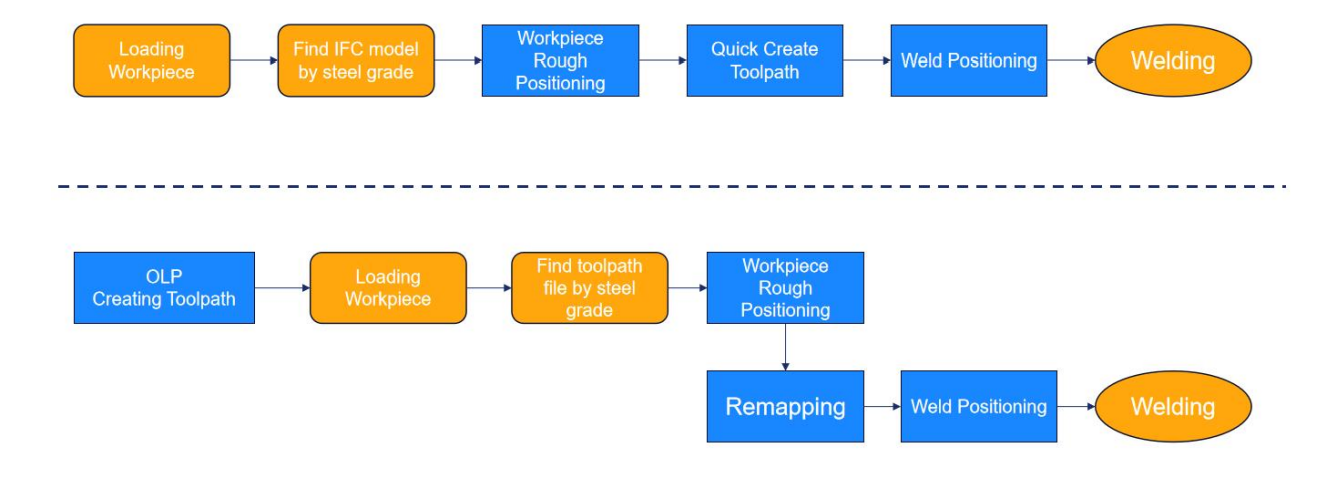
One of the most significant advantages for Monterrey fabricators is the seamless integration between Building Information Modeling (BIM) software and the laser profiler. Stadiums are designed in complex 3D environments using software like Tekla Structures or Autodesk Revit.
The 6000W I-Beam Profiler’s control system can import these 3D models directly, translating complex architectural visions into G-code without manual data entry. This “digital thread” ensures that the architect’s intent is perfectly captured in the steel. It allows for the easy fabrication of “feature” steel—structural elements that are exposed to the public eye and require the aesthetic cleanliness that only a fiber laser can provide.
Economic Impact: Why Monterrey is Investing Now
The capital investment in a 6000W beveling laser is significant, but the ROI (Return on Investment) for Monterrey’s industrial sector is undeniable. Several factors contribute to this:
1. **Secondary Process Elimination:** By combining cutting, hole-drilling, marking, and beveling into a single automated step, the cost per ton of fabricated steel drops dramatically.
2. **Consumable Efficiency:** Fiber lasers have lower operating costs compared to plasma (which requires expensive gases and electrodes) and CO2 lasers (which require high electricity and gas consumption).
3. **Labor Optimization:** As skilled welders and manual layout experts become harder to find, automation allows a single operator to do the work of a ten-person fabrication team.
4. **Market Expansion:** With ±45° beveling capabilities, Monterrey shops can bid on high-spec international projects that were previously reserved for specialized European or Asian fabricators.
Conclusion: The Future of the Monterrey Skyline
As Monterrey prepares for future global events and continues its trajectory as a leader in industrial construction, the 6000W Heavy-Duty I-Beam Laser Profiler stands as the cornerstone of its manufacturing strategy. The ability to cut through massive steel profiles with ±45° bevel precision transforms the I-beam from a raw commodity into a high-engineered component.
For the stadium structures of tomorrow—structures that must be lighter, stronger, and more visually daring—the precision of the 6kW fiber laser is no longer a luxury; it is a necessity. By embracing this technology, Monterrey is not just building stadiums; it is defining the future of structural steel fabrication on a global scale. The synergy of power, precision, and heavy-duty engineering ensures that every bolt, every weld, and every beam contributes to a legacy of safety and architectural excellence.