1.0 Introduction: The Industrial Context of Rosario’s Power Infrastructure
In the industrial corridors of Rosario, Argentina, the demand for structural steel fabrication has shifted from traditional mechanical machining toward high-precision thermal processes. This report details the field implementation of a 6000W Heavy-Duty I-Beam Laser Profiler, specifically optimized for the fabrication of high-tension power transmission towers. The integration of 6kW fiber laser technology into the structural steel sector represents a fundamental shift in how large-scale lattice structures and mono-pole assemblies are engineered. Historically, Rosario’s fabrication hubs relied on plasma cutting and manual oxygen-fuel processes, which introduced significant heat-affected zones (HAZ) and required extensive post-processing. The deployment of the 6000W profiler addresses these throughput bottlenecks by unifying cutting, hole-drilling, and beveling into a single automated sequence.
2.0 Technical Specification of the 6000W Fiber Oscillator and Beam Delivery
The heart of the profiler is a 6000W continuous wave (CW) fiber laser source. In the context of heavy-duty I-beams (ranging from HEA 200 to HEB 600 profiles), the 6kW power threshold is critical. This power density allows for stable vapor cutting and high-speed melt-extraction in carbon steel thicknesses up to 25mm, which are standard for the base plates and primary chord members of power towers.
2.1 Gas Dynamics and Kerf Management
The 6000W source utilized in the Rosario facility employs a nitrogen-oxygen mix for thick-section carbon steel. While oxygen serves as the primary exothermic reactant to facilitate the cut, the precision control of the auxiliary gas pressure (0.5 to 0.8 Bar for thick sections) ensures that the kerf width remains below 0.3mm. This level of precision is unattainable with plasma systems, where kerf deviation often exceeds 1.5mm in heavy I-beam webs. For power tower fabrication, where bolt-hole alignment across 12-meter segments is critical, this reduction in kerf variance eliminates the need for field-reaming during tower erection.
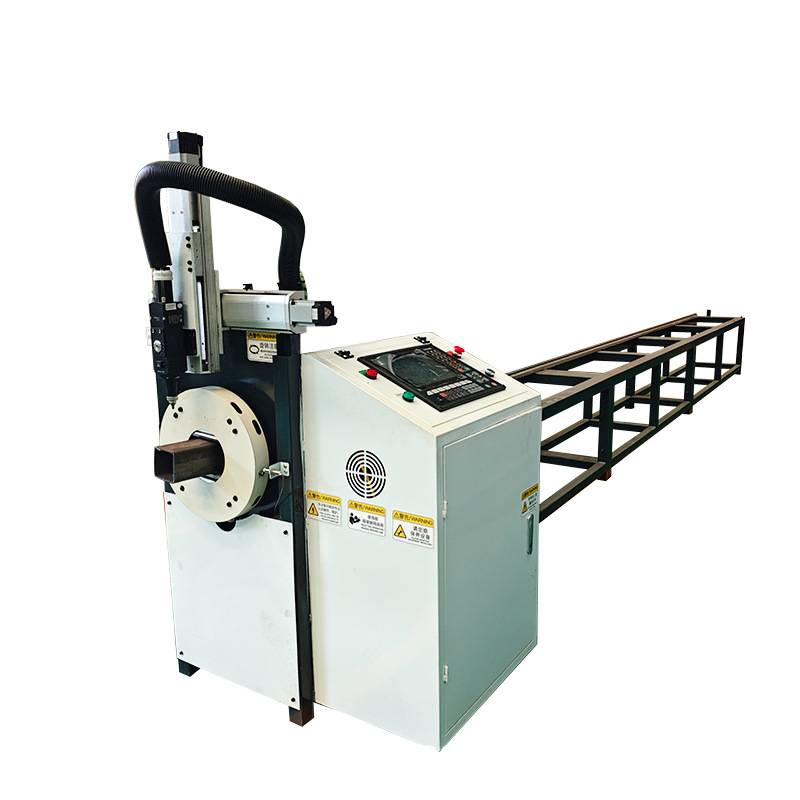
3.0 The Mechanics of ±45° Bevel Cutting in Structural Steel
The most significant technical advancement in this profiler is the 5-axis 3D cutting head capable of ±45° beveling. In power tower fabrication, structural members rarely intersect at 90-degree angles. To ensure maximum weld penetration (CJP – Complete Joint Penetration), the edges of the I-beam flanges must be prepared with specific bevel geometries.
3.1 Elimination of Secondary Grinding Operations
Traditional structural processing requires a three-step workflow: cut-to-length, manual beveling with a torch, and subsequent grinding to remove dross and carburized layers. The ±45° laser beveling system executes “V,” “Y,” and “X” type preparations during the primary cutting cycle. By maintaining a constant standoff distance via capacitive sensing even at a 45-degree tilt, the system produces a weld-ready surface finish (Ra 12.5µm). In the Rosario field tests, this resulted in a 70% reduction in man-hours dedicated to edge preparation for the tower’s main leg components.
3.2 Geometric Accuracy in Complex Intersections
Power towers utilize “K” and “X” bracing patterns. The 5-axis kinematics allow the laser to follow the complex saddle curves where a diagonal brace meets the flange of a vertical I-beam. The software-driven compensation for beam thickness at an angle ensures that the “root face” of the bevel is consistent within ±0.2mm, facilitating the use of automated robotic welding cells in the subsequent assembly phase.
4.0 Structural Integrity and Metallurgical Observations
A primary concern in the Rosario project was the Heat Affected Zone (HAZ) impact on high-tensile structural steels such as ASTM A572 Grade 50. High-power laser cutting, characterized by high feed rates and concentrated energy density, significantly narrows the HAZ compared to plasma or oxy-fuel cutting.
4.1 Hardness Profile Analysis
Metallurgical cross-sections of the I-beam flanges processed at 6000W show a martensitic transformation layer of less than 0.1mm. This is critical for power towers, which are subject to high fatigue cycles and wind loading. A wide, brittle HAZ can become a site for crack initiation. The rapid cooling cycle inherent in fiber laser processing preserves the grain structure of the base metal, ensuring that the structural integrity of the tower is not compromised at the connection points.
5.0 Automatic Structural Processing and Workflow Integration
The “Heavy-Duty” designation of the profiler refers to its material handling system. In the Rosario installation, the machine is equipped with an automated four-chuck system capable of supporting I-beams up to 1200kg per linear meter.
5.1 Synchronized Feeding and Torsional Compensation
Large-scale I-beams often exhibit “mill twist” or longitudinal bowing. The 6000W profiler utilizes a laser-based scanning system to map the actual geometry of the beam before the first cut. The CNC controller then dynamically adjusts the cutting path in real-time to compensate for these deviations. This ensures that a bolt hole pattern at the 12-meter mark is perfectly phased with the pattern at the 0-meter mark, a requirement for the verticality of power transmission towers.
5.2 Software Synergy: From CAD to Beam
The integration of TEKLA and SDS/2 BIM software with the laser’s nesting engine allows for the direct conversion of structural models into G-code. In Rosario’s fabrication environment, this “Digital-to-Steel” workflow minimizes human error. The system automatically identifies the required bevel angles from the 3D model, optimizing the nesting to minimize “drop” or scrap material, which is a significant cost factor in large-scale infrastructure projects.
6.0 Comparative Efficiency: Laser vs. Traditional Methods
To quantify the impact of the 6000W I-beam profiler in the Rosario sector, a comparative analysis of a standard 220kV lattice tower leg was conducted:
- Mechanical Punching/Drilling: Required 4.5 hours per segment, including setup, tool changes, and material movement between stations.
- Plasma Cutting + Manual Beveling: Required 2.8 hours, with significant variability in bevel quality and a 1.2mm hole tolerance.
- 6000W Laser Profiling: Total process time was reduced to 42 minutes. This includes all bolt holes, cope cuts, and ±45° beveling, with a dimensional tolerance of ±0.15mm.
The 6000W fiber source also offers a lower cost-per-cut due to reduced consumable consumption (no electrodes or nozzles required daily) and lower electrical draw compared to high-definition plasma systems of similar capacity.
7.0 Conclusion: Future-Proofing Rosario’s Steel Sector
The implementation of the 6000W Heavy-Duty I-Beam Laser Profiler with ±45° beveling technology marks a technical milestone for power tower fabrication in Rosario. By solving the precision issues associated with heavy steel processing and streamlining the workflow from raw I-beam to weld-ready component, the technology provides a scalable solution for Argentina’s expanding energy grid. The synergy between high-wattage fiber lasers and multi-axis kinematics eliminates the traditional trade-off between speed and structural precision, setting a new benchmark for heavy-duty structural engineering. The reduction in secondary processing alone justifies the capital expenditure, while the increase in structural reliability ensures the long-term viability of the high-tension infrastructure being produced.