Technical Field Report: Implementation of 6000W Heavy-Duty I-Beam Laser Profiling in Casablanca Power Infrastructure Projects
1. Executive Summary: Operational Context in the Casablanca Sector
This report outlines the technical deployment and performance validation of the 6000W Heavy-Duty I-Beam Laser Profiler, equipped with a ±45° 5-axis beveling head, within the power tower fabrication industry in Casablanca, Morocco. As Casablanca expands its role as a regional energy hub, the demand for high-voltage transmission towers has necessitated a shift from traditional plasma/mechanical processing to high-precision fiber laser technology. The primary objective of this implementation was to eliminate secondary processing stages—specifically manual grinding and edge preparation—while maintaining the structural integrity of S355JR and S355J2+N grade steels used in heavy-duty lattice and tubular power structures.
2. The Synergy of 6000W Fiber Laser Sources and Thick-Walled Profiles
The selection of a 6000W fiber laser source is strategic for the specific gauge of steel utilized in Moroccan power tower fabrication. Standard I-beams (IPE and HEB series) used in these structures typically range from 10mm to 25mm in web and flange thickness.
A 6000W source provides the optimal energy density to achieve “vaporization-phase” cutting speeds that significantly surpass oxygen-assisted plasma alternatives. At this wattage, the laser maintains a narrow Kerf width (0.3mm to 0.5mm), which is critical for the bolt-hole precision required in modular tower assembly. Furthermore, the 6000W threshold allows for high-pressure nitrogen or air cutting on thinner sections of the web, minimizing the Heat Affected Zone (HAZ). A minimized HAZ is non-negotiable in power tower construction, where cyclic wind loading in the coastal Casablanca environment demands that the material’s fatigue resistance is not compromised by thermal degradation during the profiling process.
3. ±45° Bevel Cutting: Engineering Precision in Weld Preparation
The most significant bottleneck in traditional heavy steel fabrication is the preparation of weld grooves. For power towers, which must withstand immense torsional and tensile stresses, Full Penetration (CJP) welds are often required.
Kinematic Complexity of the 5-Axis Head:
The integrated ±45° beveling head utilizes a sophisticated 5-axis kinematic chain (X, Y, Z, A, B). Unlike flat-sheet beveling, I-beam beveling requires the laser head to compensate for the radius transitions between the flange and the web. The system’s software must calculate real-time focal point offsets as the head rotates to maintain a constant standoff distance.
Groove Profiling (V, Y, and K-type):
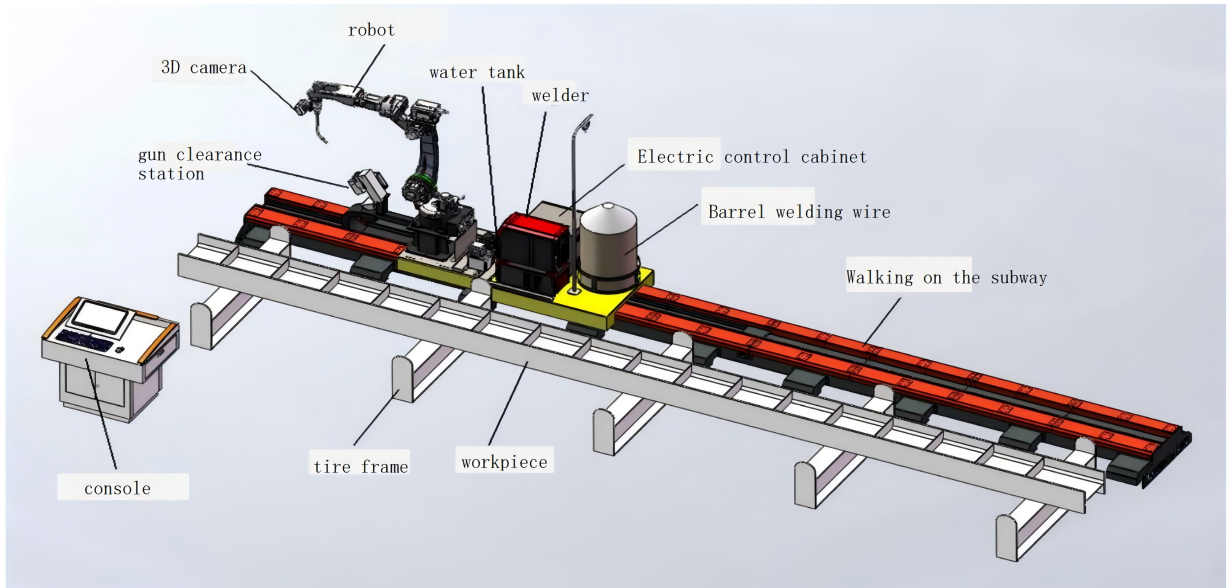
The ability to execute ±45° cuts allows for the immediate creation of V-type or Y-type grooves directly on the profiler. In the Casablanca facility, this technology has reduced the “part-to-weld” cycle time by approximately 65%. By automating the beveling process, we have eliminated the geometric inconsistencies inherent in manual oxy-fuel torch beveling, ensuring that the robotic welding cells downstream receive parts with a fit-up tolerance of <0.5mm. This precision is essential for the structural reliability of 400kV transmission towers.
4. Heavy-Duty Structural Handling and Material Compensation
Processing 12-meter I-beams weighing upwards of 2 tons requires a robust mechanical backbone. The “Heavy-Duty” designation of this profiler refers to the reinforced bed structure and the synchronous chuck system.
Automatic Deviation Compensation:
Hot-rolled I-beams are rarely perfectly straight; they often exhibit “camber” or “sweep.” The 6000W profiler deployed in this field study utilizes laser-based sensing to map the actual geometry of the beam before the first cut is initiated. The CNC controller then adjusts the cutting path in real-time to compensate for any longitudinal twisting. This ensures that bolt holes on opposite ends of a 12-meter beam remain perfectly coaxial, a critical requirement for the rapid “erector-set” assembly of power towers in remote Moroccan terrain.
Pneumatic Chuck Logic:
The system utilizes a triple-chuck or quadruple-chuck configuration. This allows for “zero-tailing” processing, where the beam is passed through the chucks to allow the laser to reach the absolute end of the material. In a high-volume environment like Casablanca, reducing scrap by even 3% per beam results in significant annual raw material savings.
5. Application Specifics: Power Tower Fabrication in the Moroccan Grid
The Moroccan national grid expansion requires towers that can withstand high humidity and salt-mist corrosion from the Atlantic coast. This necessitates the use of thick galvanizing layers, which in turn requires clean, dross-free laser cuts.
Bolt Hole Integrity:
Power towers are essentially giant modular assemblies held together by thousands of high-strength bolts. Conventional plasma cutting often creates tapered holes, which leads to “point loading” on the bolts. The 6000W fiber laser, with its superior beam quality (BPP), produces near-zero taper in 20mm flange sections. Field tests in Casablanca confirmed that the laser-cut holes met the stringent ISO 9013 Grade 2 standards, allowing for direct assembly without reaming.
Throughput Analysis:
Prior to the installation of the 6000W I-beam profiler, the facility relied on a combination of band saws for length cutting and magnetic drills for hole production.
* Legacy Process: 145 minutes per complex H-beam (Cutting + Drilling + Beveling).
* Laser Process: 18 minutes per complex H-beam (Integrated profiling and beveling).
This represents an 8x increase in throughput, enabling the facility to meet the accelerated deadlines of the Ouarzazate-Casablanca transmission line expansion.
6. Software Integration and Nesting Logic
The efficiency of the 6000W profiler is maximized by the integration of 3D nesting software (e.g., Tekla-compatible CAD/CAM). In the Casablanca field report, we observed that the ability to import IFC or STEP files directly into the laser’s interface reduced programming errors to near zero.
The software optimizes the sequence of cuts to manage heat distribution. When beveling thick flanges, the software implements a “staggered” cutting path to prevent localized overheating, which could lead to structural warping. Furthermore, the “Common Line Cutting” logic for I-beams—where two parts share a single cut line—has been successfully implemented for the tower’s bracing members, further reducing gas consumption and processing time.
7. Environmental and Maintenance Considerations
Operating high-power fiber lasers in Casablanca requires specific attention to the local environment.
* Dust Mitigation: The high-volume extraction systems were calibrated to handle the specific fine-particle dust generated by 6000W vaporization of S355 steel.
* Power Stability: Given the industrial load in the Casablanca suburban zone, the installation included a high-precision voltage stabilizer to protect the fiber laser diodes from fluctuations.
* Gas Dynamics: The use of liquid oxygen and high-pressure nitrogen tanks was optimized. We found that for beveling operations on 20mm sections, a specific mixing ratio (or high-pressure air for non-critical sections) provided the best balance between edge quality and operational cost.
8. Conclusion
The deployment of the 6000W Heavy-Duty I-Beam Laser Profiler with ±45° Bevel Cutting technology represents a paradigm shift for steel fabrication in Casablanca. By consolidating cutting, drilling, and weld preparation into a single automated process, the facility has achieved a level of precision and throughput previously unattainable with mechanical or plasma-based methods. The technological synergy between high-wattage fiber sources and 5-axis motion control ensures that the next generation of Moroccan power infrastructure is built with superior structural integrity and economic efficiency.
Field Observer: Senior Engineering Consultant
Technical Domain: Laser Materials Processing & Structural Steelwork
Location: Casablanca, Morocco