The Strategic Significance of Rayong in Global Modular Fabrication
Rayong has long been recognized as the industrial backbone of Thailand, hosting a dense cluster of petrochemical plants, automotive factories, and heavy engineering firms. However, as the global demand for modular construction—where buildings are constructed off-site in prefabricated sections—continues to rise, the region’s fabricators have faced a bottleneck: the speed and precision of structural steel preparation.
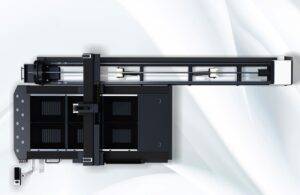
Modular construction relies on the “Lego-set” principle. If an I-beam for a chassis or a load-bearing frame is off by even two millimeters, the cumulative error across a 50-unit modular complex can be catastrophic. Traditional fabrication involving manual marking, mechanical band-sawing, and subsequent drill-press operations is simply too slow and prone to human error. The introduction of the 6000W Heavy-Duty I-Beam Laser Profiler in Rayong addresses this head-on, providing the EEC with a competitive edge in the high-stakes world of prefabricated high-rises and offshore modular platforms.
The Power of 6000W: Piercing the Limits of Structural Steel
In the realm of fiber lasers, 6000W (6kW) represents a critical “sweet spot” for structural engineering. While lower-wattage lasers excel at thin sheet metal, the heavy-duty demands of modular frames require the ability to pierce and cut through thick-walled I-beams and H-sections efficiently.
A 6000W fiber laser source provides a power density that can effortlessly vaporize carbon steel up to 25mm or 30mm with clean, dross-free edges. For Rayong’s fabricators, this means the ability to process heavy Universal Beams (UB) and Universal Columns (UC) that form the primary skeletons of modular units. The fiber laser’s wavelength is highly absorbed by steel, leading to cutting speeds that are four to five times faster than traditional plasma cutting, with a significantly smaller heat-affected zone (HAZ). This preservation of material integrity is vital for structural components that must meet stringent building safety codes.
Precision Beveling: The ±45° Game Changer
The most significant technological leap in these machines is the 3D cutting head capable of ±45° beveling. In traditional modular fabrication, cutting a beam to length is only half the battle. To prepare a beam for welding, a “bevel” or “chamfer” must be ground into the edge to allow for full-penetration welds.
Historically, this was done by hand or with a secondary beveling machine—a process that is labor-intensive, dusty, and inconsistent. The 6000W Profiler integrates this into a single process. As the laser head moves around the static or rotating I-beam, it tilts to create V, Y, X, or K-shaped grooves.
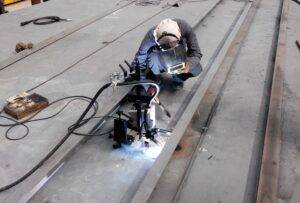
For a modular construction project in Rayong, this means that a beam can emerge from the laser cabin not just cut to the exact length, but with all bolt holes drilled (cut) and all weld prep bevels completed. When these beams arrive at the assembly jig, they fit together perfectly, and the welders can begin their work immediately without picking up a grinder. This “weld-ready” output can reduce total fabrication time by up to 40%.
Navigating Complex Geometries: I-Beams, H-Beams, and Channels
Unlike flat-bed lasers, a heavy-duty I-beam profiler must account for the unique geometry of structural sections. The machine utilizes a sophisticated system of chucks and support rollers to rotate and move long sections of steel (often up to 12 meters) through the cutting zone.
The software—the “brain” of the profiler—is particularly crucial. It must compensate for the natural “imperfections” of heavy steel, such as slight bows or twists in a 12-meter I-beam. Through advanced touch-sensing or laser-scanning, the 6000W profiler maps the actual shape of the beam before cutting, adjusting the laser’s path in real-time. This ensures that a hole cut in the center of the flange is perfectly centered, regardless of the beam’s physical deviations. In modular construction, where vertical alignment is paramount, this level of geometric control is indispensable.
Enhancing Modular Assembly Speed and Quality
Modular construction is defined by its speed. The goal is to move as much work as possible from the unpredictable environment of a construction site into the controlled environment of a factory. The 6000W Laser Profiler is the ultimate factory tool.
1. **Part Consolidation:** Because the laser can cut complex shapes, engineers can design interlocking joints (like mortise and tenon joints for steel) that “lock” beams into place before welding. This reduces the need for expensive high-precision jigs.
2. **Weight Reduction:** High-precision laser cutting allows for the use of perforated webs in I-beams. By cutting weight-saving geometries into the beams without sacrificing structural integrity, modular units become lighter and easier to transport by sea or road from Rayong to their final destination.
3. **Accuracy for Automation:** As Rayong moves toward robotic welding, the input material must be perfect. Robotic welders cannot “fill the gap” like a human welder can if a beam is cut too short. The laser profiler provides the sub-millimeter tolerances required for the next generation of robotic assembly lines.
Sustainability and Economic Impact in the EEC
Sustainability is becoming a core requirement for construction projects in Southeast Asia. The 6000W fiber laser is inherently more sustainable than the methods it replaces. It produces significantly less waste material than mechanical sawing and consumes less energy per cut than older CO2 lasers or high-definition plasma systems. Furthermore, the extreme precision reduces the amount of “rework”—the costly and energy-intensive process of fixing mistakes.
Economically, the installation of these machines in Rayong bolsters Thailand’s position as a regional hub for high-value engineering. By adopting 6kW bevel-cutting technology, local firms can bid on international modular projects that require compliance with Eurocode or AISC (American Institute of Steel Construction) standards, which demand the high levels of precision that only laser technology can provide.
Challenges and Maintenance in the Rayong Environment
While the technology is transformative, operating a 6000W laser in a tropical, industrial environment like Rayong presents specific challenges. High humidity and ambient temperatures can affect the stability of the laser source and the sensitive optics.
Modern heavy-duty profilers are equipped with dual-circuit industrial chillers and pressurized, dust-proof optical paths to mitigate these risks. For a fiber laser expert, the focus in Rayong is often on “clean air” and “stable power.” Ensuring the machine is fed with high-purity assist gases (Oxygen or Nitrogen) and protected by voltage stabilizers is key to maintaining the 6kW power density required for thick beams. Furthermore, training local technicians to move from manual fabrication mindsets to CNC-based laser programming is a critical step in the EEC’s digital transformation.
The Future: Toward 12kW and Beyond
While 6000W is currently the standard for heavy-duty modular work, the horizon is already moving toward 12kW and 20kW systems. However, for the majority of modular construction needs—where beam thicknesses typically range from 6mm to 20mm—the 6000W profiler remains the most cost-effective and efficient solution. The ±45° beveling capability remains the more important variable than raw power alone, as the complexity of the joint usually dictates the assembly speed more than the speed of the straight cut.
Conclusion
The deployment of a 6000W Heavy-Duty I-Beam Laser Profiler with ±45° bevel cutting in Rayong is more than just an equipment upgrade; it is a fundamental shift in how Southeast Asia builds. By merging the raw power of fiber laser technology with the geometric flexibility of 5-axis beveling, Rayong’s fabricators are eliminating the traditional barriers to modular efficiency. As the skylines of Bangkok, Singapore, and beyond are increasingly populated by modular structures, the precision components forged in the heart of the EEC will be the silent, perfectly-cut foundation upon which they stand. For the modular construction industry, the era of the “smart beam” has arrived, and it is powered by 6000 watts of focused light.