
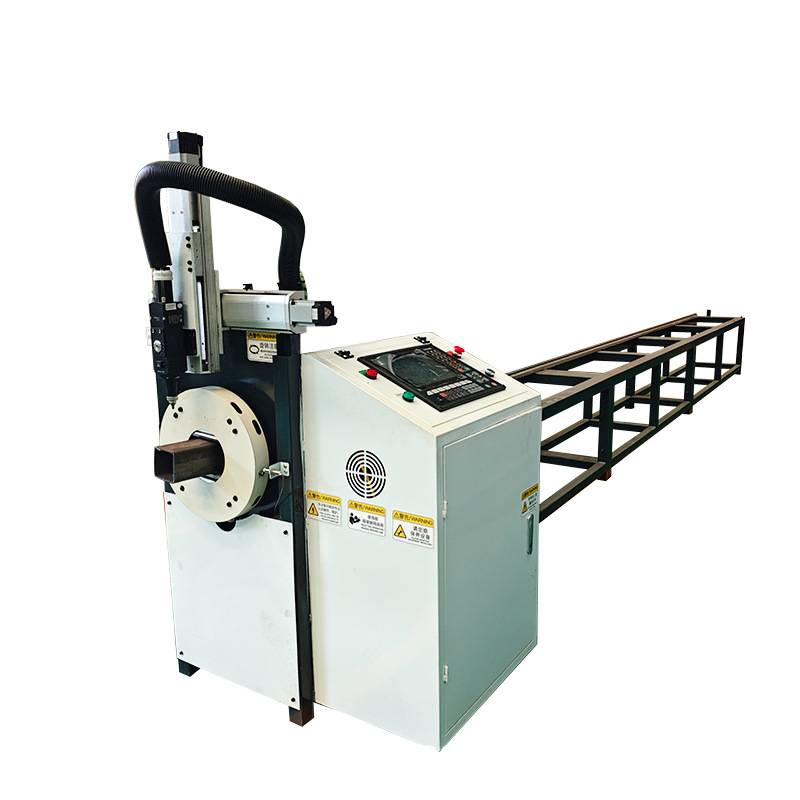
1.0 Operational Overview: The Role of High-Power Fiber Lasers in Houston’s Modular Sector
The Houston metropolitan area serves as a primary global hub for energy infrastructure and heavy industrial fabrication. In recent years, the shift toward modular construction—pre-fabricating large-scale steel structures in controlled environments before site delivery—has necessitated a paradigm shift in structural steel processing. Traditional methods, including mechanical sawing, drilling, and plasma cutting, often fail to meet the stringent tolerances and throughput requirements of high-volume modular assembly.
The introduction of the 6000W Heavy-Duty I-Beam Laser Profiler represents a significant leap in structural kinematics. By integrating a high-density 6kW fiber laser source with a multi-axis robotic or gantry-based delivery system, fabricators can now execute complex geometries on structural shapes (I-beams, H-beams, C-channels, and RHS) with a level of precision previously reserved for thin-sheet metal. This report analyzes the technical integration of this technology within the Houston modular construction framework, focusing on the synergy between power density, geometric accuracy, and downstream assembly efficiency.
2.0 6000W Fiber Laser Kinematics and Power Density
2.1 Photon Density and Kerf Control
The 6000W fiber laser source is the critical component for heavy-duty structural applications. At this power level, the laser provides sufficient energy to maintain a stable melt pool in thick-walled structural steel (up to 25mm flange thickness) while maintaining high feed rates. Unlike CO2 lasers or lower-wattage fiber systems, the 6000W output allows for a concentrated beam diameter, minimizing the Kerf width and reducing the Heat Affected Zone (HAZ).
In the context of Houston’s modular fabrication shops, which often work with ASTM A36 or A572 Grade 50 steel, the 6000W source ensures that the metallurgical properties of the steel remain largely intact. The rapid cooling cycle associated with fiber laser cutting prevents the excessive grain growth typically seen with oxy-fuel or plasma cutting, which is vital for maintaining the structural integrity of Load-Bearing Members (LBMs) in modular units.
2.2 Automatic Structural Processing and Beam Stabilization
The “Heavy-Duty” designation of the profiler refers to its physical architecture. Processing I-beams requires a robust chuck system capable of handling weights exceeding several tons. The 6000W profiler utilizes a synchronized dual-chuck or triple-chuck system that compensates for the inherent “camber” and “sweep” found in hot-rolled structural steel. This automated compensation is critical; if the beam is not perfectly linear, the laser focal point would drift, leading to incomplete cuts or excessive dross.
3.0 Precision ±45° Bevel Cutting: Technical Dynamics
3.1 Solving the Weld Prep Bottleneck
In modular construction, the efficiency of the “fit-up” stage determines the project’s overall timeline. Traditionally, I-beams require secondary processing—manual grinding or specialized beveling machines—to create the V, Y, or K-grooves necessary for Full Penetration (CJP) welds.
The ±45° bevel cutting head on the 6000W profiler eliminates these secondary operations. By utilizing 5-axis interpolation, the cutting head can pivot during the cutting cycle, creating precise chamfers on both the web and the flanges of the I-beam. This capability allows for the immediate transition from the cutting bed to the welding station. In Houston-based facilities, where labor costs for skilled grinders are high, this integration results in a 40-60% reduction in total part processing time.
3.2 Geometric Accuracy and Thermal Distortion
Beveling at 45 degrees increases the effective thickness of the material (the “slant thickness”). A 20mm flange cut at 45° presents a ~28mm path for the laser. The 6000W power reserve is essential here; it provides the necessary “punch” to clear the molten slag from the elongated kerf without reducing the feed rate to a point where thermal distortion occurs.
Furthermore, the CNC controller utilizes advanced algorithms to adjust the gas pressure (typically Oxygen for carbon steel) and focal position in real-time as the head tilts. This ensures that the bevel face is smooth (Ra < 12.5 μm), which is critical for ultrasonic testing (UT) compliance in structural welding codes like AWS D1.1.
4.0 Application in Houston’s Modular Construction Landscape
4.1 High-Rise and Energy Infrastructure Modules
Houston’s modular sector often produces “skids” for the oil and gas industry and structural frames for multi-story modular housing. These structures rely on the precise interlocking of I-beams. The 6000W profiler enables “cope” cuts and “notching” with sub-millimeter tolerances.
When an I-beam is processed with a laser, the bolt holes are cut with a cylindricality that exceeds the requirements for high-strength bolting. In modular assembly, where a single frame might consist of 50+ interconnected members, the cumulative effect of ±0.2mm tolerances versus the ±2.0mm tolerances of plasma cutting is the difference between a seamless “bolt-up” and days of on-site rework.
4.2 Integration with BIM and Tekla Workflows
The technical efficiency of the 6000W profiler is maximized through its software integration. Most Houston engineering firms utilize Tekla Structures or similar BIM (Building Information Modeling) software. The profiler’s control system directly imports DSTV or STEP files, translating complex 3D models into G-code. This “Digital Thread” ensures that the physical I-beam perfectly matches the engineering design, a necessity for the “Lego-like” assembly required in modular construction.
5.0 Comparative Analysis: Laser vs. Legacy Methods
5.1 Throughput and Consumables
While the initial capital expenditure for a 6000W I-beam profiler is higher than a plasma system, the Operational Expenditure (OPEX) is significantly lower in high-volume environments.
1. **Gas Consumption:** Fiber lasers utilize high-pressure Nitrogen or Oxygen efficiently, whereas plasma requires constant replacement of electrodes and nozzles.
2. **Post-Processing:** The laser-cut edge is weld-ready. Plasma often leaves a nitride layer that must be ground off to prevent weld porosity.
3. **Accuracy:** The laser’s repeatability allows for complex “slot and tab” designs in steel frames, which simplifies the jigging process during modular assembly.
5.2 Environmental and Safety Factors
In the humidity of the Texas Gulf Coast, maintaining machinery is a challenge. The fiber laser system is entirely enclosed, protecting the optical path from the dust and moisture that often plague open-arc plasma systems. Additionally, the localized extraction systems on modern profilers ensure that the particulate matter generated during the 6000W cut is captured, maintaining a safer work environment for the shop floor.
6.0 Conclusion: The Future of Heavy Steel Fabrication
The deployment of 6000W Heavy-Duty I-Beam Laser Profilers with ±45° beveling technology is no longer an optional upgrade for competitive fabricators in the Houston modular market; it is a foundational requirement. The ability to move from a raw 12-meter I-beam to a finished, beveled, and hole-drilled structural component in a single automated cycle redefines the economics of steel construction.
The precision of the 5-axis bevel head solves the industry’s most persistent bottleneck—weld preparation—while the 6000W fiber source provides the speed and edge quality necessary to meet modern engineering standards. As modular construction continues to scale in complexity and height, the reliance on high-power laser profiling will only intensify, cementing its role as the primary driver of structural fabrication efficiency.
**Field Report End.**
**Lead Engineer: [Technical Specifications Division]**
**Subject: Houston Modular Steel Infrastructure Deployment**
















