The Evolution of Structural Fabrication in Dubai’s Industrial Landscape
Dubai has long been a global crossroads for trade and construction, but it is rapidly evolving into a sophisticated manufacturing hub. As the UAE pushes toward its “Net Zero by 2050” strategic initiative, the demand for renewable energy infrastructure, specifically wind power, has surged. Wind turbine towers are massive structures that require uncompromising structural integrity. The backbone of these towers—and the internal platforms and support frames that house their electronics—relies on high-strength H-beams.
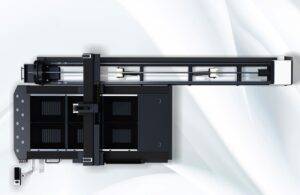
Traditionally, processing these beams involved a disjointed workflow: mechanical sawing to length, radial drilling for bolt holes, and manual oxy-fuel or plasma torching for beveling. In the high-heat, high-speed economic environment of Dubai, this traditional method is no longer viable. The introduction of the 6000W H-Beam laser cutting Machine provides an all-in-one solution that brings aerospace precision to heavy structural steel.
The Power of 6000W Fiber Technology
At the heart of this machine is a 6000W fiber laser source. In the world of laser physics, 6000W represents a “sweet spot” for structural steel. While higher wattages exist, the 6000W threshold offers the ideal balance of beam density and operating cost for the thicknesses typically found in H-beam profiles (ranging from 10mm to 35mm).
Fiber lasers operate at a wavelength of approximately 1.06 microns, which is more readily absorbed by steel compared to the 10.6 microns of older CO2 technology. This high absorption rate allows the 6000W beam to vaporize metal almost instantly. When applied to H-beams, this power ensures clean, dross-free cuts even on the thickest flanges. For a fabricator in Dubai, this means higher throughput; where a mechanical saw might take several minutes to struggle through a heavy section, the laser glides through in seconds, maintaining a narrow kerf and minimal Heat Affected Zone (HAZ).
Precision Beveling: The ±45° Advantage
The most significant technological leap in these machines is the 5-axis 3D cutting head capable of ±45° beveling. In the construction of wind turbine towers, welding is the most critical phase. To ensure deep penetration and structural soundness, the edges of the H-beams must be beveled—typically in V, Y, or K-shaped grooves.
Previously, a flat cut would be made, and then a technician would manually grind the edge to a 30° or 45° angle. This process was prone to human error and inconsistency. The 6000W H-beam laser solves this by utilizing a sophisticated CNC-controlled oscillating head. As the laser moves across the beam’s flange or web, it tilts in real-time.
The ability to achieve a precise ±45° bevel means the beam is “weld-ready” the moment it leaves the laser bed. This is essential for wind towers, which are subject to extreme cyclical loading and vibration. Precision-beveled joints ensure that the welds meet international standards such as AWS D1.1, which is the benchmark for structural welding in the energy sector.
Optimizing Wind Turbine Tower Production
Wind turbine towers are not merely hollow tubes; they are complex assemblies of internal balconies, ladders, and reinforced base sections. H-beams are used extensively in the secondary steelwork inside the tower and the transition pieces.
1. **Bolt Hole Accuracy:** Tower segments are bolted together. The 6000W laser can cut bolt holes with a tolerance of ±0.1mm. Unlike mechanical drilling, there is no tool wear, meaning the 1st hole and the 1,000th hole are identical.
2. **Complex Geometry:** Wind towers often require “cope” cuts or “notching” where beams intersect at strange angles to fit the curvature of the tower. The 3D laser head can follow these paths effortlessly, something that would be nearly impossible to do accurately with manual tools.
3. **Weight Reduction:** Because the laser is so precise, engineers can design lighter, more efficient structural supports without needing “extra” material to compensate for the inaccuracies of manual fabrication.
Thriving in Dubai’s Environment: Engineering for the Heat
Operating a 6000W laser in Dubai presents unique challenges, primarily related to ambient temperature and airborne dust. Fiber lasers are sensitive to heat; the diodes and the laser medium must be kept within a strict temperature range to prevent “thermal lensing” or catastrophic failure.
Modern H-beam lasers deployed in the UAE are equipped with dual-circuit industrial chillers. One circuit cools the laser source, while the other cools the cutting head and the optics. In Dubai’s summer, where temperatures can exceed 45°C, these chillers are oversized and reinforced with high-ambient-temperature components. Furthermore, the machines feature pressurized cabins and advanced filtration systems to keep the fine desert dust away from the sensitive rack-and-pinion drives and the fiber optic delivery cable.
Economic Impact: Cost-Efficiency in the UAE Market
In Dubai’s competitive industrial zones like JAFZA (Jebel Ali Free Zone) or DIC (Dubai Industrial City), efficiency is the primary driver of profitability. The 6000W H-beam laser offers a significant Return on Investment (ROI) through several avenues:
* **Labor Reduction:** One laser operator can replace a team of four (one sawyer, one driller, and two manual grinders).
* **Material Savings:** Advanced nesting software allows the laser to “path” the cuts so that the minimum amount of steel is wasted. This is crucial in the UAE, where raw steel prices are subject to global shipping fluctuations.
* **Energy Efficiency:** Fiber lasers are roughly 30% to 40% more energy-efficient than CO2 lasers. In an era where carbon footprints are being measured by developers, this efficiency adds to the “green” credentials of the wind tower manufacturing process.
Digital Integration and Industry 4.0
The 6000W H-beam laser is a cornerstone of the “Smart Factory” concept. Most machines in Dubai are now equipped with IoT (Internet of Things) connectivity. For wind tower projects, which require meticulous documentation and traceability, the laser can etch serial numbers, QR codes, and alignment marks directly onto the steel.
The machine’s software integrates directly with TEKLA or AutoCAD structural files. A designer in an office in Downtown Dubai can upload a 3D model of a wind tower platform, and the machine in the warehouse can immediately interpret the bevel angles and hole placements. This “file-to-finish” workflow reduces the chance of misinterpretation that often occurs with manual blueprints.
The Future of Green Energy Fabrication
As the Middle East transitions from an oil-based economy to a diversified energy leader, the role of high-tech manufacturing cannot be overstated. The 6000W H-beam laser cutting machine is more than just a piece of equipment; it is a catalyst for the localized production of renewable energy components.
By investing in ±45° beveling technology, Dubai-based fabricators are positioning themselves as regional leaders. They are no longer just importing components; they are exporting high-value, precision-engineered structural steel across the GCC and beyond.
Conclusion
The marriage of 6000W fiber laser power and ±45° beveling precision represents the pinnacle of modern structural steel processing. For the wind turbine tower industry in Dubai, this technology solves the dual challenges of extreme structural requirements and the need for high-speed production. By eliminating secondary processing, ensuring perfect weld preparation, and operating reliably in the desert climate, these machines are paving the way for a more sustainable and technologically advanced industrial future in the UAE. As wind farms begin to dot the regional landscape, the silent, sparks-flying precision of the H-beam laser will be the silent architect of those towering structures.