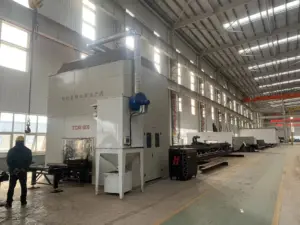
The Dawn of Precision Structural Fabrication in Dubai
Dubai has long been a global crossroads for logistics, home to the massive Jebel Ali Port and the ever-expanding Dubai World Central. As the region transitions toward a “smart” industrial economy under the “Operation 300bn” strategy, the demand for sophisticated warehouse solutions—specifically high-density storage racking—has surged. Traditional methods of fabricating H-beams, involving manual marking, mechanical sawing, and radial drilling, are no longer sufficient to meet the speed or the precision required by modern automated storage and retrieval systems (ASRS).
Enter the 6000W H-beam fiber laser cutting machine. This technology is not merely a replacement for the saw; it is a comprehensive fabrication center. In the context of Dubai’s extreme climate and high-speed project timelines, the fiber laser provides a level of reliability and throughput that was previously unattainable. For storage racking—where structural integrity is non-negotiable—the ability to cut, hole-punch, and notch H-beams in a single automated pass is transformative.
The 6000W Sweet Spot: Power Meets Efficiency
In the world of fiber lasers, power selection is critical. While 3000W machines are sufficient for thin-walled tubes and 12,000W machines are monsters of thick-plate processing, the 6000W resonance is widely considered the “workhorse” for structural H-beams used in racking.
An H-beam (or Universal Beam) features varying thicknesses between the web and the flanges. A 6000W source provides the necessary energy density to pierce through 20mm+ carbon steel flanges with clean, dross-free edges, while maintaining high speeds on the thinner web sections. This power level ensures that the Heat Affected Zone (HAZ) is minimized. In structural engineering for racking, maintaining the metallurgical properties of the steel is vital; excessive heat from slower, lower-power lasers or oxy-fuel cutting can embrittle the steel around bolt holes, leading to potential structural failure under load.
Furthermore, 6000W systems in Dubai are typically equipped with advanced nitrogen or oxygen-assisted cutting heads, allowing fabricators to toggle between high-speed production and ultra-clean finishes depending on whether the rack components will be powder-coated or galvanized.
Zero-Waste Nesting: The Economic Game-Changer
In the UAE, where raw steel prices are subject to global market fluctuations and import costs, material utilization is the difference between a profitable project and a loss. Traditional beam processing often results in “drops” or offcuts—lengths of beam that are too short to be used but too expensive to simply scrap.
“Zero-Waste Nesting” is a software-driven revolution. Modern H-beam lasers utilize sophisticated 3D nesting algorithms that analyze the entire production queue. Instead of cutting one beam at a time, the software “nests” different parts—uprights, cross-beams, and braces—onto a single long raw profile.
Key features of Zero-Waste Nesting include:
1. **Common-Line Cutting:** Shared cut lines between two parts, reducing the number of pierces and saving millimeters of material that add up over kilometers of steel.
2. **Short-Fragment Processing:** The machine’s chuck system is designed to hold the beam as close to the cutting head as possible, allowing the laser to utilize almost the entire length of the raw material, often leaving a remnant of less than 50mm.
3. **Automated Remnant Management:** If a piece is left over, the software logs its dimensions into a virtual library, prioritizing its use for smaller components in the next job.
For a Dubai-based racking manufacturer producing thousands of pallet positions, a 5% to 10% increase in material utilization through zero-waste technology can save hundreds of thousands of Dirhams annually.
Engineering Superiority for Storage Racking
Storage racking is an exercise in structural repetition and precision. Whether it is selective pallet racking, drive-in racks, or cantilever systems, the holes must align perfectly for boltless connectors or high-tensile bolts.
The 6000W H-beam laser excels here because of its multi-axis capability. Most machines feature a rotating chuck and a 3D cutting head that can bevel. This allows for:
– **Perfectly Circular Holes:** Unlike mechanical punches that can deform the surrounding metal, the laser cuts holes with a tolerance of ±0.1mm, ensuring that racking pins fit snugly, reducing “rack sway.”
– **Complex Notching:** For interlocking beam designs, the laser can cut complex geometries into the ends of H-beams that allow them to “snap” into uprights before welding, significantly reducing assembly time.
– **Marking and Etching:** The laser can etch part numbers, fold lines, or logo branding directly onto the steel, eliminating the need for manual tagging and reducing errors during on-site installation at a Dubai warehouse.
Adapting to the Dubai Environment
Operating high-powered fiber lasers in the Middle East presents unique challenges, primarily heat and dust. A 6000W laser generates significant internal heat, and the ambient temperature in Dubai can exceed 45°C in the summer.
Top-tier H-beam lasers exported to the UAE market are equipped with high-capacity industrial chillers and dual-circuit cooling systems—one for the laser source and one for the cutting head. Furthermore, the cabinets are often pressurized and dust-sealed. In the desert environment, fine silica dust can be the enemy of optics. Expert-grade machines utilize HEPA filtration and “Clean-Room” grade protective windows to ensure the 6000W beam remains stable and focused over years of operation.
ROI and Sustainability in the UAE Market
The transition to a 6000W H-beam laser is a capital-intensive decision, but the Return on Investment (ROI) is accelerated by the specific needs of the Dubai market. Labor costs for skilled welders and fabricators are rising, and the push for “green” manufacturing is intensifying.
By utilizing zero-waste nesting, companies contribute to a circular economy, reducing the carbon footprint associated with steel recycling and transport. Moreover, the speed of the 6000W laser means that a single machine can often replace three to four traditional processing stations. This reduces the factory footprint—a critical factor in high-rent industrial zones like Al Quoz or JAFZA—and lowers energy consumption per ton of processed steel.
Conclusion: The Future of Structural Steel
The 6000W H-Beam Laser Cutting Machine is more than just a tool; it is a competitive edge. In a city like Dubai, where “the biggest and the best” is the standard, the logistics industry demands infrastructure that is safe, efficient, and rapidly deployed.
For manufacturers of storage racking, the combination of high-power fiber laser cutting and zero-waste nesting technology provides a path to dominance. It allows for the production of stronger, more precise racking systems at a lower cost and with less environmental impact. As Dubai continues to build the warehouses of the future, the 6000W fiber laser will undoubtedly be the engine driving the structural steel industry forward, turning raw H-beams into the backbone of global commerce.