The Industrial Evolution of Mexico City’s Racking Sector
Mexico City, and its surrounding industrial corridors like Tlalnepantla and Vallejo, have long been the beating heart of the nation’s manufacturing and logistics sectors. With the surge in e-commerce and the “nearshoring” phenomenon, the demand for sophisticated storage racking systems has skyrocketed. However, the traditional method of producing these systems—involving separate stages for sawing, drilling, and manual plasma cutting—is no longer sufficient to meet modern requirements for speed and structural integrity.
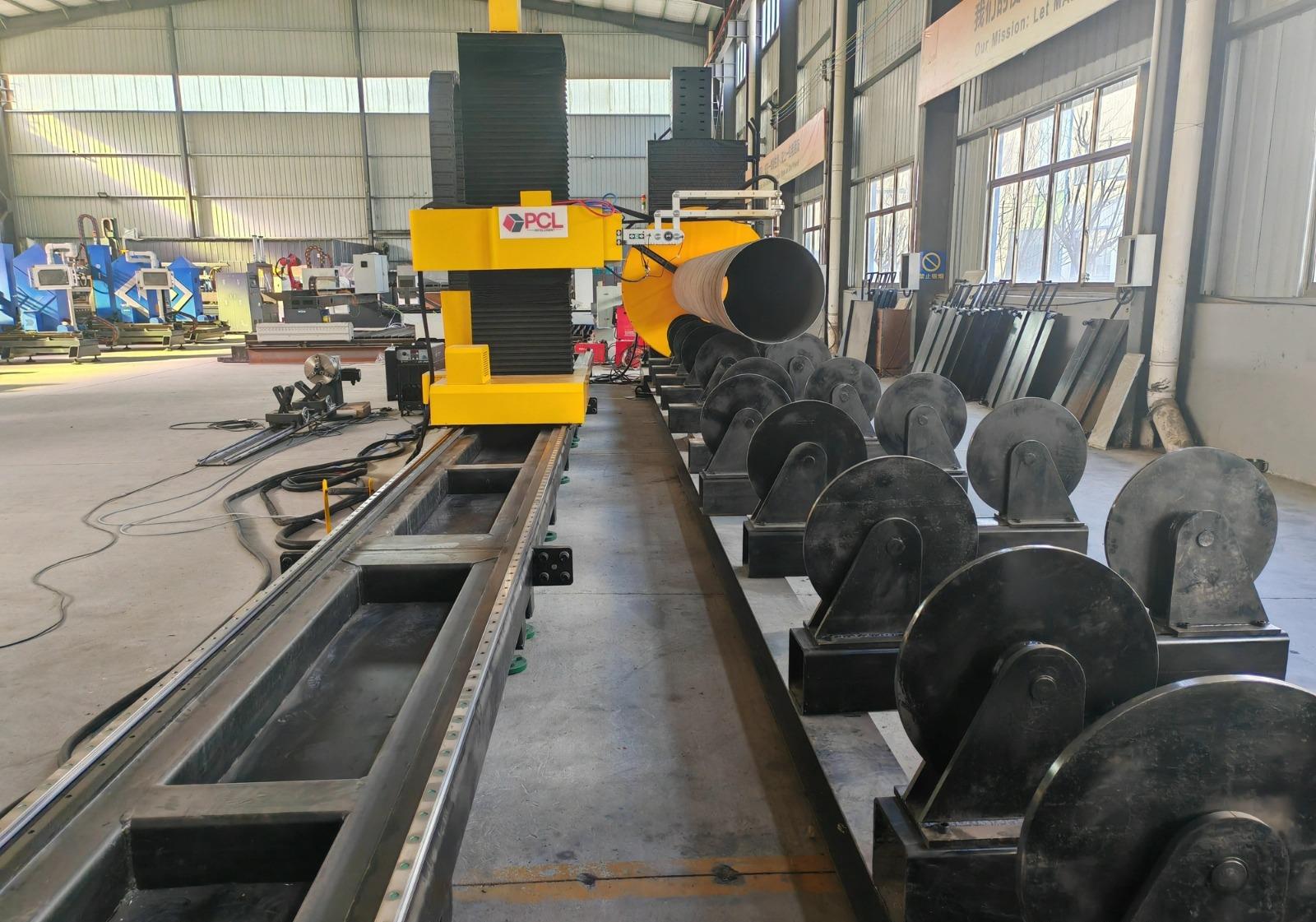
The introduction of the 6000W H-Beam laser cutting Machine with an Infinite Rotation 3D Head is the technological answer to these challenges. This machine is not merely a cutter; it is a complete fabrication center that processes structural steel in a single pass. For Mexico City’s manufacturers, this means the ability to produce high-tolerance racking components that are essential for the high-ceiling warehouses proliferating in the Valley of Mexico.
Power and Precision: The 6000W Fiber Advantage
In the world of fiber lasers, 6000W (6kW) is often considered the “sweet spot” for structural steel applications. While lower power levels can struggle with the thickness of heavy-duty H-beams, and higher power levels may offer diminishing returns for certain profiles, 6000W provides the perfect balance of penetration and edge quality.
For storage racking, which often utilizes high-strength carbon steel, the 6000W source ensures clean cuts through web and flange thicknesses of up to 20mm or more with ease. The fiber laser’s beam quality allows for a smaller heat-affected zone (HAZ) compared to plasma cutting. This is critical in Mexico City’s seismic environment, where the structural integrity of the steel must be preserved to ensure that racking systems can withstand the stresses of earth movements without brittle failure at the joints.
Understanding Infinite Rotation 3D Head Technology
The true “special sauce” of this machine lies in its 3D cutting head capable of infinite rotation. Traditional 5-axis laser heads are often limited by cable-wrap issues, requiring the head to “unwind” after a certain degree of rotation. This leads to interrupted cuts and increased cycle times.
An **Infinite Rotation 3D Head** utilizes advanced slip-ring technology and sophisticated motion control to allow the cutting nozzle to rotate indefinitely around the workpiece. When processing an H-beam, the laser must navigate the complex geometry of the flanges and the web. The 3D head can tilt (often up to ±45 degrees or more), allowing for:
1. **Bevel Cutting:** Creating V, X, or K-shaped bevels for weld preparation. In racking production, this ensures that the horizontal beams can be welded to the uprights with full-penetration welds, dramatically increasing load-bearing capacity.
2. **Complex Notching:** High-density racking often requires intricate notches where beams intersect. The 3D head can cut these shapes with extreme precision, allowing for “click-and-lock” designs that reduce onsite installation time.
3. **Hole Cutting on Curves:** Whether it’s a circular bolt hole or a teardrop adjustment slot, the 3D head maintains a perpendicular relationship with the material surface, ensuring perfectly cylindrical holes even on the radius of a beam.
Revolutionizing H-Beam Processing for Storage Racking
Storage racking is fundamentally about structural efficiency. Manufacturers in Mexico City are moving away from simple pallet racks toward Automated Storage and Retrieval Systems (AS/RS). These systems require much tighter tolerances; if a beam is off by even a few millimeters, the robotic shuttles can jam.
The 6000W H-Beam laser handles the most common profiles used in these systems—I-beams, H-beams, C-channels, and heavy-duty square tubing—with a unified workflow. Traditionally, a worker would have to measure the beam, saw it to length, move it to a drill press for bolt holes, and then perhaps use a manual torch for any specialized beveling.
The 3D laser machine replaces all these steps. A raw 12-meter H-beam is loaded into the machine’s chuck system. The software compensates for any natural “bow” or “twist” in the steel through advanced sensing. The laser then cuts the beam to length, adds all necessary holes, bevels the ends for welding, and engraves part numbers for assembly—all in one continuous process. This reduction in material handling not only saves labor but also eliminates the cumulative errors that occur when moving parts between different machines.
Localization Factors: Operating in Mexico City
Implementing a high-tech 6000W system in Mexico City comes with specific local considerations. As an expert, I emphasize that the infrastructure surrounding the machine is as important as the laser itself.
**Power Stability:** The industrial zones of CDMX can sometimes experience voltage fluctuations. A high-end 6000W laser requires a dedicated high-precision voltage stabilizer and a robust grounding system to protect the sensitive fiber source and the CNC electronics.
**Gas Supply:** Fiber lasers typically use Nitrogen or Oxygen as cutting gases. For 6000W applications in H-beam cutting, High-Pressure Air is increasingly popular as a cost-cutting measure for thinner sections, while Oxygen is used for the thicker flanges of heavy-duty beams. Mexico City’s established industrial gas supply chain ensures that manufacturers can easily source the high-purity gases required for dross-free cutting.
**Technical Talent:** One of the advantages of the Mexico City metropolitan area is the access to skilled engineers from institutions like IPN or UNAM. Operating a 3D infinite rotation head requires a higher level of CAD/CAM proficiency than standard 2D cutting. Local manufacturers are investing in training their staff to master software like Lantek or SigmaNEST, which can translate complex 3D racking designs into optimized laser paths.
The Economic Impact: ROI and Market Competitiveness
For a racking manufacturer in Mexico, the investment in a 6000W 3D laser is a strategic move to capture more market share. The primary economic benefit is the **reduction in cost per part**. By consolidating four or five traditional fabrication steps into one, the labor cost per beam drops by up to 70%.
Furthermore, the precision of the laser reduces the “rework” rate. In the racking industry, a significant amount of money is lost during the installation phase if parts do not fit together correctly at the warehouse site. Components cut with a 3D laser head fit perfectly every time, reducing the duration of installation projects and improving client satisfaction.
Additionally, the 6000W laser’s speed allows for “Just-in-Time” manufacturing. Instead of keeping a massive inventory of pre-cut beams, manufacturers can respond to custom orders in Mexico City’s fast-paced logistics market almost instantly, providing a massive competitive advantage over importers who must wait weeks for sea freight.
Seismic Safety and Structural Integrity
Finally, we must address the specific structural requirements of Mexico City. Being a high-seismic zone, the building codes for storage racking (which are essentially buildings inside buildings) are incredibly strict.
The 6000W 3D laser contributes to seismic safety through its ability to create **perfectly radius-matched cuts**. When a rack is subjected to an earthquake, stress concentrates at the joints. Traditional plasma-cut or manual-cut joints often have micro-cracks or jagged edges that act as “stress risers.” The smooth, precise edge of a fiber laser cut minimizes these risks, ensuring that the racking system behaves exactly as the structural engineers intended during a seismic event.
Conclusion
The 6000W H-Beam Laser Cutting Machine with an Infinite Rotation 3D Head is more than a piece of equipment; it is a catalyst for the modernization of the Mexican industrial landscape. By combining high-power fiber technology with the geometric freedom of infinite 3D motion, manufacturers in Mexico City can produce storage racking that is stronger, more precise, and more cost-effective. As the city continues to expand upward and outward as a logistics powerhouse, this technology will be the foundation upon which the warehouses of the future are built.