1.0 Industrial Context: Heavy Structural Fabrication in the Rosario Cluster
The industrial corridor of Rosario, Argentina, serves as a critical nexus for the production of port equipment, overhead cranes, and heavy-duty telescopic booms. Historically, the fabrication of H-beams and structural profiles in this region relied on a combination of mechanical drilling, oxy-fuel cutting, and plasma arc systems. While functional, these methods introduced significant thermal deformation and required extensive secondary processing—specifically edge grinding and manual beveling—to meet international weld certification standards (AWS D1.1/D1.1M).
The integration of a 6000W H-Beam laser cutting Machine equipped with an Infinite Rotation 3D Head represents a paradigm shift in this sector. By consolidating cutting, hole-making, and beveling into a single automated cycle, manufacturers are addressing the bottleneck of “fit-up” accuracy in crane lattice structures and end-carriages. This report analyzes the technical performance and mechanical advantages observed during the commissioning and operational phase of this technology in high-stress crane manufacturing environments.
2.0 Technical Analysis of the Infinite Rotation 3D Head
2.1 Mechanical Kinematics and Axis Interpolation
The core innovation of this system is the 3D cutting head capable of $N \times 360^\circ$ continuous rotation. Traditional 5-axis heads often suffer from “cable wind-up,” requiring the CNC controller to perform a “reset” or “untwist” move once the limit of the A or B axis is reached. In the context of H-beam processing—where the laser must navigate the internal and external corners of flanges and webs—infinite rotation eliminates these non-productive movements.
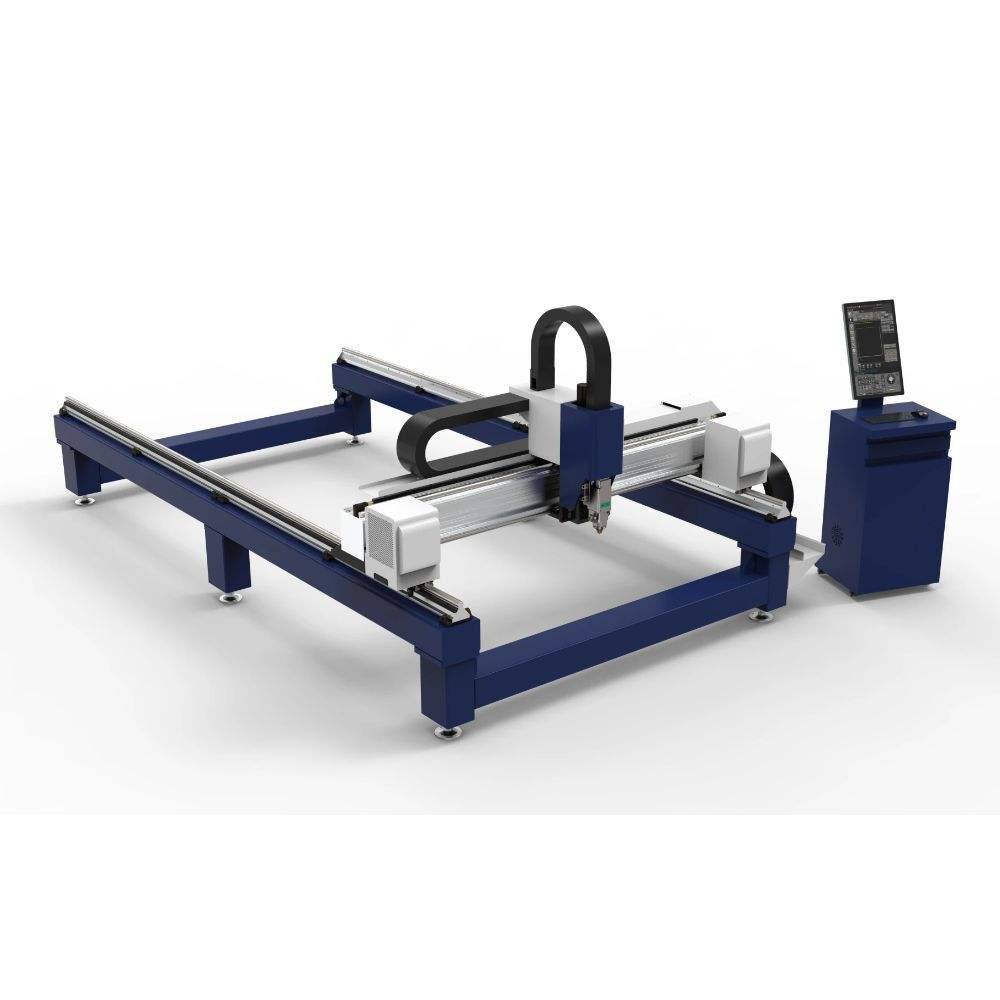
The head utilizes high-torque AC synchronous servo motors coupled with high-precision planetary reducers. This allows for a tilt angle (typically $\pm 45^\circ$) that can be maintained while the head orbits the profile. For crane manufacturers in Rosario, this is vital for creating complex weld preparations (V, Y, and K-type bevels) directly on the flange edges of heavy H-sections. The precision of this movement ensures that the root face and bevel angle remain constant, which is a prerequisite for automated robotic welding systems.
2.2 Path Optimization on Non-Linear Profiles
H-beams, unlike flat sheets, possess inherent geometric tolerances, including web off-center and flange tilt. The 3D head is integrated with a high-speed capacitive sensing system and laser displacement sensors. This allows the machine to map the actual profile of the beam in real-time. The “Infinite Rotation” capability allows the software to calculate the shortest path for the nozzle while maintaining a perpendicular or specific angular relationship to the material surface, regardless of the beam’s structural deviations.
3.0 6000W Fiber Laser Synergy in Heavy-Wall Processing
3.1 Power Density and Kerf Dynamics
A 6000W fiber laser source provides the optimal balance of power density and operating cost for the thicknesses typically encountered in crane manufacturing (ranging from 10mm to 25mm for H-beam webs and flanges). At 6kW, the beam quality ($M^2 < 1.1$) allows for a focused spot size that generates high vapor pressure within the kerf, effectively ejecting molten steel even at high aspect ratios.
In Rosario’s heavy industry, the transition from plasma to 6000W laser has resulted in a Heat Affected Zone (HAZ) reduction of approximately 80%. For high-tensile steels like S355 or S460, maintaining the metallurgical integrity of the base metal is crucial. The narrow kerf width (typically 0.2mm to 0.4mm) and minimal thermal input of the 6kW laser prevent grain growth and embrittlement at the cut edge, ensuring that crane booms can withstand cyclic loading without premature fatigue failure.
3.2 Gas Dynamics and Cut Quality
The system utilizes high-pressure Nitrogen ($N_2$) for thin-to-medium sections to achieve oxide-free cuts, and Oxygen ($O_2$) for thicker H-beam sections. The 6000W source allows for “High-Speed Oxygen Cutting,” which utilizes specialized nozzles to stabilize the O2 flow. This results in a surface roughness ($Rz$) that often eliminates the need for post-cut machining on pin-joint holes—a critical component in crane assembly where tolerances of H7/h6 are frequently required.
4.0 Applications in Crane Manufacturing
4.1 Telescopic Booms and Lattice Sections
The manufacturing of telescopic cranes involves the nesting of multiple structural sections. Precision is paramount; even a 1mm deviation over a 12-meter H-beam can lead to structural misalignment. The 6000W laser system, through its automatic centering and 3D compensation, ensures that longitudinal cuts and weight-reduction cutouts are executed with a linear accuracy of $\pm 0.05mm$ per meter.
4.2 Precision Hole Cutting for Pin Connections
In crane end-carriages, the alignment of bearing housings and pin connections is the most labor-intensive phase. Previously, these required radial drilling after the H-beam was welded. The 3D laser head allows for the cutting of “Ready-to-Assemble” holes. By utilizing the 6kW power to pierce quickly and the 3D head to compensate for the beam’s taper, the machine produces holes with minimal taper, allowing for the direct insertion of hardened pins or the tapping of threads without prior reaming.
5.0 Solving Secondary Processing Bottlenecks
5.1 Elimination of Manual Beveling
In the Rosario shipyard and crane factories, the “bottleneck” has traditionally been the welding prep area. Beveling an H-beam flange manually using a flame torch or a portable milling machine is slow and prone to human error. The 3D Infinite Rotation head executes these bevels during the primary cutting cycle. For a standard 400mm H-beam, the laser can cut the profile to length and apply a 30-degree bevel to all four flange edges in under four minutes—a task that previously took forty minutes of manual labor.
5.2 Software Integration (CAD/CAM to CNC)
The technical efficiency is bolstered by the integration of Tekla and SolidWorks files directly into the laser’s CAM software. The software automatically identifies H-beam parameters (flange width, web thickness, root radius) and applies the 3D cutting paths. This “digital twin” approach ensures that the physical part matches the structural engineer’s model exactly, which is critical for the “Modular Construction” techniques now being adopted in the Rosario industrial zone.
6.0 Operational Challenges and Mitigation
6.1 Material Handling and Clamping
Processing 12-meter H-beams requires a sophisticated chuck system. The machine employs a four-chuck configuration (fixed and movable) to provide continuous support, preventing beam “sag” which would interfere with 3D head clearance. In Rosario’s humid environment, the optical path must also be protected. The 6000W system uses a fully enclosed fiber delivery and a positive-pressure cutting head to prevent dust and moisture ingress, ensuring the longevity of the protective windows and collimating lenses.
6.2 Thermal Lensing and Beam Stability
At 6000W, thermal lensing—the slight deformation of the lens due to heat absorption—can shift the focal point. To mitigate this, the 3D head incorporates active water-cooling for the optics and an automated focal shift compensation algorithm within the CNC. This ensures that the cut quality remains consistent from the first meter of the H-beam to the last.
7.0 Conclusion
The deployment of the 6000W H-Beam Laser Cutting Machine with Infinite Rotation 3D Head is a transformative advancement for crane manufacturing in Rosario. By solving the precision issues associated with heavy structural steel and eliminating the need for secondary beveling and drilling, the technology offers a significant leap in throughput. The synergy between high-wattage fiber sources and multidimensional motion control ensures that the resulting structures meet the highest safety and fatigue-resistance standards required for modern heavy lifting equipment. The reduction in manual labor and the increase in “First-Time-Right” components mark this as the definitive standard for 21st-century steel structure processing.