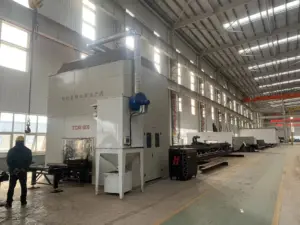
The Paradigm Shift in Structural Steel Fabrication
The construction of modern airports is a feat of engineering that demands both aesthetic grace and uncompromising structural integrity. In Rayong, where the expansion of aviation infrastructure is a cornerstone of the Thailand 4.0 initiative, the traditional methods of processing H-beams—the skeletal backbone of terminal buildings and hangars—are being phased out. For decades, fabricators relied on bandsaws for straight cuts and manual plasma torches for beveling and hole-making. These methods, while functional, introduced human error, necessitated extensive secondary grinding, and slowed down the supply chain.
The introduction of the 6000W fiber laser cutter specifically designed for H-beams changes the equation. As a fiber laser expert, I have observed that the 6kW power threshold is the “sweet spot” for structural steel. It provides enough energy to penetrate thick-walled flanges (up to 20mm-25mm for high-quality carbon steel) while maintaining a narrow kerf width that prevents material wastage. In the context of Rayong’s airport projects, this means structural components are delivered to the site with a degree of accuracy—down to 0.05mm—that was previously unthinkable in heavy industry.
Decoding the 6000W Fiber Laser Engine
At the heart of this machine is a 6000W fiber laser source. Unlike CO2 lasers, which require complex mirror alignments, the fiber laser is delivered through a flexible transport fiber. This is crucial for H-beam machines where the cutting head must move across a large gantry.
The 6kW output allows for “high-speed vaporization cutting.” When processing the web and flanges of an H-beam, the laser doesn’t just melt the metal; it vaporizes it instantly, with high-pressure nitrogen or oxygen blowing the dross away. This results in a “ready-to-weld” surface. For airport construction, where large-span roof trusses require hundreds of interlocking joints, the ability to produce clean, oxide-free cuts directly impacts the speed of the subsequent welding phase. Furthermore, the energy efficiency of a 6kW fiber source is approximately 30-40% higher than older technologies, a critical factor for Rayong-based factories looking to meet “Green Construction” certifications.
The Technical Marvel: Infinite Rotation 3D Heads
Perhaps the most significant innovation in this machine is the Five-Axis 3D Cutting Head with infinite rotation. Traditional laser heads are limited by cables and hoses, meaning they must “unwind” after a certain degree of rotation. An infinite rotation head utilizes advanced slip-ring technology and specialized optical pathways to spin 360 degrees (and beyond) without stopping.
Why is this vital for airport construction? Modern airport terminals, like the one currently expanding in the U-Tapao vicinity, often feature organic, sweeping architectural designs. This requires “bevel cutting”—the process of cutting the ends of H-beams at angles (V, X, Y, or K joints) to allow for perfect fitment during welding.
With an infinite rotation 3D head, the machine can perform complex beveling on all four sides of a beam in a single pass. It can oscillate to compensate for the “R-angle” (the curved inner corner where the flange meets the web), ensuring that holes and notches are perfectly placed even on non-flat surfaces. This eliminates the need to flip the heavy beam manually, which is both a safety risk and a massive time-sink.
Precision Engineering for Rayong’s Aviation Hub
Rayong’s climate and the proximity to the coast present unique challenges. Structural steel used in airport construction must be prepared for specialized anti-corrosion coatings. The precision of a 6000W laser ensures that the edges of the H-beam are not carbonized or overly heat-affected. A smaller Heat Affected Zone (HAZ) means the structural integrity of the steel remains intact, and coatings adhere better, extending the lifespan of the airport’s skeletal frame in the humid, saline environment of the Gulf of Thailand.
Furthermore, the software integration (typically using specialized 3D CAD/CAM packages like Lantek or CypCut) allows engineers at the Rayong site to feed BIM (Building Information Modeling) data directly into the machine. The H-beam laser then “reads” the beam using touch-probes or laser sensors to detect any slight warping—a common occurrence in long structural sections. The 3D head then automatically adjusts its cutting path to match the real-world dimensions of the steel, ensuring that every bolt hole lines up perfectly during site assembly.
Operational Efficiency and Labor Dynamics
The labor market in the Rayong industrial zone is becoming increasingly competitive. Skilled welders and fabricators are in high demand. By deploying a 6000W H-beam laser with a 3D head, a facility can replace four to five traditional processing machines (saws, drills, and manual plasma stations) with a single automated line.
In a typical airport hangar project, an H-beam might require:
1. Cutting to length.
2. Beveling for the primary joint.
3. Drilling 12-20 bolt holes.
4. Cutting “rat holes” (access holes for welding).
5. Etching part numbers for logistics tracking.
A 6000W laser performs all five tasks in a fraction of the time. What used to take four hours of manual labor now takes 15 minutes of automated laser processing. This high throughput is essential for the EEC’s ambitious timelines, where delays in structural delivery can lead to millions of dollars in liquidated damages.
Safety and Compliance in Airport Construction
Aviation construction is governed by some of the strictest safety codes in the world. Every notch and hole in a structural beam is a potential point of failure if not executed correctly. Micro-cracks caused by inferior cutting methods can propagate under the stress of the massive roof loads found in airport terminals.
The 6000W fiber laser provides a “cold-cutting” feel compared to plasma. Because the energy is so concentrated, the surrounding metal does not reach the high temperatures that cause metallurgical changes. The infinite rotation head ensures that the bevel angle is constant throughout the cut, providing a uniform gap for the robotic or manual welding that follows. This consistency makes it much easier to pass X-ray and ultrasonic weld inspections, which are mandatory for public infrastructure projects in Rayong.
The Future: Automation and Connectivity
As Rayong continues to evolve into a global logistics center, the 6000W H-beam laser is just the beginning. These machines are increasingly being connected to the “Industrial Internet of Things” (IIoT). Project managers at the airport construction site can receive real-time updates on how many beams have been processed and the exact time they will arrive on-site.
The infinite rotation 3D head also allows for creative architectural freedom. Architects are no longer limited by what a saw can cut. They can design complex “bird-mouth” joints and interlocking structural components that are both stronger and more aesthetically pleasing. For the Rayong airport project, this means a facility that is not just functional, but an architectural landmark for Thailand.
Conclusion
The deployment of a 6000W H-Beam laser cutting Machine with infinite rotation 3D technology in Rayong is more than just a capital investment; it is a strategic upgrade to the nation’s construction capability. As the U-Tapao Airport expansion and the surrounding EEC projects accelerate, the precision, speed, and versatility of fiber laser technology will be the “silent engine” driving the region’s growth. By eliminating secondary processing, reducing human error, and enabling complex 3D geometries, this technology ensures that the future of Thai infrastructure is built on a foundation of absolute precision and unmatched efficiency. For the fiber laser expert and the civil engineer alike, the message is clear: the era of manual structural fabrication is over; the era of the 3D laser has arrived.