The Logistics Epicenter: Why Dubai Demands High-Power Laser Precision
Dubai stands as the undisputed logistics gateway between the East and the West. With the massive expansion of the Jebel Ali Free Zone (JAFZA) and the continued growth of Dubai South, the demand for sophisticated storage racking systems—ranging from high-bay pallet racking to complex mezzanine structures—has reached an all-time high. In this environment, traditional methods of processing H-beams, such as mechanical sawing and manual drilling, are no longer commercially viable.
The storage racking industry requires absolute structural integrity combined with modular flexibility. H-beams (or Universal Beams) serve as the skeletal backbone of these systems. To meet the rigorous safety standards of the UAE and international codes, every bolt hole, notch, and miter cut must be executed with sub-millimeter accuracy. The 6000W H-Beam laser cutting Machine has emerged as the definitive solution, offering a leap in productivity that manual fabrication simply cannot match.
Unpacking the 6000W Fiber Laser: The Sweet Spot for Structural Steel
In the realm of fiber lasers, wattage is not merely a measure of speed; it is a measure of “processing range” and “edge quality.” For the structural steel typical of storage racking—where beam thicknesses often range from 6mm to 20mm—a 6000W power source represents the industrial “sweet spot.”
At 6000W, the laser beam maintains a high power density that allows for “high-speed nitrogen cutting” on thinner sections and “stable oxygen cutting” on thicker structural flanges. Unlike plasma cutting, which leaves a significant Heat Affected Zone (HAZ) and dross that requires secondary grinding, the 6000W fiber laser produces a clean, square edge. For a storage racking manufacturer in Dubai, this means components can move directly from the laser bed to the powder-coating line or the assembly site, eliminating hours of post-processing.
Furthermore, the wavelength of a fiber laser (approx. 1.06µm) is absorbed more efficiently by carbon steel than the 10.6µm wavelength of traditional CO2 lasers. This efficiency translates to lower electrical consumption—a critical factor for sustainable operations in the UAE’s push towards “Green Manufacturing.”
The Engineering Marvel: 3D Cutting and Four-Chuck Kinematics
Processing an H-beam is significantly more complex than cutting flat sheet metal. It involves navigating the web and the flanges of the beam, which requires a specialized 3D cutting head capable of tilting (often up to 45 degrees) to perform bevel cuts for weld preparations.
The 6000W machines deployed in Dubai’s leading fabrication shops typically feature a four-chuck system. This configuration is essential for “zero-tailing” waste management. Two chucks act as the feeders, while the third and fourth chucks stabilize the beam during the final cuts. In the context of expensive structural steel, the ability to use nearly 100% of the raw material by minimizing the “dead zone” at the end of the beam can save a high-volume racking manufacturer tens of thousands of dollars annually in scrap costs.
The software integration is equally vital. Modern machines utilize specialized nesting software that can import TEKLA or AutoCAD files directly. For a storage racking project, this means the machine automatically calculates the most efficient way to cut uprights and beams, including the complex interlocking joints required for boltless racking systems.
Automatic Unloading: Solving the Throughput Bottleneck
One of the most significant advancements in these machines is the integrated automatic unloading system. In many traditional setups, the laser cuts so fast that the human operators cannot clear the finished parts quickly enough, leading to “machine idle time.”
The automatic unloading system utilizes a series of hydraulic lifters and conveyor belts that synchronize with the cutting cycle. As the laser completes the final cut on an H-beam segment, the unloading arms support the piece, preventing it from dropping and potentially damaging the edges or the machine’s internal components. The part is then transported to a designated collection area.
In the high-temperature climate of Dubai, reducing the physical labor required to handle heavy steel beams is a significant occupational health and safety (OHS) victory. It allows the machine to operate in a “lights-out” capacity, continuing production during shift changes or even overnight, maximizing the ROI on the capital investment.
The “Dubai Factor”: Overcoming Environmental Challenges
Operating high-power fiber lasers in the Middle East requires specific engineering considerations that are often overlooked in temperate climates. Dubai’s ambient temperatures can soar, and despite being indoors, factory floors can become punishing environments for sensitive optics.
The 6000W H-Beam machines used in this region are equipped with high-capacity, dual-circuit industrial chillers. These units precisely regulate the temperature of both the fiber laser source and the cutting head. Additionally, the machines feature pressurized cabinets for the electrical components to prevent the ingress of fine desert dust, which can be catastrophic for high-voltage laser components.
Furthermore, the local service ecosystem in Dubai has evolved. Leading manufacturers now provide 24/7 remote monitoring. If a 6000W laser in a Jebel Ali facility experiences a beam misalignment or a software glitch, technicians can often diagnose and calibrate the system via the cloud, ensuring that the critical supply chain for storage racking remains uninterrupted.
ROI Analysis: Why Racking Manufacturers are Switching
The capital expenditure for a 6000W H-Beam Laser with automatic unloading is substantial, but the Return on Investment (ROI) is compelling for the Dubai market.
1. **Labor Reduction:** A single laser machine can replace the output of three separate traditional lines (sawing, drilling, and milling), reducing the head-count required for structural fabrication.
2. **Accuracy for Automated Warehousing:** Dubai is seeing a surge in Automated Storage and Retrieval Systems (ASRS). These systems have extremely tight tolerances. A beam that is off by 2mm can cause a robotic crane to jam. The fiber laser ensures +/- 0.05mm accuracy, making it the only choice for ASRS fabrication.
3. **Speed to Market:** In the fast-paced Dubai real estate and logistics market, warehouse completion deadlines are aggressive. The 6000W laser can process an entire H-beam, including all holes and bevels, in a fraction of the time of traditional methods, allowing contractors to meet “impossible” deadlines.
Sustainability and the Future of Steel Fabrication in the UAE
As the UAE moves toward its “Net Zero 2050” initiative, the efficiency of fiber laser technology plays a major role. By reducing material waste through precision nesting and lowering energy consumption per cut compared to older technologies, the 6000W H-beam laser aligns with the nation’s sustainability goals.
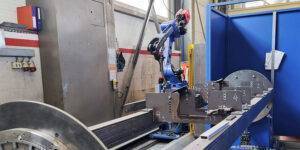
The future of this technology in Dubai lies in further integration. We are already seeing the first steps toward fully autonomous “Steel Service Centers” where raw H-beams are loaded by AGVs (Automated Guided Vehicles), cut by the 6000W laser, and moved to robotic welding cells without human intervention.
Conclusion: The Edge in Competitive Logistics
For manufacturers of storage racking in Dubai, the 6000W H-Beam Laser Cutting Machine with Automatic Unloading is no longer a luxury—it is a strategic necessity. It represents the intersection of power, precision, and automation. By adopting this technology, UAE-based companies are not just building shelves; they are building the infrastructure of global commerce with a level of efficiency that reinforces Dubai’s status as a world-class center of industrial excellence. As a fiber laser expert, I see this as the definitive standard for the next decade of structural steel fabrication.