The Industrial Evolution of Casablanca’s Crane Manufacturing
Casablanca, as the economic engine of Morocco and a vital gateway to African trade, is currently witnessing a massive expansion in infrastructure and port logistics. From the expansion of Casablanca Port to the satellite developments in Mohammedia, the demand for high-capacity cranes—overhead, gantry, and tower—has never been higher. However, for local manufacturers, the challenge has always been the speed and precision of processing structural steel, specifically H-beams, I-beams, and channels.
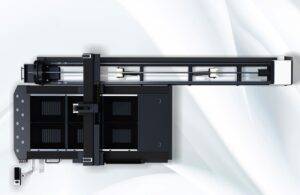
Traditional methods involved a fragmented workflow: mechanical sawing to length, manual layout marking, radial drilling for bolt holes, and manual oxy-fuel or plasma cutting for notches and bevels. This manual chain is prone to human error, leading to structural misalignments that can be catastrophic in crane manufacturing. The introduction of the 6000W H-Beam laser cutting Machine with Automatic Unloading has transformed this multi-step process into a single, automated operation, ensuring that every beam produced in Casablanca meets international safety and quality standards.
The Power of 6000W: Why Wattage Matters for Structural Steel
In the realm of fiber lasers, 6000W is the “sweet spot” for structural steel fabrication. While lower power lasers struggle with the thickness of heavy H-beam flanges, a 6000W source provides the necessary energy density to slice through carbon steel up to 25mm or more with clean, dross-free edges.
For crane manufacturers, this power translates to speed. A 6000W laser can process the web and flanges of an H-beam significantly faster than a plasma torch, without the heat-affected zone (HAZ) that can weaken the molecular integrity of the steel. In crane manufacturing, where the “fatigue life” of a girder is paramount, the minimal thermal distortion provided by a fiber laser is a critical engineering advantage. Furthermore, the 6000W output allows for high-speed “flying cuts” on thinner sections, drastically reducing the cycle time per beam.
Advanced H-Beam Processing: Beyond Simple Cutting
Cutting an H-beam is far more complex than cutting a flat sheet. It requires a machine capable of 3D spatial movement. Modern 6000W H-beam lasers utilize a sophisticated chuck system—often a four-chuck configuration—that allows the beam to be rotated and moved along the X, Y, and Z axes with zero tailing (waste).
The laser head itself is usually equipped with a 5-axis or 3D swing capability. This allows for bevel cutting (up to 45 degrees), which is essential for weld preparation. In crane manufacturing, joining two massive H-beams requires a deep-penetration weld. By laser-beveling the edges during the cutting process, the machine eliminates the need for secondary grinding or manual edge preparation. The beams go straight from the laser to the welding station, perfectly prepped for a full-strength structural bond.
The Game Changer: Automatic Unloading Systems
One of the most significant risks in a Casablanca fabrication shop is the manual handling of heavy structural members. An H-beam can weigh several tons, and the logistics of moving a finished piece out of the machine to make room for the next raw beam often creates a bottleneck.
The automatic unloading system solves this through integrated hydraulic lifters and conveyor belts. Once the 6000W laser completes its program, the machine’s CNC communicates with the unloading module. The finished H-beam is systematically moved to a storage rack or the next stage of the assembly line without human intervention. This not only increases safety by reducing the use of overhead workshop cranes for internal movement but also allows the laser to operate at a 95% duty cycle. While one beam is being unloaded, the next is already being fed into the chucks. In a high-output environment like a crane factory, this “non-stop” processing can double the daily tonnage output.
Precision Engineering for Crane Safety
Cranes are subject to extreme dynamic loads. The holes for pins and bolts must be perfectly circular and positioned with sub-millimeter accuracy. Conventional drilling can lead to “walking” of the bit, resulting in slightly offset holes that require reaming or “forcing” during assembly.
A 6000W fiber laser uses high-precision rack-and-pinion systems and Japanese or German servo motors to ensure positional accuracy of ±0.05mm. When a Casablanca manufacturer produces a 30-meter gantry girder composed of several H-beam segments, the laser ensures that every bolt hole aligns perfectly across the entire span. This precision reduces internal stresses in the crane structure, leading to a longer service life and higher safety ratings for the end-user.
Economic Impact on the Moroccan Market
The investment in a 6000W H-Beam Laser Cutting Machine is a strategic move for Moroccan firms looking to compete internationally. Traditionally, many complex structural components were imported from Europe or China. By localizing this high-tech capability in Casablanca, manufacturers can reduce lead times from months to weeks.
Furthermore, the fiber laser is remarkably energy-efficient compared to older CO2 lasers or high-definition plasma systems. Given the rising energy costs in North Africa, the high wall-plug efficiency of fiber technology (often exceeding 35%) ensures that the cost-per-cut remains competitive. The reduction in scrap—thanks to nesting software that optimizes the cut path on each H-beam—further enhances the bottom line.
Overcoming Casablanca’s Environmental Challenges
Operating high-power lasers in a coastal industrial city like Casablanca presents specific challenges, notably humidity and salt-laden air, which can be corrosive to sensitive optics and electronics.
Expert-level H-beam laser systems designed for this region feature pressurized, climate-controlled electrical cabinets and dust-extraction systems with HEPA filtration. The laser source itself is typically housed in a sealed, air-conditioned “power room” within the machine’s frame to prevent any atmospheric contaminants from interfering with the beam quality. Regular maintenance protocols, supported by local service technicians in Casablanca, ensure that the 6000W source maintains its peak power for over 100,000 hours of operation.
Software Integration: The “Brain” of the Machine
The hardware is only as good as the software driving it. For crane manufacturing, the ability to import CAD/Madrigal files directly into the laser’s CNC is vital. Advanced nesting software specifically for profiles (like TubesT or similar) allows engineers to visualize the H-beam in 3D, simulate the cut to prevent collisions, and optimize the sequence to minimize heat buildup.
In Casablanca’s fast-paced workshops, this digital workflow means that an engineer can design a custom crane bracket in the office and have it being cut on the shop floor within minutes. This agility allows Moroccan manufacturers to take on bespoke projects—such as custom-sized cranes for specific shipyard footprints—that larger, more rigid international competitors might avoid.
The Future of Casablanca’s Heavy Industry
As we look toward the future, the 6000W H-Beam Laser Cutting Machine with Automatic Unloading is more than just a tool; it is a statement of industrial maturity. For the crane manufacturing industry in Casablanca, it represents the move toward “Industry 4.0.”
The data collected by these machines—cutting hours, gas consumption, and part counts—can be integrated into Enterprise Resource Planning (ERP) systems, allowing managers to track production in real-time. As Casablanca continues to position itself as a global logistics hub, the ability to build the infrastructure that moves the world’s cargo—the cranes—using the world’s most advanced laser technology is a testament to the region’s industrial ambition.
Conclusion
The marriage of 6000W fiber laser power with specialized H-beam handling and automated unloading is the ultimate solution for modern crane manufacturing. For the factories of Casablanca, this technology eliminates the inefficiencies of the past and replaces them with a streamlined, safe, and ultra-precise production line. By investing in such high-caliber machinery, Moroccan manufacturers are not just cutting steel; they are building the backbone of the nation’s future infrastructure with surgical precision.