1.0 Executive Summary: The Structural Shift in Railway Fabrication
The modernization of India’s railway infrastructure, specifically within the Pune industrial corridor—encompassing the Pune Metro Phase II and the expansion of heavy-load freight junctions—has necessitated a paradigm shift in structural steel processing. Traditional methods involving band saws, radial drills, and manual plasma gouging are no longer sufficient to meet the stringent tolerances and throughput requirements of modern engineering. This report evaluates the deployment of 6000W CNC Beam and Channel Laser Cutters equipped with ±45° beveling heads. The focus is on the transition from multi-stage mechanical processing to a single-pass automated laser workflow for H-beams, I-beams, and C-channels.
2.0 Technical Specifications and Kinematics of the 6000W Source
The 6000W fiber laser source represents the optimal power-to-thickness ratio for structural steel applications in the railway sector. Unlike lower-wattage systems that struggle with the high thermal mass of thick-walled channels (typically 12mm to 24mm), the 6000W density allows for high-speed sublimation and melt-expulsion cutting.
2.1 Beam Parameter Product (BPP) and Kerf Control
At 6000W, the Beam Parameter Product (BPP) is tuned to maintain a consistent focal spot even across the varying thicknesses of a tapered flange in an I-beam. For Pune-based fabricators utilizing IS 2062 Grade E250 or E350 steel, the laser provides a narrow kerf width (0.3mm to 0.5mm), which is critical for the interference fits required in railway bridge trusses. The ability to modulate pulse frequency and duty cycle prevents “over-burn” at the corners of C-channels, a common failure point in traditional plasma systems.
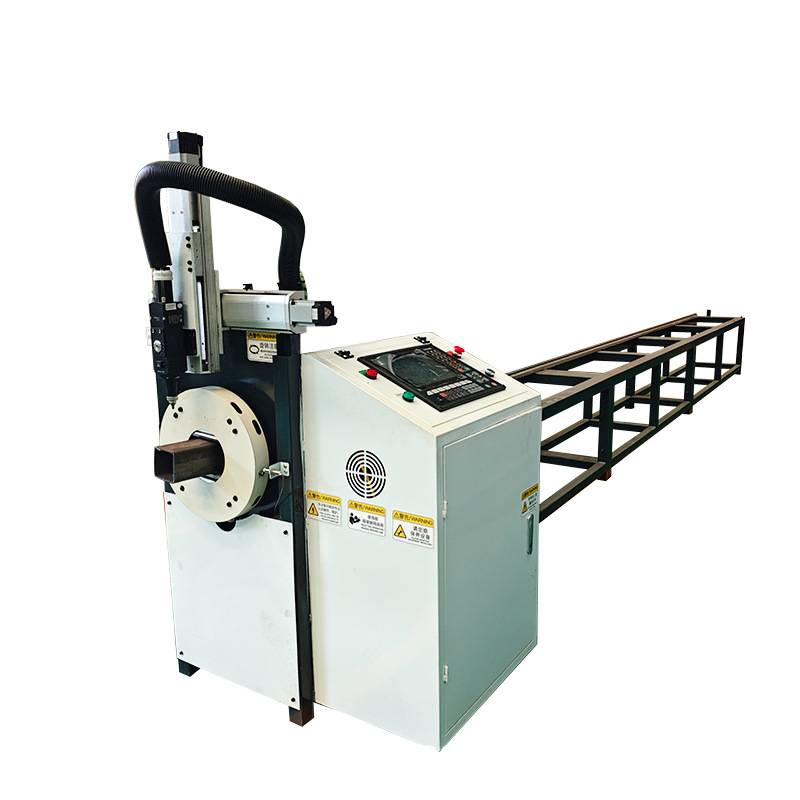
3.0 The ±45° Beveling Head: Solving the Weld Preparation Bottleneck
The primary technical hurdle in heavy steel fabrication has historically been the “secondary process” bottleneck. Beams must usually be cut to length, then moved to a separate station for beveling (weld preparation). The integration of a 5-axis or 6-axis ±45° beveling head directly onto the CNC beam cutter resolves this inefficiency.
3.1 Geometric Versatility in Railway Girders
Railway infrastructure requires various groove profiles—V, X, Y, and K-type—to ensure full-penetration welds in load-bearing members. The ±45° beveling capability allows the 6000W laser to execute these profiles in a single pass. In Pune’s fabrication yards, this technology is being used to create complex miter joints for overhead electrification (OHE) structures and station roof trusses where beams meet at non-orthogonal angles. The precision of the ±45° sweep ensures that the root face and bevel angle remain constant, reducing the volume of weld metal required and minimizing the Heat Affected Zone (HAZ).
3.2 Mitigating Thermal Distortion
Manual oxy-fuel beveling introduces significant heat into the structural member, often leading to longitudinal bowing or twisting. The 6000W fiber laser, due to its high energy density and feed rate (up to 2.5 m/min on 12mm bevels), limits heat soak. This ensures that the structural integrity of the beam is maintained, and the dimensions remain within the ±0.5mm tolerance over a 12-meter span—a requirement often cited by the Research Designs and Standards Organisation (RDSO).
4.0 Application in Pune’s Railway Infrastructure Projects
Pune serves as a critical node for both the Central Railway and the expanding Metro Rail. The specific challenges of this region include high-volume production of sleepers, support pillars, and cross-girders for elevated tracks.
4.1 High-Speed Channel Processing for Electrification
The CNC Beam Laser’s ability to handle C-channels (up to 400mm) is pivotal for the fabrication of OHE masts. Conventional punching and shearing often cause micro-cracking around bolt holes. The laser, however, executes holes and slots with a surface finish that requires no post-processing. In a field study of a Pune-based project, the 6000W laser reduced the processing time per mast from 45 minutes (manual/mechanical) to under 6 minutes.
4.2 Intersection Cutting for Complex Trusses
Pune’s new railway station expansions feature aesthetic and complex architectural steel. The ±45° beveling head enables “fish-mouth” cuts and complex intersecting geometries where tubular or channeled members meet. The software-driven CNC interface allows for the import of Tekla or AutoCAD files, automatically calculating the compensation for the beam’s rotation and the bevel angle relative to the material thickness.
5.0 Automation and Material Handling: The 4-Chuck Synergy
The efficiency of the 6000W laser is maximized by the mechanical configuration of the machine, typically a multi-chuck system (3 or 4 chucks) that facilitates “zero-tailing” and heavy-duty support.
5.1 Structural Stability and Vibration Damping
Processing a 12-meter H-beam weighing several hundred kilograms requires a rigid bed and high-torque servomotors. The CNC systems deployed in Pune utilize an automated loading and unloading sequence. The 4-chuck system allows for the beam to be rotated 360° with absolute concentricity. This is vital when the beveling head must transition from the web to the flange of a beam without losing the coordinate datum. The 6000W source is synchronized with these movements to adjust the focus height (Z-axis) in real-time, compensating for any mill-scale irregularities or slight deviations in the beam’s straightness.
6.0 Metallurgical Considerations and Edge Quality
In railway engineering, the edge quality of a cut is a safety-critical factor. Rough edges act as stress concentrators, leading to fatigue failure under the cyclic loading of passing trains.
6.1 HAZ Analysis and Surface Finish
The 6000W fiber laser produces a significantly narrower Heat Affected Zone (HAZ) compared to plasma cutting. Microstructural analysis of 16mm thick IS 2062 steel cut with the beveling head shows a HAZ depth of less than 0.2mm. Furthermore, the dross-free finish on 45° bevels ensures that the subsequent welding process achieves superior fusion. For Pune’s railway contractors, this eliminates the need for manual grinding, which is both labor-intensive and inconsistent.
7.0 Economic and Operational Impact (Pune Field Data)
Based on operational data from Tier-1 fabricators in the Pimpri-Chinchwad industrial belt, the implementation of 6000W CNC Beam Lasers has resulted in:
- Labor Reduction: 70% decrease in manual labor required for marking, cutting, and grinding.
- Material Yield: 12-15% improvement due to optimized nesting of components on a single beam length.
- Downstream Efficiency: 30% faster assembly times at the construction site because components fit perfectly without field-rectification.
8.0 Conclusion: The Standard for Modern Structural Engineering
The integration of 6000W fiber laser sources with ±45° beveling technology is no longer an optional upgrade but a fundamental requirement for large-scale railway infrastructure projects. In Pune, where the demand for precision and volume is accelerating, this technology solves the dual problem of speed and structural integrity. By consolidating cutting, drilling, and beveling into a single automated CNC process, the industry can meet the rigorous standards of the RDSO while significantly reducing the project lifecycle duration. The technical superiority of the laser’s precision, combined with the versatility of the beveling head, establishes a new benchmark for structural steel fabrication in the Indian market.













