1.0 Executive Summary: The Structural Shift in Rayong’s Industrial Corridor
In the industrial heart of Rayong, particularly within the Eastern Economic Corridor (EEC), the demand for modular construction in the petrochemical, energy, and logistics sectors has reached a critical inflection point. Traditional fabrication methods—characterized by manual plasma cutting, mechanical sawing, and secondary oxy-fuel beveling—are no longer sufficient to meet the rigorous tolerances required for large-scale modular assembly. This report evaluates the field performance of the 6000W CNC Beam and Channel Laser Cutter, specifically focusing on its ±45° beveling capabilities and its transformative impact on structural steel throughput.
2.0 System Architecture and the 6000W Photon Density Advantage
The integration of a 6000W fiber laser source into a multi-axis structural CNC platform represents a significant leap in power density. At 6kW, the system achieves a stabilized energy profile capable of penetrating heavy-walled carbon steel sections (up to 20mm–25mm depending on material grade) with a significantly reduced Heat Affected Zone (HAZ) compared to plasma equivalents.
2.1 Fiber Laser Synergy with Beam Kinematics
The 6000W source is coupled with a high-dynamic 5-axis cutting head. Unlike flat-sheet lasers, beam processing requires the laser head to navigate the complex geometry of H-beams, I-beams, and C-channels. The power density allows for high-speed “fly-cutting” on thinner webs, while maintaining the torque and stability required for the slow-speed, high-precision maneuvers necessary when transitioning from the flange to the web of a structural member.
3.0 ±45° Bevel Cutting: Engineering Precision in Weld Preparation
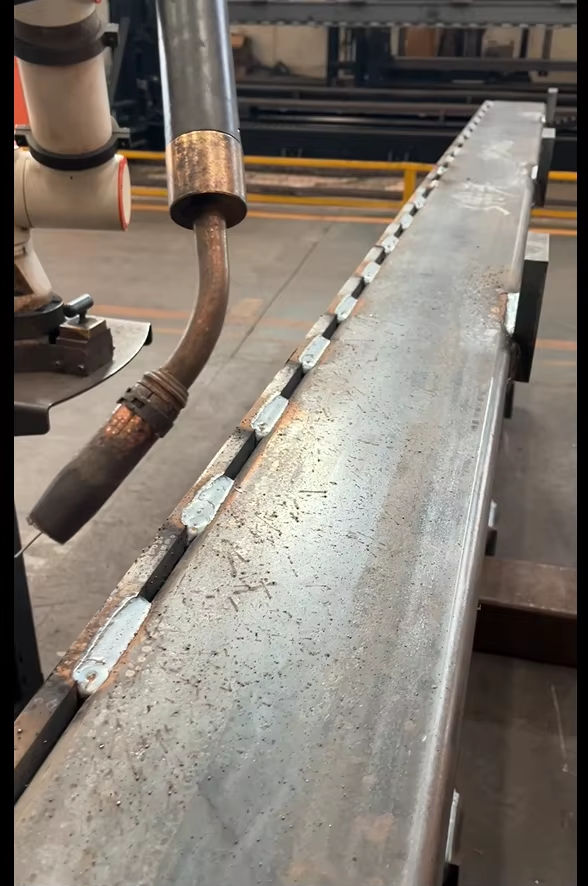
The core technical differentiator of this system is the ±45° 3D beveling head. In modular construction, structural integrity depends on the quality of the weld joints between primary and secondary members. Traditionally, beveling for V, Y, or K-type joints was a secondary process involving manual grinding or portable beveling machines.
3.1 Eliminating Secondary Processing
The CNC laser system executes the bevel simultaneously with the length-cut or hole-profiling. By tilting the head up to 45 degrees, the machine produces “weld-ready” edges. This is critical for Rayong’s modular fabricators who must adhere to international standards such as AWS D1.1. The precision of the CNC-controlled bevel ensures a uniform root gap and land thickness across the entire length of the joint, which is virtually impossible to achieve consistently with manual methods.
3.2 Complex Geometry Intersections
Modular frames often require “fish-mouth” cuts or complex cope joints where a channel meets a beam at an oblique angle. The ±45° capability allows the laser to follow the contour of the intersection while maintaining the correct weld prep angle. This geometric accuracy reduces the volume of filler metal required during welding and minimizes internal stresses caused by poor fit-up.
4.0 Application in Modular Construction: A Case Study in Rayong
The modular construction sector in Rayong focuses on the pre-assembly of pipe racks, offshore modules, and skid-mounted equipment. These structures require extreme repeatability. If a single beam in a 50-unit module series is out of tolerance by 2mm, the cumulative error can derail the entire assembly line.
4.1 Tolerance Management and Fit-Up
Field data indicates that the 6000W CNC laser maintains a dimensional tolerance of ±0.3mm over a 12-meter beam length. In the context of “plug-and-play” modularity, this precision ensures that bolted connections align perfectly without the need for field reaming or structural forcing. The laser’s ability to cut bolt holes with zero taper—even in thick flanges—is a direct result of the high-power density and optimized gas flow dynamics of the 6000W head.
4.2 Material Handling and Throughput
In the Rayong facility, the synergy between the 6000W source and the automatic loading/unloading system has reduced the production cycle of a standard 6-meter H-beam with multiple cope cuts and bolt holes from 45 minutes (manual) to under 6 minutes. The automation of the structural processing line allows for continuous operation, which is vital for meeting the aggressive timelines of petrochemical expansion projects.
5.0 Technical Analysis of Structural Processing Synergy
The efficiency of the CNC Beam and Channel Laser is not solely dependent on raw power, but on the software-hardware integration that manages the structural variables unique to long-form steel.
5.1 Real-time Compensation for Beam Deformation
Structural steel is rarely perfectly straight. Channels and beams often exhibit “camber” or “sweep” from the rolling mill. The evaluated system utilizes touch-probe sensors or laser scanning to map the actual profile of the beam before cutting. The CNC controller then adjusts the cutting path in real-time to ensure that the ±45° bevel remains concentric to the beam’s actual centerline, rather than the theoretical CAD model. This compensation is crucial for maintaining structural geometry in heavy-duty modular frames.
5.2 Nesting and Material Optimization
Advanced nesting algorithms specifically designed for 3D profiles allow for the “common line cutting” of beams and channels. By sharing a single cut path between two parts—including the bevel—the system reduces scrap rates by 8-12%. In a high-volume environment like Rayong, where raw material costs fluctuate, this level of optimization contributes directly to the project’s bottom line.
6.0 Metallurgical Considerations and Edge Quality
A frequent concern in heavy structural laser cutting is the Heat Affected Zone (HAZ). At 6000W, the cutting speed is high enough that the heat input into the base material is localized. Micro-hardness testing on S355JR steel sections processed in the field shows a negligible increase in hardness at the cut edge. This ensures that the bevelled edge remains ductile and does not develop micro-cracks during the subsequent welding process or under the cyclic loading conditions typical of industrial modules.
7.0 Environmental and Infrastructure Factors in Rayong
Operating high-power fiber lasers in Rayong presents specific environmental challenges, primarily high humidity and ambient temperatures. The field report confirms that the integration of industrial-grade chillers and pressurized, filtered optical paths is mandatory. The 6000W system’s internal climate control for the power supply and the cutting head optics has proven effective in preventing condensation-related failures, which are a common failure point for lesser-specced machines in the region.
8.0 Conclusion: The Engineering Verdict
The deployment of the 6000W CNC Beam and Channel Laser Cutter with ±45° bevel technology represents a fundamental upgrade to the modular construction workflow. By consolidating the functions of a saw, a drill, and a manual beveling station into a single automated process, fabricators in Rayong can achieve a level of precision that was previously cost-prohibitive.
The ability to produce weld-ready, complex structural intersections with sub-millimeter accuracy directly addresses the primary bottlenecks in heavy steel processing. For senior project managers and structural engineers, the ROI is found not just in the speed of the cut, but in the elimination of secondary labor, the reduction in weld-filler consumption, and the absolute certainty of fit-up during modular assembly. This technology is the prerequisite for the next generation of industrial infrastructure fabrication.