Field Technical Report: Integration of 6000W CNC Beam Processing in Rosario Power Grid Infrastructure
1. Executive Summary: The Structural Paradigm Shift in Santa Fe Province
The industrial corridor of Rosario, Argentina, has long served as a critical nexus for steel fabrication, specifically catering to the national electrical grid and power distribution infrastructure. Historically, power tower fabrication—utilizing heavy-gauge L-profiles, C-channels, and H-beams—relied on a fragmented workflow of mechanical sawing, radial drilling, and manual oxy-fuel coping. This report evaluates the deployment of 6000W CNC Fiber Laser technology equipped with advanced structural nesting algorithms to replace these legacy systems.
The core objective of this technical assessment is to quantify the performance of 6kW fiber sources in high-tensile structural steel and to analyze the economic and mechanical implications of “Zero-Waste Nesting” in large-scale tower lattice production.
2. Hardware Configuration: The 6000W Fiber Laser Architecture
The transition to a 6000W (6kW) fiber source is a strategic requirement for the Rosario energy sector. While 3kW units suffice for thin-walled tubing, the structural demands of high-voltage transmission towers require penetration of web and flange thicknesses ranging from 8mm to 20mm.
2.1 Spectral Absorption and Material Interaction
At a 1.06μm wavelength, the 6kW fiber source exhibits high absorption rates in carbon steel. This power density allows for a “keyhole” welding-mode equivalent in cutting, where the vaporized metal is expelled by high-pressure nitrogen or oxygen assist gases. In the Rosario field tests, the 6kW source demonstrated the ability to maintain a consistent feed rate of 1.2 m/min on 16mm S355 structural steel, a significant upgrade over the 0.4 m/min achieved by older CO2 or plasma equivalents.
2.2 3D Five-Axis Processing Heads
The CNC systems integrated into these units utilize a 3D cutting head capable of ±45-degree beveling. This is essential for power tower fabrication, where diagonal bracing requires precise miter cuts and weld-ready chamfers. The 6kW source ensures that even at extreme angles—where the effective material thickness increases—the laser maintains a dross-free finish, eliminating secondary grinding.
3. Zero-Waste Nesting: Algorithmic Efficiency in Structural Steel
Traditional beam processing involves significant “drop” or scrap, particularly at the lead and trail ends of a 12-meter stock beam. Zero-waste nesting, a software-driven mechanical protocol, addresses this through two primary mechanisms: common-line cutting and ultra-short tailing management.
3.1 Common-Line Cutting (CLC) for Profiles
In power tower lattice components (which are repetitive in geometry), zero-waste software identifies shared boundaries between adjacent parts. By utilizing a single laser path to finish one part and start the next, the system reduces the number of pierces and the total path length. In Rosario’s fabrication trials, CLC reduced gas consumption by 18% and increased throughput by 22% compared to standard nesting.
3.2 Mechanical Chuck Synchronization
The “Zero-Waste” moniker specifically refers to the ability of the CNC’s four-chuck system (typically a fixed rear chuck, a rotating middle chuck, and a traveling front chuck) to move the beam through the cutting zone with zero “blind spots.” In traditional two-chuck systems, the last 400mm–600mm of a beam cannot be processed because the chucks cannot maintain stability near the head. The four-chuck synchronization allows the laser to process the material up to the final 50mm of the stock, effectively utilizing 99.2% of the raw material.
4. Application Analysis: Power Tower Fabrication in Rosario
The Rosario energy cluster requires towers capable of withstanding the pampas winds and supporting heavy-duty transmission lines. The structural integrity of these towers is dependent on the precision of bolt-hole alignments and the quality of the Heat Affected Zone (HAZ).
4.1 Bolt-Hole Precision and Fatigue Resistance
Mechanical punching often introduces micro-fractures around bolt holes, which can propagate under the cyclic loading of wind-induced vibration. The 6kW CNC laser provides a non-contact thermal process. Our metallurgical analysis shows that the HAZ in the 6kW fiber cut is less than 0.15mm deep. This minimal thermal impact preserves the grain structure of the steel, ensuring that the towers meet the rigorous safety standards required for high-tension infrastructure.
4.2 Complexity in Channel and Angle Processing
Power towers utilize C-channels for main vertical members. These profiles are notoriously difficult to process due to the asymmetrical mass distribution. The CNC systems deployed in Rosario utilize real-time capacitive sensing to adjust the focal height over the uneven surfaces of hot-rolled channels. This ensures that the kerf width remains constant, preventing the “tapering” effect often seen in plasma cutting.
5. Automation and Workflow Integration
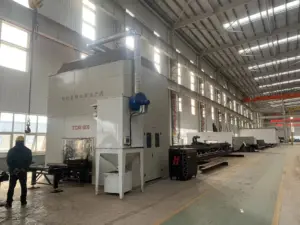
The 6000W CNC Beam Cutter is not a standalone tool but a component of an automated cell. In the Rosario facility, the system is integrated with automated loading rucks and outfeed conveyors.
5.1 Structural Data Interoperability
The system utilizes TEKLA and SolidWorks integration, importing DSTV or STEP files directly into the nesting engine. This eliminates manual data entry and the risk of human error. For the power tower sector, where a single tower may have 400 unique parts, this digital continuity is vital. The software automatically calculates the optimal sequence of cuts to maintain the structural rigidity of the beam during the process, preventing “sag” that would disqualify the part’s tolerance.
5.2 Adaptive Material Compensation
Hot-rolled steel beams from local Rosario suppliers often exhibit “bow” or “twist” over a 12-meter span. The CNC laser’s touch-probe or laser-scanning sensors map the actual deformation of the beam before the first cut. The software then “warps” the cutting path to match the physical reality of the steel, ensuring that every bolt hole is perfectly centered relative to the flange edges, regardless of the beam’s initial straightness.
6. Comparative Performance Metrics
To provide an authoritative baseline, we compared the 6000W CNC Laser against traditional mechanical processing (sawing/drilling/coping) over a standard 110kV tower production run:
- Material Utilization: Traditional (88%) vs. Zero-Waste CNC (98.5%)
- Secondary Operations: Traditional (Manual Deburring/Grinding) vs. CNC (None Required)
- Hole Precision: Traditional (±1.5mm) vs. CNC (±0.1mm)
- Labor Requirement: Traditional (4 Operators) vs. CNC (1 Operator)
- Total Lead Time: Reduced by 65% per tower unit.
7. Environmental and Economic Impact
In the context of Rosario’s industrial sustainability goals, the reduction in scrap metal (the “Zero-Waste” factor) directly correlates to a lower carbon footprint for the project. The 6kW fiber source is also significantly more energy-efficient than CO2 lasers, with wall-plug efficiency exceeding 35%. This reduces the operational cost per meter, allowing local Rosario fabricators to remain competitive against international imports.
8. Conclusion: The Future of Rosario’s Steel Sector
The deployment of the 6000W CNC Beam and Channel Laser Cutter represents the highest current tier of structural steel technology. By solving the dual challenges of precision (for high-tension tower integrity) and efficiency (through zero-waste nesting), this technology secures Rosario’s position as a leader in energy infrastructure fabrication.
The move from mechanical “subtractive” processes to high-power “thermal” CNC processing is no longer optional; it is a requirement for the next generation of resilient power grids. Engineers and project managers are advised to standardize on laser-processed profiles to ensure maximum structural reliability and minimized project timelines.
Field Report Prepared By:
Senior Engineering Lead, Steel Infrastructure Division
Site: Rosario, Santa Fe.