The Evolution of Structural Steel Processing in Dubai’s Railway Sector
Dubai’s infrastructure is synonymous with ambition and precision. From the expansion of the Dubai Metro to the monumental progress of Etihad Rail, the backbone of these projects is structural steel. Historically, the fabrication of heavy beams and channels relied on mechanical sawing, drilling, and plasma cutting. However, these methods often necessitate secondary finishing processes, such as grinding or deburring, which increase labor costs and project timelines.
The introduction of the 6000W CNC Beam and Channel Laser Cutter has redefined these standards. In an environment where heat and humidity can affect material behavior, the fiber laser offers a non-contact, high-velocity solution. By utilizing a 6000W resonance, fabricators can pierce through thick-walled carbon steel and stainless steel with surgical precision, ensuring that every bolt hole, notch, and bevel is perfectly aligned for rapid on-site assembly.
The 6000W Fiber Advantage: Power and Efficiency
In the realm of fiber lasers, 6000W is widely considered the “sweet spot” for structural engineering. While higher wattages exist, the 6000W threshold provides the optimal balance between capital investment and cutting capability for the gauges typically found in railway bridges, station frames, and support pillars.
For railway infrastructure, the ability to cut through 16mm to 25mm carbon steel with high feed rates is critical. The 6000W laser source generates a high-density beam that minimizes the Heat Affected Zone (HAZ). This is particularly vital in rail applications where the metallurgical integrity of the beam is paramount. A smaller HAZ means less thermal deformation, ensuring that long-span beams remain perfectly straight and within the tight tolerances required for high-speed rail alignment.
The Infinite Rotation 3D Head: Five-Axis Freedom
The true “brain” of this system is the 3D infinite rotation head. Traditional 2D lasers are limited to flat sheets, but railway infrastructure demands the processing of three-dimensional profiles like H-beams and U-channels.
The “infinite rotation” capability refers to a 5-axis head that can rotate 360 degrees (and beyond) without the need to “unwind” cables. This allows for continuous beveling and complex geometry cutting across all sides of a beam in a single pass. For Dubai’s architects and engineers, this means the ability to create complex “bird-mouth” joints and miter cuts that allow beams to interlock with zero gap. This level of precision is essential for the aesthetic and structural requirements of modern rail stations, where exposed steelwork is often a key architectural feature.
Precision Processing of Beams and Channels
Railway infrastructure utilizes a variety of profiles, including I-beams for load-bearing, C-channels for secondary supports, and square tubing for overhead line equipment (OLE). Processing these on a standard machine is cumbersome.
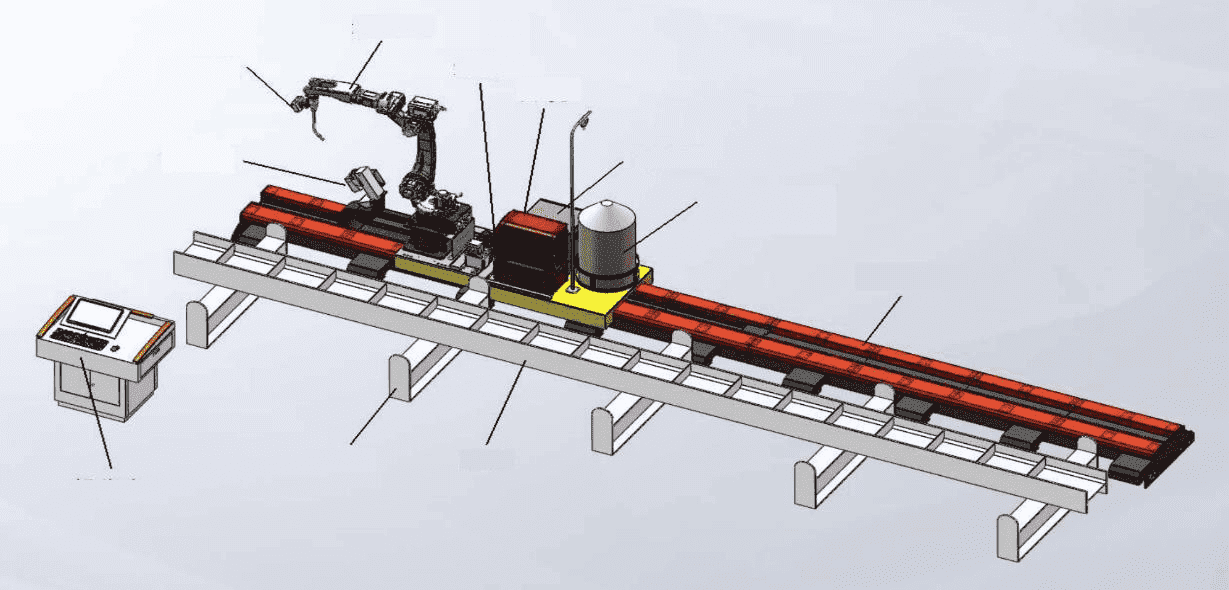
The specialized CNC laser cutter for beams utilizes a “through-hole” chuck system or a multi-point robotic feeding system. As the beam moves through the machine, the 3D head maneuvers around the profile.
– **H-Beams and I-Beams:** The laser can cut through the flange and the web simultaneously, creating slots for interlocking cross-members.
– **Channels and Angles:** Precision notches can be cut to allow for easy folding or joining, reducing the need for heavy welding.
– **Bolt Hole Accuracy:** In railway construction, bolt holes must be exact to prevent structural play. The 6000W laser achieves H7-grade tolerance, often eliminating the need for post-process drilling.
Adapting to the Dubai Environment: Heat and Dust
Operating high-power fiber lasers in Dubai presents unique challenges, primarily extreme ambient temperatures and fine desert dust. A 6000W laser generates significant internal heat, and when external temperatures exceed 45°C, standard cooling systems can fail.
Expert-grade machines deployed in the UAE are equipped with dual-circuit industrial chillers featuring oversized condensers. These systems maintain the laser source and the cutting head at a constant 20-22°C, regardless of the factory floor temperature. Furthermore, the CNC components must be housed in IP54-rated, climate-controlled electrical cabinets to prevent dust ingress from contaminating the sensitive optics and drive electronics. In Dubai’s railway workshops, these “tropicalized” features are not optional—they are the difference between 98% uptime and constant failure.
Railway Infrastructure Applications
The applications for a 6000W 3D laser in the rail sector are vast and varied:
1. **Station Frameworks:** The futuristic designs of Dubai’s rail stations require complex, curved structural members. The 3D head can create the necessary bevels for curved welding paths, ensuring the structural safety of large-span roofs.
2. **Rolling Stock Components:** While the heavy beams form the tracks and stations, lighter-gauge channels are used in the chassis of maintenance vehicles and passenger car frames.
3. **Bridge and Viaduct Segments:** For elevated rail sections, the laser cuts thick-plate gussets and reinforcement beams that must withstand the dynamic loads of passing trains.
4. **Signaling and Electrification:** The OLE masts that provide power to the trains are manufactured from galvanized channels. The laser can process these pre-galvanized materials with specialized gas mixes (Nitrogen/Oxygen) to prevent dross and maintain corrosion resistance.
Economic Impact: Speed, Waste, and Labor
In the competitive landscape of Dubai’s construction industry, the 6000W CNC laser cutter provides a massive ROI. Traditional fabrication for a complex H-beam junction might take 4 to 6 hours of manual labor (layout, sawing, drilling, grinding). The 3D laser can complete the same task in under 15 minutes.
Moreover, nesting software optimized for 3D profiles allows fabricators to “nest” parts along a single long beam, drastically reducing material waste. In a world where steel prices fluctuate, saving 5-10% on raw material can equate to millions of Dirhams over the course of a major railway project.
The Role of Software and Digital Twins
As a fiber laser expert, I must emphasize that the hardware is only half the battle. The integration of BIM (Building Information Modeling) and CAD/CAM software allows Dubai’s engineers to export 3D models directly to the laser cutter. This “Digital Twin” approach ensures that what is designed in the office is exactly what is cut on the floor. The software automatically calculates the 3D cutting path, accounting for the beam’s rotation and the head’s tilt, ensuring collision-free operation even with the most complex geometries.
Future-Proofing Dubai’s Transit with Fiber Laser Technology
As we look toward the future, including the potential implementation of Hyperloop technology and the further expansion of the GCC Rail Network, the demand for precision structural steel will only intensify. The 6000W CNC Beam and Channel Laser Cutter with an Infinite Rotation 3D Head is more than just a tool; it is a catalyst for industrial modernization.
By adopting this technology, Dubai-based fabricators are not just keeping pace with global standards—they are setting them. The ability to produce high-integrity, complex rail components locally reduces the reliance on imported pre-fabricated steel, bolsters the local economy, and ensures that the UAE’s infrastructure is built to last for centuries.
In conclusion, the marriage of high-power fiber optics with multi-axis robotics provides the rail industry with the ultimate solution for structural fabrication. It solves the “impossible” geometries, withstands the harsh Middle Eastern climate, and delivers the speed required to meet Dubai’s aggressive infrastructure timelines. For any serious player in the railway sector, the 6000W 3D laser is no longer a luxury—it is the foundational technology of the modern age.