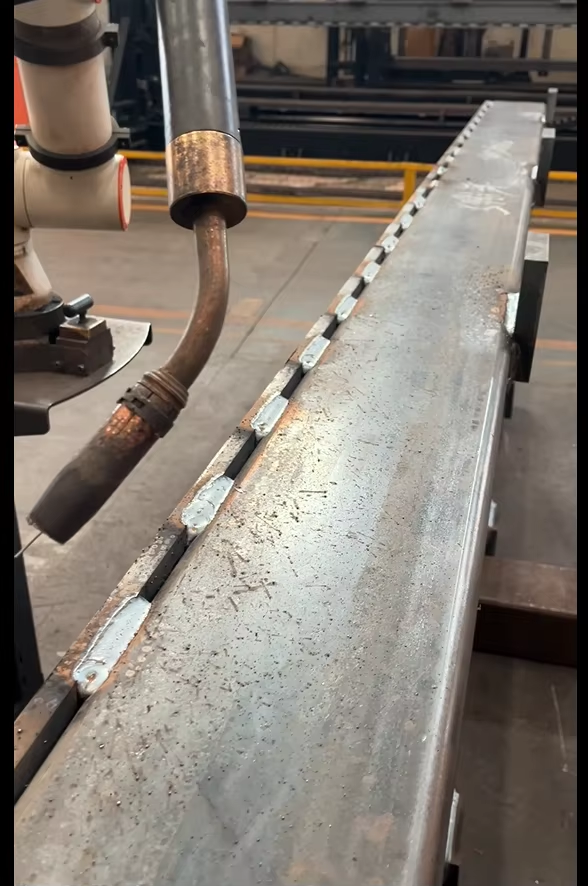
The Industrial Context: Casablanca’s Role in the Modular Revolution
Casablanca is no longer just a commercial gateway; it is the beating heart of Morocco’s “Industrial Acceleration Plan.” As the demand for rapid infrastructure—ranging from affordable housing to high-end commercial complexes—surges across the Maghreb and Sub-Saharan Africa, the construction industry is pivoting toward modularity. Modular construction relies on the off-site fabrication of structural components that are later assembled on-site. The success of this model hinges entirely on precision.
In this context, the 6000W CNC Beam and Channel Laser Cutter serves as the technological backbone. Traditional methods of cutting H-beams, I-beams, and U-channels often involve manual marking, bandsaws, and drilling, leading to cumulative errors. In a modular setup, a deviation of even three millimeters can compromise the integrity of an entire multi-story structure. The deployment of high-power fiber lasers in Casablanca ensures that every component produced locally meets international tolerances, allowing Moroccan firms to compete on a global stage.
The Power of 6000W: Why 6kW is the Strategic Choice
In the realm of fiber lasers, power correlates directly with thickness capacity and throughput speed. For structural steel used in modular frames, 6000W (6kW) is widely considered the “sweet spot.” While lower power sources (2kW-3kW) are excellent for thin sheet metal, they struggle with the heavy gauges required for load-bearing channels and thick-walled beams.
A 6000W fiber laser provides the necessary energy density to achieve “melt-and-blow” dynamics through carbon steel beams up to 25mm or more, depending on the oxygen or nitrogen assist gas configuration. More importantly, at 6kW, the cutting speed for medium-thickness materials (10mm to 16mm) is significantly higher than that of plasma or lower-power lasers. This speed does not come at the cost of quality; the high power ensures a narrower heat-affected zone (HAZ), which preserves the metallurgical integrity of the structural steel—a critical factor in seismic-prone construction or high-load modular designs.
Infinite Rotation 3D Head: The Geometry of Innovation
The most significant technological breakthrough in this system is the Infinite Rotation 3D Head. Traditional laser heads are often limited by “cable wind-up,” meaning they can only rotate a certain number of degrees before needing to unwind. This creates downtime and limits the complexity of the cut.
An “Infinite Rotation” head utilizes advanced slip-ring technology and high-torque servo motors to allow the cutting nozzle to rotate indefinitely around the C-axis. When combined with the A/B-axis tilting capabilities (often up to ±45 or ±60 degrees), the machine transforms into a true 5-axis powerhouse.
For modular construction, this is transformative. It allows for:
1. **Precision Beveling:** Creating V, X, and Y-type bevels for weld preparation directly on the laser, eliminating the need for secondary grinding.
2. **Complex Intersections:** Cutting holes and notches into the “web” and “flange” of a beam at angles that allow two beams to slot together perfectly.
3. **Countersinking and Slotting:** Generating complex geometries that facilitate “bolt-together” assembly, which is the hallmark of modern modular engineering.
The Synergy Between CNC Intelligence and Structural Engineering
The “CNC” (Computer Numerical Control) aspect of these machines in Casablanca is powered by sophisticated CAD/CAM software tailored for structural steel. In modular construction, the design often starts in BIM (Building Information Modeling) software like Tekla or Revit. The 6000W laser’s control system can ingest these 3D files directly.
The software automatically calculates the nesting of parts on a long beam (some machines handle beams up to 12 meters) to minimize scrap. It also accounts for the “kerf” (the width of the laser cut) and adjusts the 3D head’s path to ensure that even on the curved radii of a channel’s inner corners, the cut remains perpendicular or at the precise specified bevel. This level of automation reduces the reliance on highly skilled manual layout artists, who are increasingly difficult to find, and places the power of fabrication in the hands of digital designers and machine operators.
Efficiency and Sustainability in Casablanca’s Construction Sector
Sustainability is no longer an option in modern construction; it is a requirement. The 6000W fiber laser is inherently more “green” than its predecessors. Fiber lasers boast an electrical conversion efficiency of roughly 30-40%, compared to the 10% seen in older CO2 technology.
Furthermore, the precision of the 3D head significantly reduces material waste. In the modular process, “right-first-time” manufacturing means that heavy steel beams aren’t being discarded due to human error. In a city like Casablanca, where logistics and material costs are influenced by global steel prices, the ability to maximize the yield from every ton of steel is a massive economic advantage. Additionally, the laser process is cleaner than plasma cutting, producing fewer fumes and requiring less intensive post-process cleaning, which improves the working environment for the Moroccan labor force.
Applications: From Stadiums to Modular Hospitals
The versatility of the 6000W 3D laser cutter allows Casablanca-based firms to pivot between various project types. In modular construction, we see this tech being used for:
– **Steel Braced Frames:** Cutting the primary vertical and horizontal members for modular housing units.
– **Service Penetrations:** Rapidly cutting precise holes for HVAC, plumbing, and electrical runs through structural beams before they leave the factory.
– **Connection Plates:** Integrating the cutting of beams and the plates that connect them into a single automated workflow.
As Morocco prepares for major international events and continues to modernize its healthcare infrastructure, the ability to rapidly “print” structural steel components means that modular hospitals or temporary event structures can be designed, cut, and assembled in a fraction of the time required for traditional reinforced concrete builds.
Overcoming the Challenges of Thick-Section Processing
A fiber laser expert knows that cutting beams and channels isn’t as simple as cutting flat sheets. Beams have varying thicknesses between the flange and the web, and they often possess internal stresses from the rolling process.
The 6000W system in Casablanca is equipped with advanced sensors for “height sensing” and “seam tracking.” As the 3D head moves over the irregular surface of a hot-rolled U-channel, the CNC system adjusts the focus position in real-time. This ensures that the focal point of the 6kW beam is always optimized, preventing “dross” (hardened slag) from forming on the underside of the cut. This level of technical finesse is what separates a world-class modular component from a substandard one.
The ROI and Future Outlook
The investment in a 6000W CNC Beam and Channel Laser with Infinite Rotation is significant, but the Return on Investment (ROI) for a Casablanca-based enterprise is compelling. By consolidating multiple processes—sawing, drilling, milling, and beveling—into a single machine, the fabricator reduces the footprint of the factory and the number of times a heavy beam must be moved by crane or conveyor. Each “touch” of a beam costs money; by minimizing these touches, the laser pays for itself through labor savings and increased throughput.
Looking forward, the integration of Artificial Intelligence (AI) in the CNC controllers will further enhance these machines. Predictive maintenance will alert operators in Casablanca to clean their protective windows or check their gas pressures before a failure occurs. As the African Continental Free Trade Area (AfCFTA) matures, Casablanca is positioned to become the “Fabrication Shop of Africa,” exporting precision-cut modular components across the continent.
Conclusion
The 6000W CNC Beam and Channel Laser Cutter with an Infinite Rotation 3D Head is more than a tool; it is a catalyst for an industrial evolution in Casablanca. By marrying the raw power of 6kW fiber technology with the surgical precision of 5-axis motion, Moroccan manufacturers are unlocking the true potential of modular construction. This technology ensures that the buildings of tomorrow are constructed faster, stronger, and with a level of mathematical perfection that was once thought impossible in the heavy steel industry. As the skyline of Casablanca continues to grow, it will be built upon the precise, laser-cut foundations of this remarkable engineering achievement.