
1.0 Executive Summary: Technical Integration in the Dammam Industrial Corridor
This report details the operational deployment and technical efficacy of 6000W CNC Beam and Channel laser cutting systems equipped with automated unloading modules, specifically within the storage racking manufacturing sector in Dammam, Eastern Province. The transition from legacy mechanical punching and plasma sawing to high-wattage fiber laser processing represents a critical shift in structural steel fabrication. In the Dammam industrial context—characterized by high-volume logistics infrastructure requirements—the precision of 6000W fiber sources, coupled with the mechanical automation of unloading, addresses the dual challenges of dimensional accuracy and throughput bottlenecks inherent in heavy structural sections (IPE, UPN, and PFC profiles).
2.0 Power Dynamics: The 6000W Fiber Laser Source in Structural Applications
2.1 Wavelength and Absorption Efficiency
The 6000W fiber laser operates at a wavelength of approximately 1.07 microns. In the context of the storage racking industry, where cold-rolled and hot-rolled carbon steel (S235JR to S355JR) are the primary substrates, this wavelength offers an absorption rate significantly higher than CO2 alternatives. At a 6000W threshold, the power density at the focal point allows for “high-speed melt-shearing,” particularly in the 6mm to 16mm thickness range common in rack uprights and heavy-duty beams. This power level ensures that the kerf remains narrow and the Heat Affected Zone (HAZ) is minimized, preserving the structural integrity of the load-bearing members.
2.2 Gas Dynamics and Kerf Quality
For the Dammam racking sector, the use of high-pressure Nitrogen (N2) for “clean cutting” of thinner gauge connectors and Oxygen (O2) for reactive cutting of thicker structural channels is optimized by the 6000W ceiling. The 6000W capacity allows for increased nozzle standoff distances without losing beam stability, which is essential when traversing the uneven surfaces of hot-rolled channels. This results in a dross-free finish, eliminating the need for secondary grinding—a labor-intensive process that historically slowed production in Saudi fabrication facilities.
3.0 Kinematics of the CNC Beam and Channel Processing
3.1 3D Profiling and 4-Axis Synchronicity
Storage racking components require complex geometries: teardrop holes, rectangular slots for beam connectors, and precise end-mitering. The CNC system utilizes a 4-axis or 5-axis head movement to maintain a perpendicular relationship between the laser nozzle and the curved surfaces of the channel “toes” and “flanges.” Unlike flat-bed lasers, the beam/channel cutter must compensate for the geometric deviations inherent in structural sections. The 6000W system’s CNC controller utilizes real-time capacitive sensing to adjust focal height as the head rotates around the radius of a U-channel, ensuring consistent cut quality across the web and the flange.
3.2 Chuck Mechanism and Torque Control
The handling of 12-meter structural lengths (standard for Dammam logistics hubs) requires high-torque pneumatic or hydraulic chucks. The synchronization between the feeding chuck and the rotating chuck is critical. Any lag in rotational speed during a 6000W cut would result in “over-burning” at the corners. The system analyzed utilizes a self-centering dual-chuck configuration that maintains concentricity within ±0.1mm over the entire length of the beam, a prerequisite for the interlocking tolerances required in high-bay racking systems.
4.0 Automatic Unloading: Solving the Heavy Steel Bottleneck
4.1 Mechanical Sequence and Structural Safety
The most significant failure point in high-speed laser cutting of heavy beams is the manual unloading phase. A 12-meter UPN 200 channel represents significant mass; manual extraction leads to machine downtime and safety risks. The Automatic Unloading system utilizes a series of hydraulic lifting arms and conveyor rollers synchronized with the CNC’s “end-of-program” signal. As the final cut is completed, the pneumatic support rollers descend, and the “kick-out” mechanism transfers the finished part to a lateral storage rack.
4.2 Precision Preservation
Automatic unloading is not merely about speed; it is about protecting the part. In racking systems, the “straightness” of the upright is paramount. Manual handling of hot, freshly cut sections often leads to minor mechanical deformations. The automated system ensures the part is supported at equidistant points, preventing sag and maintaining the linearity of the profile. In the Dammam environment, where ambient temperatures can reach 50°C, the controlled mechanical cooling and unloading prevent thermal warping that can occur when heavy sections are stacked unevenly while still retaining latent heat from the 6000W cutting process.
5.0 Application in the Storage Racking Sector: Dammam Case Study
5.1 Upright Profiling for High-Bay Warehousing
In Dammam’s expanding logistics zones, high-bay racking requires uprights with precise pitch for beam levels. Using the 6000W CNC laser, manufacturers can achieve a pitch tolerance of ±0.05mm over a 12,000mm length. This level of precision is unattainable via mechanical punching, which suffers from tool wear and material deformation. The laser’s ability to “drill” bolt holes and “cut” slots in a single continuous operation reduces the manufacturing cycle time for a single upright by approximately 65%.
5.2 Optimization of Beam Connectors and Bracing
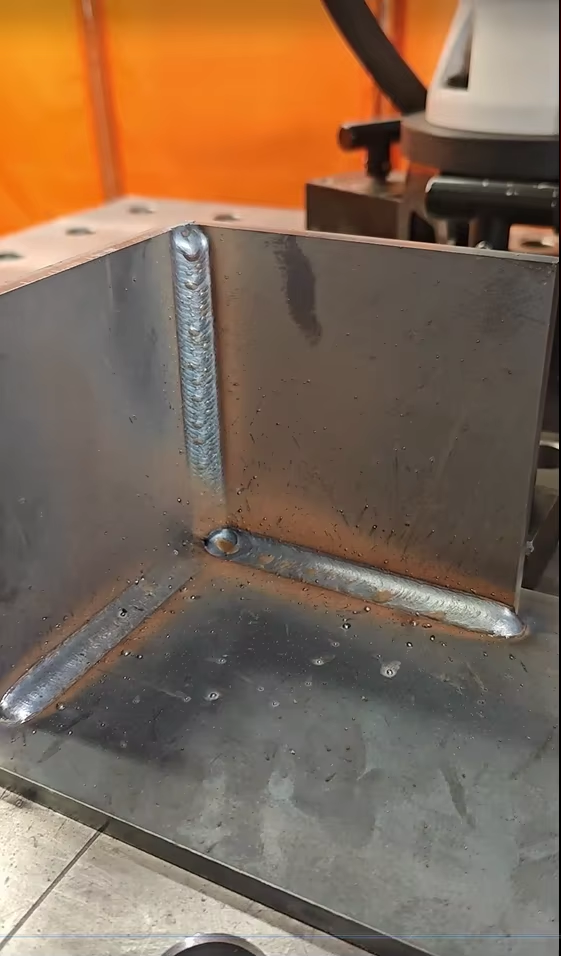
The structural stability of a rack depends on the fitment of the beam connectors into the upright slots. The 6000W fiber laser allows for “tab-and-slot” design architecture. Channels can be cut with integrated tabs that lock into the web of the beam, which are then robotically welded. This synergy between laser precision and automated unloading allows Dammam-based firms to produce “boltless” racking systems that meet stringent international safety standards (such as RMI or SEMA) with reduced material waste.
6.0 Technical Challenges and Environmental Mitigations
6.1 Atmospheric Interference and Filtration
Dammam’s industrial atmosphere is characterized by high humidity and particulate matter (sand/dust). For a 6000W fiber laser, beam path protection is vital. The systems deployed in this region utilize positive pressure cabinets for the laser source and pressurized bellows for the CNC gantry. Furthermore, the automatic unloading area must be integrated with high-volume dust extraction. The vaporized metal from a 6000W cut on a thick channel is substantial; efficient filtration is required to prevent “plasma cloud” interference, which can defocus the beam.
6.2 Thermal Management of the Fiber Source
Operating a 6000W source in the Eastern Province requires industrial-grade chilling units with a high BTU rating. The synergy between the laser and the unloading system includes a cooling-cycle logic where the chiller’s load is balanced during the unloading phase, ensuring that the laser source remains within a ±1°C operational window, preventing wavelength shift or diode degradation.
7.0 Conclusion: The ROI of Automated Structural Processing
The integration of 6000W CNC technology with automatic unloading signifies the maturation of the steel fabrication industry in Dammam. The technical advantages—namely the elimination of secondary finishing, the achievement of sub-millimeter tolerances on 12-meter sections, and the drastic reduction in manual labor risks—provide a clear path to scaling production for the logistics sector. For senior engineering management, the transition to automated structural laser processing is no longer an optional upgrade but a technical necessity to meet the dimensional and safety requirements of modern storage infrastructure.
End of Report
Prepared by: Senior Technical Consultant, Laser Systems & Structural Steel Division
Location: Dammam Industrial Area, KSA
















