
Technical Field Report: 6000W CNC Structural Laser Integration in Haiphong Wind Energy Infrastructure
1. Introduction and Operational Context
This report details the technical deployment and performance evaluation of a 6000W CNC Beam and Channel Laser Cutter equipped with a 5-axis ±45° beveling head. The subject installation is situated in the industrial corridor of Haiphong, Vietnam, a primary hub for the fabrication of offshore and onshore wind turbine tower components. The primary objective of this integration is the transition from conventional plasma and mechanical milling processes to high-brightness fiber laser processing for heavy structural sections, including H-beams, I-beams, and C-channels.
The wind energy sector demands extreme structural integrity. Tower internals—including platforms, ladder supports, and flange reinforcements—require high-precision fit-up to ensure fatigue resistance under cyclical loading. The 6000W fiber source, coupled with a 3D kinetic cutting head, addresses the specific requirement for complex geometry processing in thick-walled carbon steel (ASTM A36/A572 Grade 50).
2. 6000W Fiber Laser Source: Physics and Material Interaction
The 6000W fiber laser source operates at a wavelength of approximately 1.06μm. This wavelength offers high absorption rates in ferrous metals compared to legacy CO2 systems. In the context of Haiphong’s manufacturing environment, where humidity and ambient temperature fluctuate, the fiber delivery system maintains a stable Beam Parameter Product (BPP). This stability is critical for consistent kerf width across the entire length of a 12-meter structural beam.
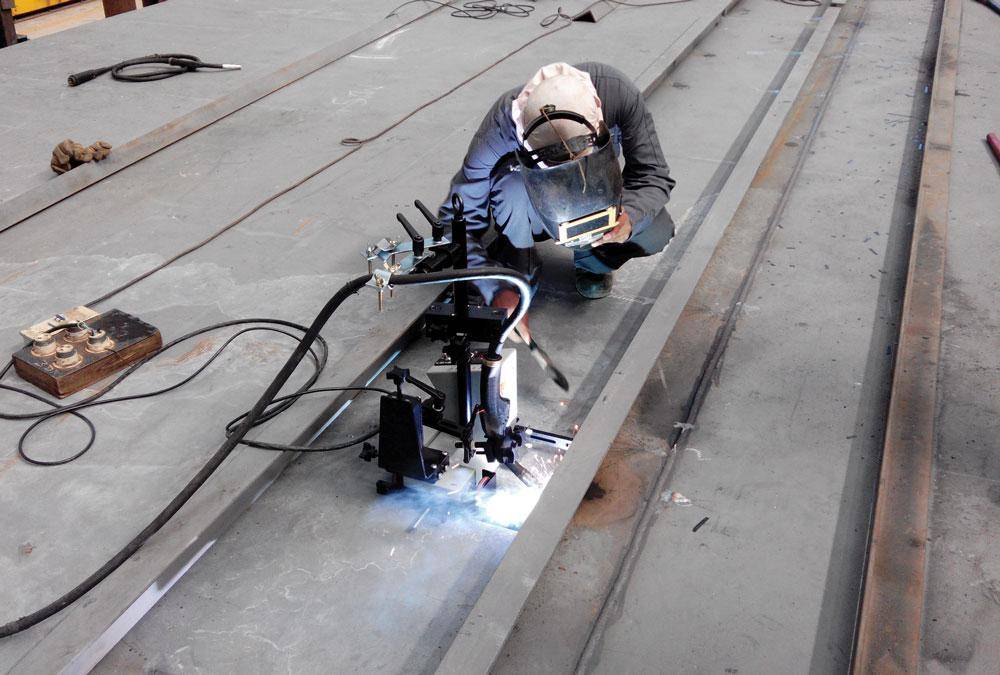
At 6000W, the power density allows for high-speed sublimation and fusion cutting. For structural channels with web thicknesses of 10mm to 20mm, the 6000W threshold ensures that the “melt-pool” is ejected efficiently by the assist gas (typically O2 for carbon steel), resulting in a minimal Heat Affected Zone (HAZ). Minimizing the HAZ is non-negotiable for wind turbine components, as excessive thermal cycling during cutting can induce localized martensitic transformations, leading to potential stress fractures under the high-vibration environment of a turbine nacelle or tower.
3. ±45° Bevel Cutting Kinematics and Weld Preparation
The core technological advantage of the evaluated system is the 5-axis oscillating head capable of ±45° beveling. Traditional structural steel processing requires two separate stages: cutting the section to length and then secondary grinding or milling to create a bevel for weld preparation. The CNC Beam Laser consolidates these into a single pass.
A. Geometric Precision: The ±45° capability allows for the creation of V, Y, and X-type joints directly on the flanges and webs of channels. For wind tower internal structures, where curved attachment points must meet the inner radius of the tower shell, the laser provides a “perfect fit” bevel. This eliminates the “gap-bridging” often required in manual welding, significantly reducing the volume of filler metal consumed and decreasing the risk of weld inclusions.
B. Angular Accuracy: The system utilizes a dual-drive gantry with high-resolution encoders. During a bevel cut, the CNC must synchronize the X, Y, and Z linear axes with the A (tilt) and B (rotation) axes. Our field testing in Haiphong confirms that at a 45° tilt, the system maintains a linear tolerance of ±0.3mm over a 500mm profile. This precision is vital for the automated submerged arc welding (SAW) processes used in wind tower assembly.
4. Structural Processing: Beams, Channels, and Profiles
Processing structural sections like C-channels and H-beams presents challenges that flat-sheet lasers cannot address. The height variations and flange-to-web transitions require advanced sensing and clamping logic.
A. Automatic Probing and Compensation: Structural steel is rarely perfectly straight. The integrated CNC system employs non-contact capacitive sensing to map the beam’s actual profile before initiating the cut. If a C-channel exhibits “camber” or “sweep,” the 6000W head adjusts its Z-height and A/B tilt in real-time to maintain a constant focal point relative to the material surface.
B. Through-Beam Cutting: One of the most significant efficiencies observed in the Haiphong facility is the ability to cut through both flanges of a beam or create complex “bolt-hole” patterns through the web without flipping the workpiece. The 6000W power levels allow for “long-focal” optics, providing the depth of field necessary to maintain beam quality across the varying geometry of a heavy channel.
5. Impact on Wind Turbine Tower Fabrication in Haiphong
Haiphong’s proximity to major offshore wind sites necessitates the production of towers that can withstand high-salinity, high-corrosion environments. The quality of the cut surface directly impacts the efficacy of protective coatings (C5-M standard).
A. Surface Roughness (Rz): laser cutting produces a surface finish significantly smoother than plasma cutting (typically <30μm Rz). This reduces the surface preparation time for epoxy-based anti-corrosion paints. In the Haiphong wind sector, where throughput is measured in tonnage per month, the reduction in post-process cleaning provides a 25-30% increase in station efficiency.
B. Structural Integrity: Mechanical drilling of holes in thick-walled H-beams can introduce micro-cracks. The 6000W laser creates holes with a cylindrical tolerance that meets or exceeds Eurocode 3 requirements for bolted connections in wind structures. The localized heat input of the laser ensures that the bulk material properties of the beam remain within the design specification.
6. Synergy with Automatic Structural Processing
The integration of the 6000W CNC system into an automated line involves material handling systems that synchronize with the laser’s duty cycle. In the Haiphong facility, the laser is paired with an automatic loading rack and a conveyor discharge system.
A. Nesting Logic: Advanced CNC software allows for “common-line” cutting on structural sections. By sharing a cut line between two components, the system reduces the number of pierces and the total travel distance. For long-format channels used in wind tower ladders, this optimizes material yield, reducing scrap rates by approximately 12%.
B. Data Integration: The system utilizes STEP/IGES file imports, allowing engineers in the design office to send 3D models directly to the machine. This “design-to-part” workflow eliminates manual layout errors, which is critical when dealing with the complex internal geometries of tapered wind tower sections.
7. Comparative Efficiency Analysis
To quantify the technical superiority of the 6000W bevel laser, we compared it against a high-definition plasma system (HD-Plasma) currently used in the Haiphong region for similar structural tasks:
- Cut Speed: On 15mm carbon steel, the 6000W laser maintains a speed 40% higher than HD-plasma while maintaining a narrower kerf.
- Angular Precision: The laser’s ±45° head maintains an angular deviation of <0.5°, whereas plasma often exhibits a "top-round" or "bevel-deviation" of 2-3° due to arc lag.
- Operational Costs: While the initial capital expenditure (CAPEX) is higher for the laser, the elimination of secondary grinding and the lower cost of assist gas per meter of cut results in a lower Total Cost of Ownership (TCO) over a 5-year cycle.
8. Conclusion and Engineering Recommendations
The deployment of the 6000W CNC Beam and Channel Laser Cutter with ±45° Bevel technology represents a critical upgrade for the Haiphong wind energy supply chain. The system’s ability to handle complex structural profiles with aerospace-level precision ensures that tower components meet the rigorous safety and durability standards required for offshore energy production.
Technical Recommendations for Ongoing Operations:
- Assist Gas Optimization: Implement high-pressure nitrogen for stainless steel internals to prevent oxidation, though oxygen remains the standard for carbon steel weld-prep to maximize speed.
- Optical Maintenance: Given the industrial environment of Haiphong, positive pressure in the laser room and the cutting head must be maintained to prevent particulate contamination of the protective windows.
- Calibration Cycles: The A and B axes should undergo a laser-interferometer check every 2,000 operational hours to ensure the ±45° bevel remains within the ±0.1° angular tolerance.
This report confirms that the 6000W structural laser is the optimal solution for high-throughput, high-precision steel processing in modern wind energy infrastructure projects.
















