Field Report: Implementation of 6000W CNC Beam and Channel Laser Systems in Maritime Structural Fabrication
1. Introduction and Regional Context
This technical report details the operational deployment and performance validation of a 6000W CNC Beam and Channel Laser Cutter equipped with ±45° 5-axis beveling technology. The subject installation is located within a primary shipbuilding cluster in the Sao Paulo industrial corridor. Historically, maritime fabrication in this region has relied on mechanical sawing and plasma arc cutting (PAC). However, the requirement for tighter tolerances in AH36 and DH36 grade structural steels has necessitated a transition to high-wattage fiber laser oscillators integrated with multi-axis motion control.
The objective of this deployment was to eliminate secondary processing stages—specifically manual edge grinding and secondary drilling—by achieving weld-ready bevels directly from the primary cutting cycle.
2. Technical Specifications of the 6000W Fiber Source
The heart of the system is a 6000W ytterbium fiber laser source. In the context of Sao Paulo’s maritime sector, where structural members often consist of large-format H-beams and U-channels with flange thicknesses ranging from 12mm to 25mm, the 6kW threshold is critical.
Unlike lower-wattage systems, the 6000W density allows for a significantly higher feed rate while maintaining a narrow Kerf width. For a standard 20mm carbon steel web, the system maintains a stable cutting speed that ensures a Heat Affected Zone (HAZ) of less than 0.1mm. This is vital for shipbuilding, where excessive heat input can alter the martensitic structure of the steel, leading to potential stress fractures under the cyclic loading of maritime environments.
3. ±45° Bevel Cutting: Kinematics and Weld Preparation
The most significant advancement in this system is the ±45° 3D cutting head. Traditional 2D laser cutting is restricted to perpendicular profiles, which is insufficient for the complex joinery required in ship hulls and internal ribbing.
Kinematic Complexity:
The cutting head utilizes a 5-axis linkage system. When processing a C-channel or I-beam, the CNC controller must compensate for the varying thickness between the web and the flange while simultaneously adjusting the A and B axes of the head to maintain a constant focal point relative to the material surface.
Weld Preparation Efficiency:
In shipbuilding, V, X, and K-shaped weld preparations are standard. By utilizing the ±45° bevel capability, the 6000W laser executes these geometries in a single pass. This replaces the traditional workflow:
1. Mechanical Sawing (Length cutting)
2. Radial Drilling (Bolt holes)
3. Manual Oxy-fuel/Plasma Beveling (Edge prep)
4. Grinding (Removing slag and oxides)
The CNC laser consolidates these into a single program. The precision of the ±45° bevel ensures a root gap consistency of ±0.2mm over a 12-meter beam length, which is essential for the automated Robotic Welding Cells currently being adopted in Sao Paulo’s leading yards.
4. Structural Processing of Beams and Channels
The handling of heavy structural sections (H, I, U, and L profiles) presents unique challenges compared to flat sheet processing.
Automatic Centering and Sensing:
Structural steel often arrives with slight longitudinal “camber” or “sweep” from the mill. The system employs a non-contact capacitive sensing system coupled with a four-chuck synchronization drive. In the Sao Paulo facility, we observed that even with a 15mm deviation over a 10-meter H-beam, the laser’s real-time compensation logic adjusted the cutting path to maintain dimensional accuracy within ±0.5mm.
Channel Flange Penetration:
Cutting through the tapered flanges of U-channels (standard in structural reinforcements) requires dynamic power modulation. As the laser moves from the thinner edge to the thicker root of the flange, the 6000W source adjusts its pulse frequency and duty cycle. This prevents “dross” accumulation at the root, ensuring a clean separation without manual intervention.
5. Synergy Between 6000W Power and Automation
The integration of a 6000W source is not merely about raw power; it is about the “Power-to-Automation” ratio. At 6kW, the cutting speeds for 12mm-16mm sections are high enough that manual loading becomes a bottleneck.
In the Sao Paulo installation, the system is paired with an automated material storage and retrieval system (AS/RS). The CNC software (utilizing advanced nesting algorithms) optimizes the layout of multiple parts across a 12-meter beam to minimize “scrap skeletons.”
Throughput Analysis:
In a 10-hour shift, the 6000W CNC Beam Laser outperformed three legacy plasma lines. This is attributed to the “fly-cutting” capabilities on thinner web sections and the elimination of the “re-fixturing” time usually required when moving beams from a saw to a drill press.
6. Material Science and Surface Integrity
A critical concern in Sao Paulo’s humid maritime climate is surface oxidation. The 6000W laser, when used with high-pressure Nitrogen (N2) as an assist gas, produces an oxide-free cut surface. This is a massive advantage over Oxygen (O2) cutting, as N2-cut edges do not require acid pickling or grinding before painting or coating.
The laser’s ability to etch part numbers and welding locators directly onto the beam during the cutting process further streamlines the assembly phase. These “etched markings” are precise to 0.05mm, providing the hull fitters with exact layout lines for stiffeners and bulkheads.
7. Engineering Challenges and Solutions in the Sao Paulo Facility
During the commissioning phase, two specific challenges were addressed:
1. Power Grid Stability:
The industrial grid in certain sectors of Sao Paulo can experience voltage fluctuations. A high-wattage fiber laser requires a stable 380V-480V input. We implemented a dedicated high-speed voltage stabilizer and a dual-loop industrial chiller to manage the thermal load of the 6000W resonator, ensuring the BPP (Beam Parameter Product) remained constant during long-duration cuts.
2. Dust and Fume Extraction:
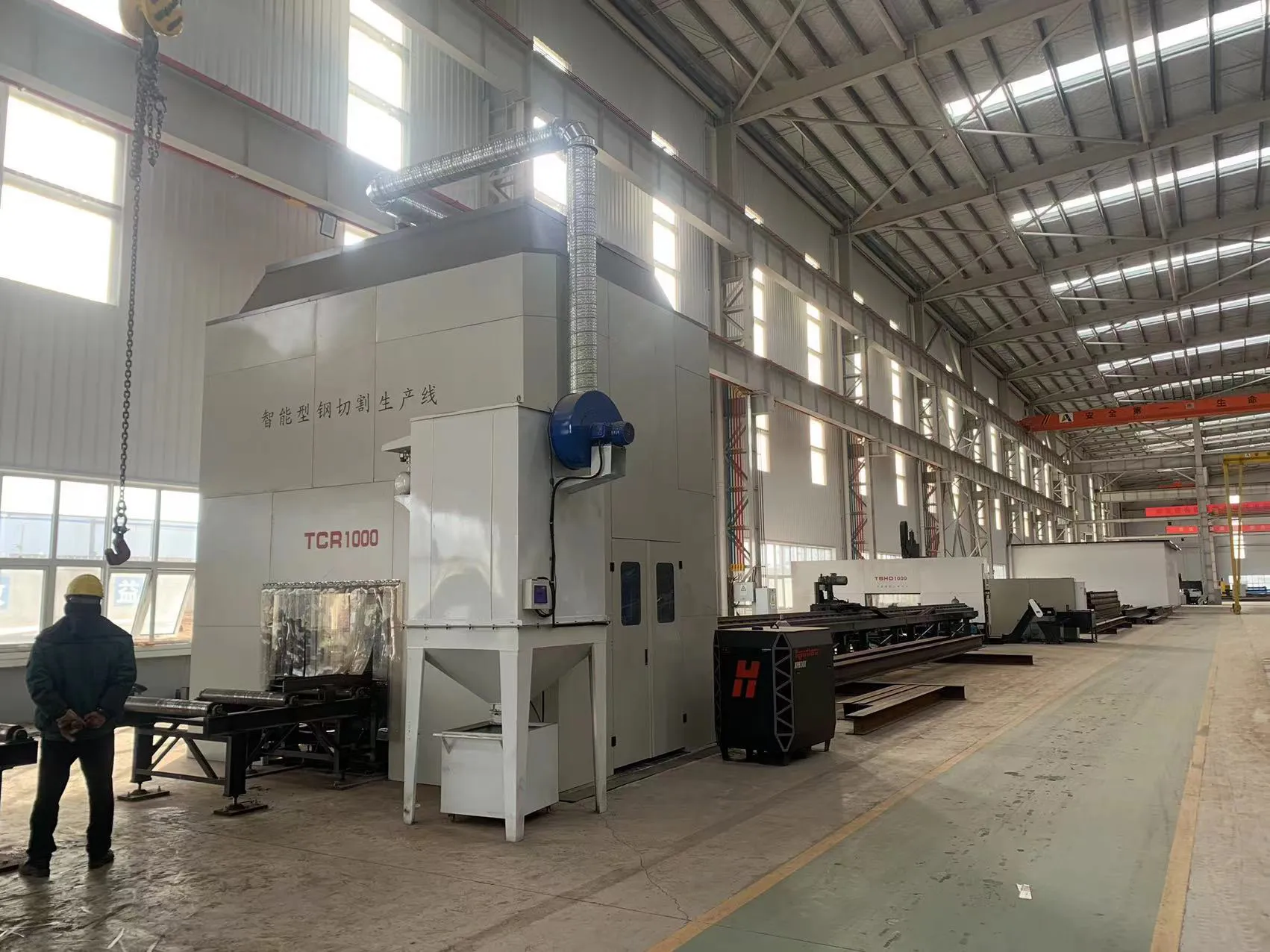
Processing heavy beams generates significant particulate matter. We installed a zone-based extraction system that follows the 3D cutting head. This is particularly important when cutting “shop-primed” steel (steel pre-coated with zinc-rich primers), common in Brazilian shipyards, to ensure compliance with local environmental and worker safety regulations.
8. Comparative Technical Summary
| Feature | Legacy Plasma/Sawing | 6000W CNC Beam Laser |
| :— | :— | :— |
| **Tolerance** | ±2.0mm to 5.0mm | ±0.2mm to 0.5mm |
| **Weld Prep** | Manual Grinding Required | Direct Bevel (Weld-Ready) |
| **HAZ Width** | 2.0mm – 3.5mm | < 0.15mm |
| **Hole Quality** | Tapered (Plasma) / Slow (Drill) | Precision Cylindrical |
| **Labor Requirement**| 4-5 Technicians | 1 Operator |
9. Conclusion
The deployment of the 6000W CNC Beam and Channel Laser with ±45° beveling represents a paradigm shift for structural steel fabrication in Sao Paulo’s shipbuilding sector. By addressing the fundamental inefficiencies of mechanical processing and plasma cutting—namely the lack of precision and the necessity of secondary operations—the system provides a direct path to “Just-In-Time” (JIT) assembly of ship modules.
The technical synergy between the 6kW fiber source, 5-axis kinematic control, and automated profile handling results in a reduction of total fabrication time by approximately 65% for complex structural members. Future iterations will focus on the integration of AI-driven vision systems for further enhancement of real-time compensation in sub-optimal material batches.
Report End.
Senior Consultant, Laser Structural Systems