The Dawn of High-Power Fiber Lasers in Rayong’s Industrial Landscape
Rayong has long been the backbone of Thailand’s heavy industry, housing massive petrochemical plants, automotive factories, and steel fabrication yards. As the demand for electrical infrastructure surges across Southeast Asia, the traditional methods of fabricating power towers—manual sawing, mechanical punching, and plasma cutting—are reaching their limits. Enter the 6000W CNC Beam and Channel Laser Cutter.
As a fiber laser expert, I have witnessed the transition from CO2 to fiber, and now from flat-sheet cutting to 3D structural processing. The 6000W power rating is the “sweet spot” for structural steel. It provides enough energy to pierce thick-walled H-beams and heavy-duty channels with surgical precision, while maintaining an operating cost that is significantly lower than legacy plasma systems. In the context of Rayong’s competitive market, the ability to cut faster and cleaner translates directly into higher margins and the capacity to take on larger national infrastructure tenders.
Understanding the ±45° Bevel Cutting Advantage
In power tower fabrication, the joints are the most critical points. Towers are subjected to immense tension, wind loads, and environmental stress. Consequently, the weld quality must be flawless. Traditional laser cutters produce a 90-degree perpendicular cut. However, to create a strong “V,” “Y,” or “K” shaped weld joint, the edges of the steel must be beveled.
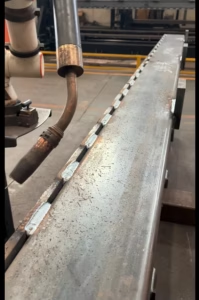
The ±45° bevel cutting head is a marvel of 5-axis engineering. Unlike a standard 2D head, the bevel head can tilt and rotate while the beam or channel is being fed through the machine or rotated by the chucks. This allows the laser to create precise chamfers in a single operation. For a fabricator in Rayong, this means a part can move straight from the laser cutter to the welding station. The elimination of manual grinding or secondary milling for weld prep reduces labor costs by up to 60% and ensures a level of repeatability that human operators simply cannot match.
Technical Synergy: 6000W Power and Beam Dynamics
Why 6000W? In the world of fiber lasers, wattage dictates both the maximum thickness and the cutting speed. For power towers, which utilize thick-gauge angle iron, C-channels, and I-beams, 6000W allows for high-speed processing of carbon steel up to 25mm or more, depending on the oxygen or nitrogen assist gas setup.
The beam quality (BPP) of a 6000W source is optimized for a balance between “kerf” width and penetration. When cutting through the flanges of a channel or the web of an H-beam, the laser must maintain focus over varying distances. Modern CNC systems in these machines use “Active Focus Tracking” to adjust the focal point in real-time as the head moves around the complex geometry of the structural profile. This ensures that the ±45° bevel remains consistent across the entire length of the beam, which can often exceed 12 meters in high-capacity industrial setups.
Precision Hole Cutting for Bolt-Ready Assemblies
Power towers are essentially giant “Meccano” sets. They are held together by thousands of high-strength bolts. In traditional fabrication, holes are often punched, which can create micro-cracks in the heat-affected zone (HAZ) or cause material deformation.
The 6000W CNC laser overcomes this by utilizing high-frequency pulsing and precise gas pressure control to “bore” holes that are perfectly circular and perpendicular (or beveled, if required). The accuracy of these holes—often within ±0.1mm—is vital. When these massive steel components are transported to a remote site in the Thai highlands for assembly, the holes must align perfectly. A mismatch of even a few millimeters can stall a multi-million baht project. The CNC laser ensures that every channel and beam is a perfect “digital twin” of the engineering CAD model.
The Complexity of 3D Kinematics in Structural Steel
Cutting a flat plate is simple; cutting a 12-meter H-beam with a ±45° bevel is an exercise in complex kinematics. The machines deployed in Rayong typically feature a “moving-chuck” or “rotary-clamping” system. The beam is supported by a series of intelligent rollers and held by massive CNC chucks that can rotate the workpiece with arc-second precision.
The software integration is equally important. To maximize the 6000W output, specialized nesting software (such as Lantek or SigmaNEST) is used to layout cuts on the beam to minimize scrap. For power towers, where beams are often used in varied lengths, the software can nest multiple different parts onto a single stock beam, optimizing material usage in an era where steel prices are volatile.
Meeting International Standards in Power Tower Fabrication
Thailand’s energy sector follows rigorous standards, often mirroring ASTM or European EN 1090-2 execution classes. The use of a 6000W laser with beveling capabilities helps fabricators meet these standards with ease. The laser’s narrow Heat Affected Zone (HAZ) preserves the metallurgical properties of the structural steel, preventing the embrittlement that can sometimes occur with high-amperage plasma cutting.
Furthermore, the clean, dross-free edges produced by the 6000W fiber laser mean that the protective galvanization process—crucial for towers exposed to Rayong’s humid, coastal air—adheres much better to the steel. Poorly cut edges often lead to premature rust; laser-cut edges provide the perfect substrate for long-term corrosion resistance.
Operational Excellence and Local Support in Rayong
Operating a 6000W system requires more than just a high-tech machine; it requires a robust ecosystem. Rayong’s proximity to specialized gas suppliers (for high-purity Oxygen and Nitrogen) and technical service centers makes it the ideal location for these machines.
As an expert, I always emphasize the “Total Cost of Ownership” (TCO). While the initial investment in a 6000W bevel-capable system is higher than a standard cutter, the ROI in the power tower sector is rapid. The speed of a 6000W source is approximately 3-4 times faster than a 2000W source on medium-thickness steel. When you factor in the saved hours from not having to manually grind bevels, the machine often pays for itself within the first 18 to 24 months of a major infrastructure contract.
Conclusion: The Future of Infrastructure Fabrication
The 6000W CNC Beam and Channel Laser Cutter with ±45° beveling is not just a tool; it is a competitive strategy for Thai fabricators. In the industrial zones of Rayong, where efficiency and precision are the currencies of success, this technology is setting a new benchmark for how we build the skeletons of our modern world.
By embracing the power of fiber laser technology, power tower manufacturers are moving away from the “hammer and spark” era into an era of “photon precision.” The result is safer infrastructure, faster project completion, and a stronger industrial foundation for Thailand’s future. For the structural steel industry, the beam of the 6000W laser is quite literally the cutting edge of progress.