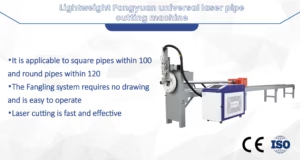
The Industrial Renaissance: Why Casablanca is the Epicenter for Laser Innovation
Casablanca, the economic heart of Morocco, is currently experiencing an unprecedented surge in infrastructure development. With the 2030 FIFA World Cup on the horizon and the nation’s “Industrial Acceleration Plan” in full swing, the demand for rapid, high-quality construction has never been higher. Modular construction—the process of building structures off-site in controlled factory environments—has emerged as the solution to Morocco’s urban expansion needs.
However, modular construction is only as effective as the precision of its components. This is where the 6000W CNC Beam and Channel Laser Cutter comes into play. In the industrial zones of Nouaceur and Ain Sebaa, local manufacturers are replacing traditional plasma cutters and mechanical saws with high-wattage fiber lasers. The 6000W power source provides the perfect balance of penetration depth and edge quality, specifically tailored for the heavy-duty structural steel used in modular frames.
Deconstructing the 6000W Fiber Laser Advantage
As an expert in fiber optics and laser dynamics, I often emphasize that “power is nothing without control.” A 6000W fiber laser source, typically powered by industry leaders like IPG or Raycus, delivers a concentrated beam of light at a wavelength of approximately 1.06 microns. This wavelength is highly absorbed by structural metals like carbon steel and stainless steel.
At 6000W, the machine can effortlessly slice through thick-walled beams and channels that characterize structural skeletons. Unlike CO2 lasers, which struggle with reflectivity and high operating costs, the fiber laser is solid-state, meaning fewer moving parts and higher wall-plug efficiency. For a business in Casablanca, this translates to significantly lower electricity bills and minimal maintenance—critical factors when operating in a competitive global market.
The Game Changer: ±45° Bevel Cutting for Perfect Welds
The most significant technical hurdle in modular construction is the “fit-up.” When two massive steel beams meet, they cannot simply be blunted against each other; they require specific grooves (V, X, Y, or K shapes) to allow for deep weld penetration. Traditional methods required a two-step process: cutting the beam to length, then manually grinding the bevel.
The integration of a 5-axis ±45° bevel cutting head transforms this workflow. The CNC system calculates the necessary tilt in real-time as the laser head moves around the perimeter of the beam or channel. This allows the machine to create complex chamfers and bevels in a single pass.
For engineers in Casablanca’s modular sector, this means that components arriving at the assembly site are “weld-ready.” The precision of the ±45° bevel ensures that the gap between joints is consistent to within microns, which is essential for robotic welding cells or high-standard manual welding. This level of accuracy eliminates the need for on-site adjustments, which are the primary cause of delays in modular projects.
Processing Beams and Channels: Complexity Made Simple
Structural steel is not flat. Cutting an H-beam or a U-channel involves navigating flanges, webs, and varying thicknesses. A standard flatbed laser cannot handle the geometry of a 12-meter structural beam. The 6000W CNC Beam and Channel Laser Cutter utilizes a rotary chuck system—often a four-chuck configuration—to support and rotate the heavy profile during the cutting process.
In the context of modular construction, these machines are used to cut:
– **H-Beams and I-Beams:** For the primary load-bearing frames.
– **C-Channels and U-Channels:** For floor joists and wall tracks.
– **Square and Rectangular Tubing:** For corner posts and bracing.
The CNC software allows for “nesting” on these 3D profiles. Just as one would nest flat parts on a sheet to save material, this software optimizes the layout of holes, notches, and bevels on a beam, drastically reducing scrap metal waste—a major cost-saving for Moroccan fabricators.
Modular Construction: Speed, Precision, and Scalability
The modular construction philosophy relies on the “Lego-block” principle. Every module must be identical and perfectly square. If a 6000W laser cuts a channel 2mm too short, the entire 10-story modular building can fall out of alignment.
In Casablanca’s fast-paced construction market, the 6000W CNC laser provides:
1. **Unmatched Speed:** Cutting a hole pattern in a 10mm thick steel channel takes seconds, compared to minutes with mechanical drilling.
2. **Minimal Heat Affected Zone (HAZ):** Fiber lasers focus energy so tightly that the surrounding metal stays relatively cool. This prevents the warping and distortion often seen with plasma cutting, ensuring the beam remains straight.
3. **Complex Geometry:** Need a hexagonal cutout for HVAC ducting to pass through a load-bearing beam? The laser handles this with the same ease as a simple bolt hole.
By digitizing the fabrication process, Casablanca-based firms can move from a CAD drawing to a finished, beveled beam in a matter of hours, rather than days.
The Economic Impact on Morocco’s Industrial Sector
Investing in a 6000W bevel laser cutter is a strategic move for any Moroccan enterprise. Casablanca’s proximity to Europe and its role as a gateway to West Africa make it a prime location for exporting modular units. By adopting this technology, local companies can compete with European manufacturers on both quality and price.
Furthermore, the shift toward CNC-driven laser cutting addresses the skilled labor shortage. While it is difficult to find twenty expert manual grinders and saw operators, a company can train a handful of technicians to operate a sophisticated CNC laser system. This “Industry 4.0” approach elevates the local workforce, moving them from manual labor to high-tech system management.
Technical Integration: Software and Automation
The “brain” of the 6000W CNC cutter is its control system, often running specialized software like Lantek Flex3d or Alma. These programs integrate directly with BIM (Building Information Modeling) software used by architects and structural engineers.
In a typical Casablanca project workflow:
1. The structural model is designed in software like Tekla Structures.
2. The file is exported directly to the laser cutter’s CNC.
3. The machine automatically detects the beam length and cross-section.
4. The ±45° bevel head executes the cuts, including bolt holes for assembly and bevels for welding.
5. The finished part is labeled and ready for the modular assembly line.
This digital thread ensures that there is zero “lost in translation” between the architect’s vision and the physical steel.
Maintenance and Sustainability in the Moroccan Climate
Operating high-power lasers in Casablanca requires consideration of the local environment. The coastal humidity and temperature fluctuations necessitate robust chiller systems to keep the 6000W source stable. Modern fiber lasers are designed with sealed optical paths to prevent dust and salt air from contaminating the beam delivery system.
Moreover, the fiber laser is the “greenest” choice for structural steel. It produces significantly less fumes than plasma cutting and eliminates the need for cutting fluids and chemicals associated with mechanical sawing. This aligns with Morocco’s national commitment to sustainable development and environmental stewardship.
Conclusion: Shaping the Future of the Maghreb
The 6000W CNC Beam and Channel Laser Cutter with ±45° Bevel Cutting is more than just a tool; it is a catalyst for industrial transformation. For the modular construction industry in Casablanca, it represents the bridge between traditional heavy engineering and the precision of the digital age.
As the city grows and the skyline evolves, the skeletons of its newest buildings will be shaped by the invisible, high-powered light of the fiber laser. By embracing this technology, Moroccan manufacturers are not just building structures; they are building a reputation for excellence, precision, and rapid innovation that will resonate across the continent and the world. The investment in 6000W laser technology is an investment in the future of Casablanca as a premier destination for modern, modular infrastructure.