
1.0 Introduction: The Shift in Charlotte’s Heavy Structural Fabrication
In the industrial corridors of Charlotte, North Carolina, the crane manufacturing sector is undergoing a fundamental shift from traditional mechanical processing to integrated CNC fiber laser solutions. This report evaluates the deployment of 6000W CNC Beam and Channel Laser Cutters equipped with ±45° beveling heads. For crane fabricators—producing overhead bridges, gantry systems, and jib cranes—the transition represents more than a speed upgrade; it is a total overhaul of the structural integrity and assembly precision workflow.
Traditional methods involved a fragmented chain: band sawing for length, radial arm drilling for bolt holes, and manual oxy-fuel or plasma grinding for weld preparations. The 6000W fiber laser system consolidates these operations into a single-pass kinematic process. In the context of Charlotte’s high-output fabrication shops, this technology addresses the critical bottleneck of material handling and secondary processing of long-format structural profiles.
2.0 6000W Fiber Laser Physics and Material Interaction
The selection of a 6000W power rating is strategic for the structural steel profiles common in crane manufacturing, such as S355JR or A36 I-beams and C-channels. At this power density, the 1.07-micron wavelength of the fiber laser achieves optimal absorption rates in carbon steel, allowing for high-speed sublimation and melt-expulsion.
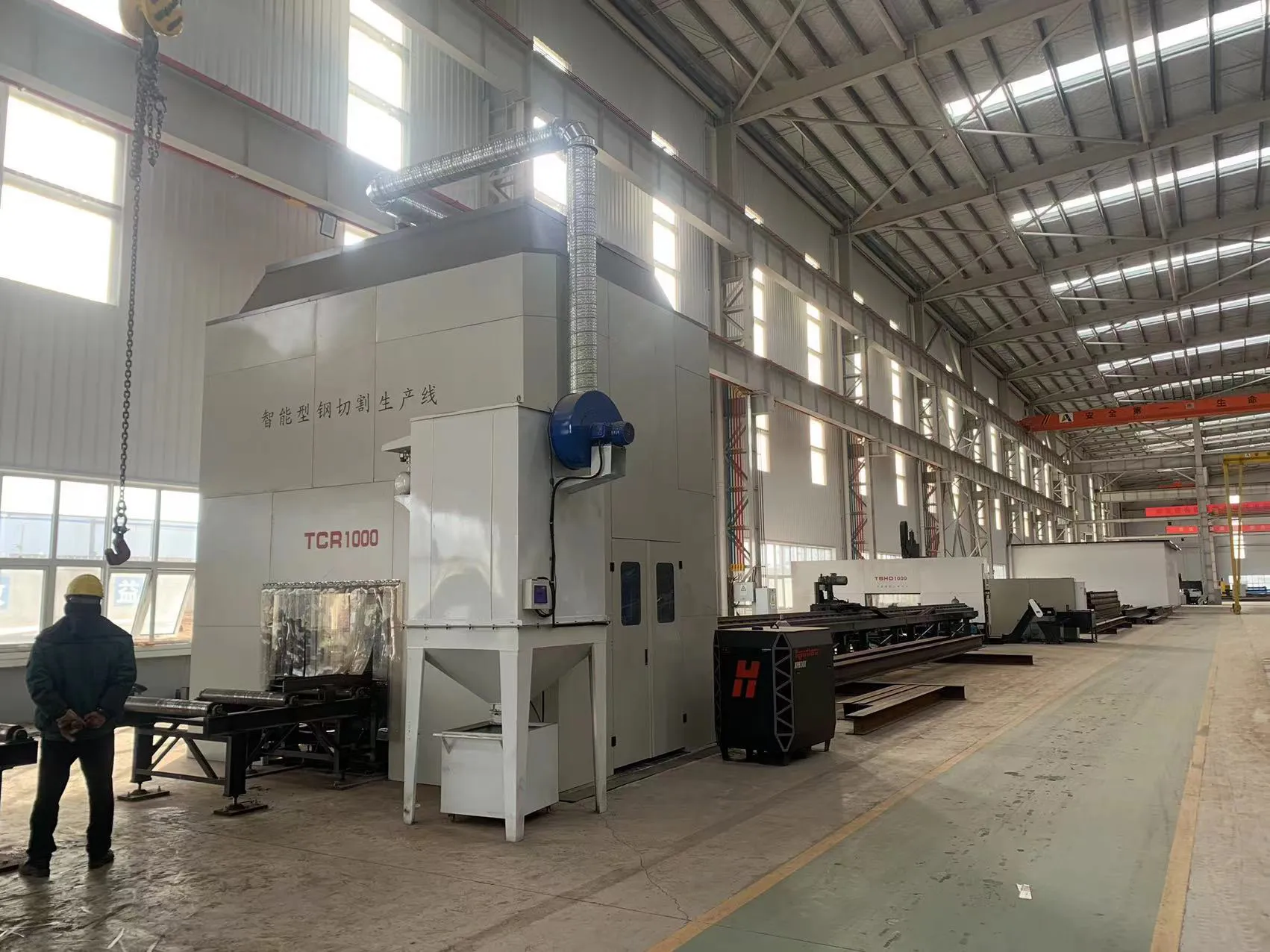
2.1 Kerf Management and Heat-Affected Zone (HAZ)
One of the primary concerns in crane manufacturing is the Heat-Affected Zone (HAZ), which can alter the grain structure of the steel and lead to brittle failure under fatigue. The 6000W source, when paired with high-pressure oxygen (O2) assist gas, allows for a significantly narrowed HAZ compared to plasma or oxy-fuel. The precision of the fiber beam ensures a kerf width typically under 0.2mm, maintaining the metallurgical properties of the beam web and flange. This is vital for the structural load-bearing components of overhead cranes that must endure millions of loading cycles.
2.2 Feed Rate and Throughput Metrics
For a standard 12mm wall thickness C-channel, a 6000W source maintains linear cutting speeds that outperform traditional mechanical methods by a factor of five. More importantly, the consistency of the cut surface eliminates the need for post-cut de-burring, allowing the material to move directly from the laser bed to the welding station.
3.0 Kinematics of ±45° Bevel Cutting in Structural Profiles
The integration of a 5-axis cutting head capable of ±45° beveling is the core technological differentiator in this field report. In crane fabrication, the junction between the end carriage and the bridge girder requires deep-penetration welds. Traditionally, these bevels were ground manually—a process prone to human error and inconsistent root gaps.
3.1 Multi-Axis Articulation
The CNC system controls the A and B axes of the cutting head in synchronization with the rotation of the profile (the U-axis) and the longitudinal movement (the X-axis). This allows the laser to perform complex “K,” “V,” “Y,” and “X” type weld preparations on the fly. When cutting a channel or a beam, the head adjusts its angle relative to the surface normal, ensuring that the bevel remains constant even as the head traverses the radius of the beam’s flange-to-web transition.
3.2 Eliminating Secondary Weld Prep
By achieving a ±45° bevel during the primary cutting phase, the fabricator ensures a perfect fit-up. In Charlotte-based crane plants, we have observed a 40% reduction in welding time purely due to the precision of the laser-cut bevels. A tighter fit-up reduces the volume of filler metal required and minimizes the heat input during the welding process, further preserving the structural geometry of the crane bridge.
4.0 Application Specifics: Crane Girders and End Carriages
Crane manufacturing requires the processing of large-scale members, often reaching lengths of 12 meters or more. The CNC Beam and Channel Laser Cutter utilizes a multi-chuck system (typically three or four chucks) to maintain the rigidity of these heavy profiles during the cutting process.
4.1 Bolt Hole Precision and Alignment
High-capacity cranes rely on bolted connections for modular assembly. The CNC laser provides hole tolerances within ±0.1mm, far exceeding the capabilities of magnetic drills. This precision ensures that when the crane components reach the job site in Charlotte or beyond, the alignment of the bridge and the end carriages is instantaneous, eliminating the need for on-site reaming.
4.2 Processing of Channel Steel and I-Beams
C-channels are often used as reinforcements or as the primary rails for crane trolleys. The ability of the laser to cut through the varying thicknesses of a channel (from the thick web to the tapered flanges) requires sophisticated power ramping. The 6000W controller automatically modulates power and gas pressure based on the instantaneous thickness perceived by the capacitive height sensor, ensuring a clean cut even on the internal radii of the profile.
5.0 Synergy Between 6000W Sources and Automation
The efficiency of the hardware is maximized by the software ecosystem. Modern CNC beam lasers utilize specialized nesting software (such as SigmaTube or Lantek) that accounts for the 3D geometry of the beam. This synergy is critical for minimizing material waste in expensive structural steel.
5.1 Automatic Material Handling
In high-volume Charlotte facilities, the 6000W laser is integrated with automated loading and unloading racks. Sensors detect the profile dimensions, verify the material type, and feed it into the chuck system. The “zero-tailing” technology, made possible by the multi-chuck configuration, allows the laser to cut almost to the very end of the beam, significantly increasing material utilization rates.
5.2 Real-time Monitoring and Feedback Loops
The 6000W systems are equipped with internal sensors that monitor the health of the protective windows, the temperature of the cutting head, and the consistency of the laser beam. In a “Smart Factory” environment, this data is fed back to the plant’s ERP system, allowing Charlotte crane manufacturers to predict maintenance intervals and avoid unplanned downtime during critical production runs.
6.0 Structural Integrity and Compliance Standards
Crane manufacturing is governed by strict safety standards (such as CMAA or ASME). The use of CNC laser technology supports compliance by providing a digital “paper trail” of every cut. The repeatability of the laser ensures that every crane produced meets the exact engineering specifications defined in the CAD model.
Furthermore, the high-quality finish of a 6000W laser cut reduces the risk of stress concentrators. Micro-fractures often caused by mechanical shearing or the jagged edges of manual plasma cutting are non-existent with laser processing. This leads to a higher fatigue life for the crane, a critical selling point for manufacturers in the competitive North American market.
7.0 Conclusion: The Competitive Edge in Charlotte
The implementation of a 6000W CNC Beam and Channel Laser Cutter with ±45° beveling technology represents the pinnacle of current structural steel processing. For crane manufacturers in Charlotte, it solves the dual challenge of labor shortages and the need for extreme precision. By automating the most labor-intensive parts of the fabrication process—measuring, cutting, drilling, and beveling—and consolidating them into a single 5-axis CNC operation, manufacturers achieve a level of throughput and quality that was previously unattainable.
As the demand for heavy infrastructure and automated warehousing increases, the ability to produce high-tolerance, weld-ready structural members will define the leaders in the crane manufacturing sector. The 6000W fiber laser is not merely a tool; it is the foundation of a modern, data-driven fabrication strategy.
















