
Field Report: High-Power Structural Laser Integration in Edmonton’s Modular Construction Sector
Introduction: The Shift to Automated Structural Fabrication
The industrial landscape in Edmonton, Alberta, increasingly demands high-throughput, high-precision structural steel components to support the burgeoning modular construction industry. Traditional methods of processing heavy beams and channels—primarily involving band sawing, manual layout, and plasma arc gouging—are proving insufficient to meet the tolerances required for rapid assembly of modular units. This report evaluates the operational implementation of a 6000W CNC Beam and Channel Laser Cutter equipped with ±45° bevel cutting capabilities. The focus is on its technical efficacy in processing H-beams, C-channels, and hollow structural sections (HSS) within a high-latitude industrial context.
The Physics of the 6000W Fiber Laser Source in Heavy Gauge Steel
The selection of a 6000W fiber laser source represents a strategic equilibrium between radiant intensity and operational cost. At a wavelength of approximately 1.064 microns, the fiber laser provides an absorption rate in carbon steel significantly higher than that of legacy CO2 systems.
For the heavy-walled sections typical of Edmonton’s modular frames (often ranging from 10mm to 20mm in flange thickness), the 6000W power density allows for a stabilized melt pool. This wattage is critical for maintaining “pierce-to-cut” speed ratios that prevent excessive heat accumulation. In structural steel, heat management is paramount; excessive Heat Affected Zones (HAZ) can alter the martensitic structure of the steel, potentially compromising the integrity of the weldment. The 6000W source ensures a narrow kerf width and a minimized HAZ, maintaining the metallurgical properties required by CSA S16 and AWS D1.1 standards.
±45° Bevel Cutting: Kinematics and Weld Preparation Efficiency
The core technological differentiator in this system is the 5-axis or 6-axis robotic cutting head capable of ±45° beveling. In traditional structural fabrication, creating a V-groove, K-bevel, or J-prep for full-penetration welds requires secondary mechanical grinding or oxy-fuel beveling. Both are labor-intensive and prone to human error.
The CNC laser system integrates beveling directly into the primary cutting cycle. The kinematics of the head allow for dynamic angle adjustment during the traverse of the beam’s flange or web. This is not merely a geometric achievement but a compensation challenge. As the angle of the laser head increases, the “effective thickness” of the material increases (e.g., a 45° cut through 15mm plate results in a ~21.2mm travel path). The 6000W source provides the necessary overhead to maintain consistent cutting speeds even as the effective thickness fluctuates during complex beveling maneuvers.
This capability is transformative for Edmonton’s modular builders, who often utilize complex intersections where C-channels must seat flush against H-beam webs. The precision of the ±45° bevel ensures that fit-up tolerances are kept within ±0.5mm, virtually eliminating the need for “gap-filling” with weld wire—a common point of failure in cold-weather structural applications.
Application in Edmonton’s Modular Construction Infrastructure
Edmonton serves as a primary hub for modular pre-fabrication for the oil sands and remote housing sectors. These structures are subjected to extreme thermal expansion and contraction cycles. Precision in the “Lego-like” assembly of these modules is non-negotiable.
1. H-Beam and C-Channel Optimization
Modular chassis typically rely on heavy H-beams for the primary load-bearing members. The CNC laser’s ability to execute bolt holes, cope cuts, and bevels in a single pass ensures that the structural integrity of the beam is not compromised by multiple handling stages. When processing C-channels for floor joists, the laser’s software compensates for the inherent “toe-in” or taper of the channel flanges—a common frustration in mechanical punching or sawing.
2. Accuracy in Bolt-Hole Circularity
Traditional plasma cutting often results in “tapered” holes (top diameter vs. bottom diameter variance). In modular construction, where high-strength bolts (A325 or A490) are used for field connections, hole circularity and perpendicularity are critical. The high beam quality (M² factor) of the 6000W fiber laser ensures that even in thick-walled structural sections, the hole taper is negligible, meeting the stringent “Standard Hole” requirements of the AISC/CISC.
Synergy Between Automation and Structural Processing
The integration of a 6000W CNC system into a structural shop is not solely about the cutting head; it is about the automation of material handling. Edmonton’s high labor costs necessitate a reduction in “touches” per ton of steel.
Automatic Load/Unload and Sensing
Structural steel is rarely perfectly straight. “Camber” and “sweep” are inherent in rolled sections. The CNC laser utilizes high-speed touch probes or laser displacement sensors to map the actual geometry of the beam before the first cut is made. The software then dynamically adjusts the cutting path (NC code) to match the real-world profile of the steel. This “Best Fit” logic is essential for ensuring that when two 12-meter beams are joined, the bevels align perfectly despite mill tolerances in the raw material.
Nesting and Waste Mitigation
Advanced nesting algorithms specifically designed for structural shapes allow for the nesting of “parts within parts.” For example, smaller gusset plates or connection tabs can be cut from the web of a larger H-beam in areas that would otherwise be scrap. In the high-volume environment of modular fabrication, a 5% increase in material utilization across a multi-million dollar project represents a significant capital recovery.
Technical Considerations for Cold-Climate Operations
Operating high-power fiber lasers in the Edmonton environment introduces specific challenges regarding cooling and gas purity.
– **Chiller Integration:** The 6000W source generates significant heat at the resonator and the optics. Dual-circuit chillers must be housed in climate-controlled environments to prevent coolant thickening or freezing during winter shutdowns.
– **Assist Gas Dynamics:** Oxygen (O2) is typically used for carbon steel to facilitate an exothermic reaction, increasing speed. However, for the high-quality edges required in modular frames, high-pressure Nitrogen (N2) or filtered dry air is utilized to prevent oxidation layers. In Edmonton, ensuring a dew point of -40°C for compressed air is vital to prevent moisture-induced plasma instability during the laser process.
Eliminating the Secondary Processing Bottleneck
In traditional fabrication, the workflow is: Saw -> Drill -> Manual Bevel -> Grind. Each step introduces a margin of error. The CNC 6000W laser consolidates these into a single “Raw-to-Ready” station.
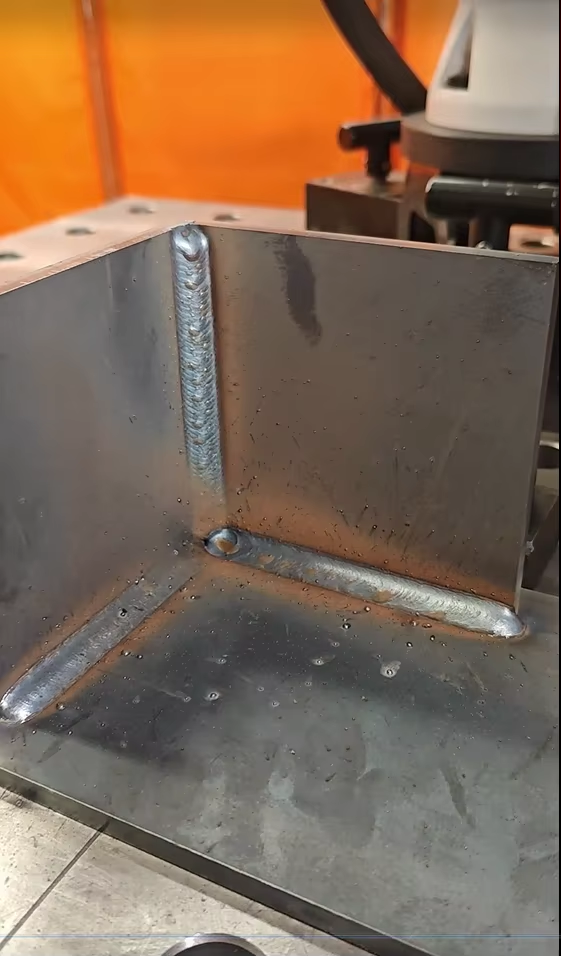
The ±45° beveling capability specifically addresses the “weld-prep bottleneck.” By producing a “ready-to-weld” edge with the correct land thickness and bevel angle, the fabricator reduces the welding time. Cleaner cuts lead to more stable arcs and less spatter. In a modular facility where thousands of linear meters of welding are performed, the reduction in wire consumption and grinding discs alone justifies the transition to laser technology.
Conclusion: The Future of Structural Steel in Alberta
The implementation of 6000W CNC Beam and Channel Laser technology with ±45° beveling marks a shift from “general fabrication” to “precision engineering” in the Edmonton modular sector. The ability to handle the heavy sections required for North American infrastructure with the precision of a Swiss watchmaker allows for faster project timelines and safer structures. As the industry moves toward more complex, multi-story modular designs, the reliance on automated, high-power laser systems will become the baseline for competitiveness in the global structural market.
The data confirms that the integration of this technology reduces total fabrication time per ton by approximately 30-40% while simultaneously increasing the fatigue life of the joints through superior fit-up. For the senior engineer, the decision is clear: the precision of the laser is no longer a luxury—it is a structural necessity.
















