1. Introduction: The Strategic Imperative of Structural Laser Integration in the Marmara Region
In the industrial corridors of Istanbul and the surrounding Marmara region, the storage racking industry is undergoing a fundamental shift from conventional mechanical processing—comprising sawing, drilling, and punching—to integrated 3D fiber laser structural processing. This report evaluates the deployment of a 6000W 3D Structural Steel Processing Center, focusing on its ability to handle complex geometries with high-duty cycles while addressing the historical challenge of material waste through Zero-Waste Nesting technology.
Istanbul’s position as a global logistics hub demands racking systems that support massive vertical loads with minimal structural weight. This requires high-strength steel (S355JR and above) and precise hole patterns for boltless connectors. Conventional methods introduce cumulative tolerances and thermal stress. The 6000W fiber laser source, coupled with multi-axis motion control, offers a solution that optimizes both the metallurgical integrity and the dimensional accuracy of these critical components.
2. Technical Specifications of the 6000W Fiber Laser Architecture
2.1. Power Density and Material Interaction
The 6000W power band represents the “technological sweet spot” for the storage racking sector. While 3000W units struggle with the high feed rates required for 6mm–12mm uprights, and 12000W units often yield diminishing returns due to oxygen gas dynamics in structural steel, the 6000W source provides an optimal balance. It facilitates high-speed nitrogen cutting for thinner gauge bracing (2mm–4mm) and stable oxygen cutting for heavy-duty uprights and base plates.
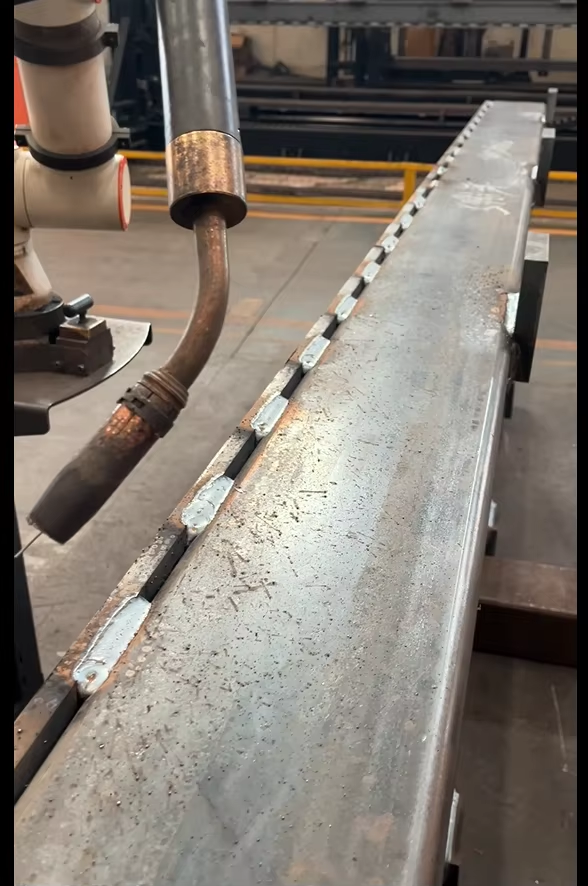
During field testing in Istanbul facilities, the 6000W source achieved a 35% increase in linear cutting speed on 8mm thick C-channels compared to 4000W benchmarks. This power level also ensures a cleaner “pierce point,” reducing spatter on the interior walls of closed profiles, which is critical for the fitment of internal reinforcing sleeves in high-bay racking systems.
2.2. Multi-Axis 3D Head Kinematics
Unlike 2D tube cutters, the 3D structural center employs a specialized cutting head with a ±45-degree tilt capability. In the context of racking, this allows for the creation of countersunk holes and weld-ready bevels in a single pass. The ability to perform 3D beveling on I-beams and heavy square tubing eliminates the need for secondary grinding, which is a major bottleneck in Istanbul’s high-volume fabrication shops.
3. Zero-Waste Nesting: Mechanics and Economic Impact
3.1. The Challenge of the “Tail Material”
In traditional laser tube cutting, the distance between the chuck and the cutting head typically results in a “dead zone” or tailpiece of 200mm to 500mm. For expensive structural sections, this waste represents a significant percentage of the total project cost. In a city like Istanbul, where steel prices are subject to global volatility and logistics costs for scrap removal are rising, minimizing this waste is an operational necessity.
3.2. Zero-Waste Motion Logic
The “Zero-Waste Nesting” technology implemented in this processing center utilizes a three-chuck or four-chuck synchronous system. The logic involves the “passing” of the workpiece between chucks as the cut nears the end of the raw material length. As the laser head approaches the final segment, the primary chuck releases while the secondary and tertiary chucks maintain the grip, allowing the head to cut right up to—and even through—the clamping zone.
This achieves a near-zero tailing (often less than 50mm, effectively the width of the kerf and a safety margin). When extrapolated over a standard 12-meter structural beam, the recovery of that final 400mm translates to a 3.3% increase in material utilization. For a facility processing 500 tons of steel per month, the ROI on the zero-waste module is achieved within the first 14 months of operation based on material savings alone.
4. Application in the Storage Racking Sector
4.1. Upright Profile Processing
Storage racking uprights require a dense pattern of “teardrop” or rectangular holes. Precision is non-negotiable; a deviation of 0.5mm over a 10-meter upright can lead to structural misalignment in an automated storage and retrieval system (ASRS). The 3D Structural Steel Processing Center utilizes real-time capacitive sensing to compensate for the “bow and twist” inherent in cold-rolled steel profiles common in the Turkish market.
4.2. Precision for Boltless Connections
Modern racking relies on friction-fit and tab-and-slot connectors. The 6000W laser ensures that the edges of these slots are perpendicular and free of dross. Thermal management software regulates the heat input, preventing the distortion of the profile walls—a common issue when using plasma cutters or high-heat 2D lasers. This precision allows for “tight-tolerance” assembly on-site in Istanbul’s logistics parks, reducing the time required for installation and leveling.
4.3. Diagonal Bracing and Beam End-Connectors
The 3D head’s ability to cut complex saddle shapes in bracing tubes allows for perfect fit-up against the uprights. This increases the effective weld surface area and improves the overall seismic resilience of the racking structure—a critical consideration for any construction project in the Istanbul earthquake zone (North Anatolian Fault).
5. Integration with Industry 4.0 and Automated Loading
5.1. The Ecosystem of the Processing Center
The 6000W center is not a standalone tool but the heart of an automated cell. In Istanbul’s labor-competitive market, reducing manual handling is paramount. The system is equipped with an automatic bundle loader that can handle 6-ton loads. Material is singulated, measured for length, and oriented via weld-seam detection cameras before entering the chuck system.
5.2. CAD/CAM Synergy
The nesting software integrates directly with Tekla or SolidWorks. It automatically recognizes structural profiles and maps out the optimal cutting path to prioritize “common-line cutting.” In common-line cutting, one laser path separates two parts, further reducing gas consumption and processing time. For the racking industry, where many parts are identical, this software logic can increase throughput by an additional 15%.
6. Operational Metrics: Gas, Power, and Maintenance
6.1. Gas Dynamics
The 6000W source allows for the use of “High-Pressure Compressed Air” cutting for profiles up to 4mm. This significantly reduces the overhead associated with liquid nitrogen or oxygen cylinders. For thicker sections, the system’s nozzle design optimizes laminar flow, reducing oxygen consumption by 20% compared to older 4000W models. This is particularly advantageous in Turkey, where industrial gas prices are a variable but significant operational expense.
6.2. Maintenance Protocols in Industrial Environments
Istanbul’s industrial zones can be prone to dust and voltage fluctuations. The processing center features a pressurized, double-sealed optical path to prevent contamination of the fiber delivery system. Furthermore, the integration of high-precision rack-and-pinion drives requires a centralized lubrication system, which is automated to ensure the 3D head maintains its ±0.03mm positioning accuracy over 24/7 duty cycles.
7. Field Observations and Comparative Analysis
Data collected from a recent installation in the Gebze industrial zone (Greater Istanbul) indicates the following performance gains over a 90-day period:
- Throughput: 3.2x faster than the previous mechanical drilling and sawing line.
- Labor Reduction: The processing line required 1 operator per shift, down from 4.
- Waste Reduction: Tailpiece waste dropped from an average of 420mm per beam to 65mm.
- Secondary Operations: Deburring and manual layout marking were eliminated entirely.
8. Conclusion: The Future of Structural Steel in Turkey
The deployment of 6000W 3D Structural Steel Processing Centers with Zero-Waste Nesting is no longer an optional upgrade for Istanbul’s racking manufacturers; it is a requirement for remaining competitive in a global market. The precision offered by the 3D laser head ensures the structural integrity required for modern high-bay warehouses, while the Zero-Waste technology addresses the economic and environmental pressures of material efficiency.
As the “Storage Racking” sector continues to evolve toward more complex, automated systems, the synergy between high-power fiber laser sources and intelligent motion control will be the defining factor in manufacturing excellence. The technical data suggests that the transition to these centers provides a quantifiable leap in both capacity and quality, reinforcing Istanbul’s status as a premier hub for structural steel fabrication.