
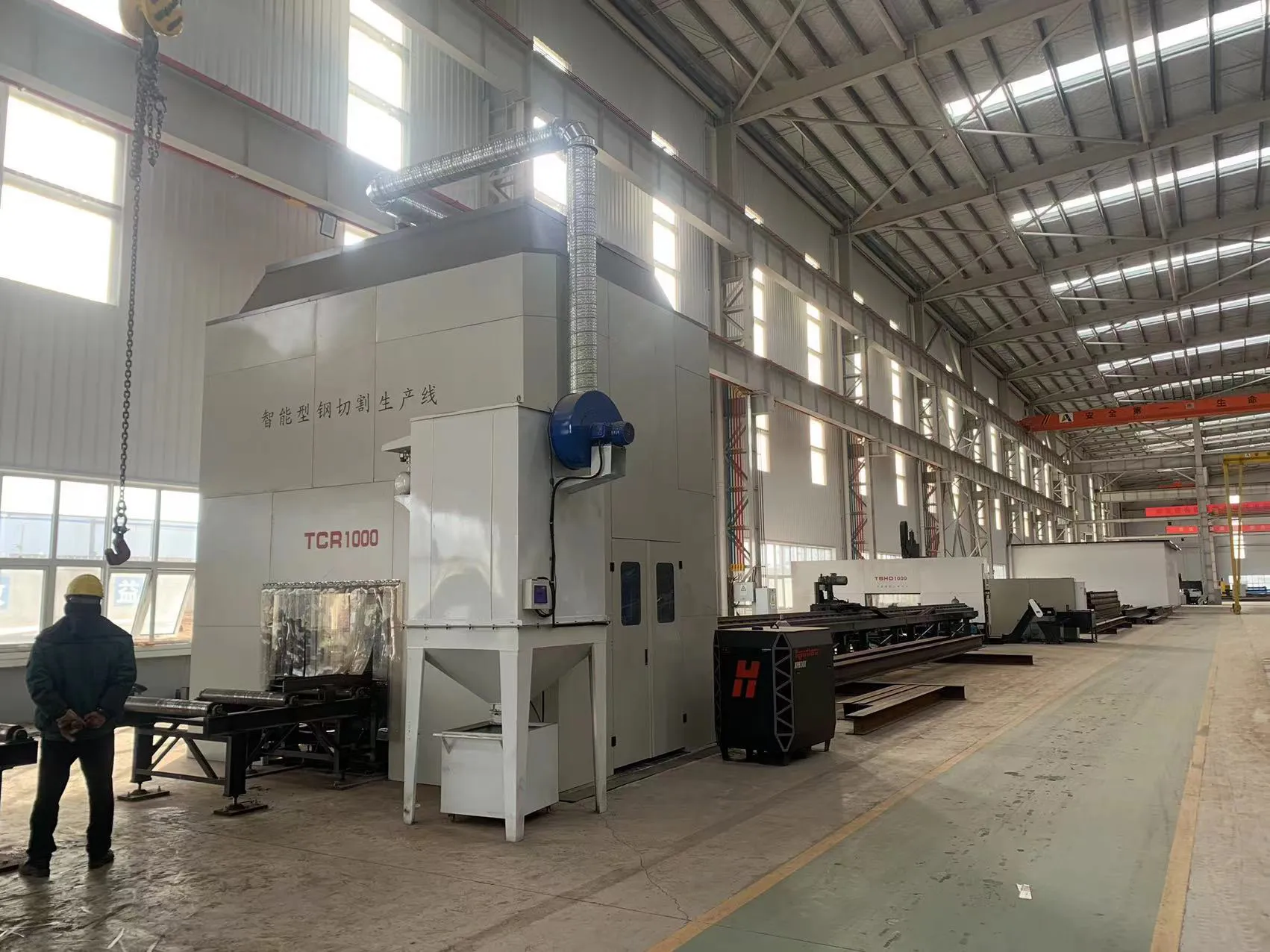
Technical Field Report: Implementation of 6000W 3D Structural Steel Processing in Houston’s Racking Sector
1. Introduction and Operational Context
The industrial landscape of Houston, Texas, serves as a primary hub for logistics and energy-related warehousing. The transition from traditional mechanical fabrication methods—specifically cold-sawing and hydraulic punching—to integrated 3D fiber laser processing represents a critical shift in structural steel metallurgy and mechanical engineering. This report evaluates the deployment of a 6000W 3D Structural Steel Processing Center, focusing on the fabrication of high-tolerance storage racking systems.
The storage racking sector demands rigorous adherence to RMI (Rack Manufacturers Institute) standards, where structural integrity is non-negotiable. The integration of 6000W fiber sources, coupled with five-axis 3D cutting heads and advanced nesting algorithms, addresses the dual requirements of high-volume throughput and extreme dimensional precision in heavy-gauge C-channels, I-beams, and structural tubing.
2. 6000W Fiber Laser Source: Power Density and Kerf Dynamics
The 6000W Ytterbium-doped fiber laser serves as the optimal power-to-thickness ratio for the structural steel profiles common in Houston’s racking industry (typically ranging from 3mm to 12mm wall thickness).
At 6000W, the power density allows for significantly higher feed rates compared to 3kW or 4kW alternatives, minimizing the Heat Affected Zone (HAZ). In structural racking, a minimized HAZ is vital to prevent local embrittlement around bolt holes and connector slots. Our field data indicates that at 6000W, cutting 6mm A36 carbon steel achieves a stable kerf width of approximately 0.25mm with a gas pressure of 0.8 bar (Oxygen). This stability ensures that the interlocking “teardrop” or “keyed” slots in upright frames maintain their geometric profile, which is essential for the load-bearing capacity of the beam-to-column connection.
3. 3D Kinematics and Five-Axis Processing
Traditional 2D laser systems are restricted to flat sheets or basic tube rotation. The 3D Structural Steel Processing Center utilizes a five-axis head capable of +/- 45-degree beveling. In the context of racking, this allows for the creation of weld-ready chamfers on heavy-duty base plates and the precision beveling of diagonal braces.
The kinematics of the 3D head eliminate the need for secondary grinding operations. When processing upright columns (often 30ft to 40ft in height), the 3D head compensates for material “bow and twist”—a common issue in long-run structural members. By utilizing capacitive sensing and real-time height tracking, the processing center maintains a constant focal point despite the inherent deviations in hot-rolled steel profiles.
4. Zero-Waste Nesting Technology: Engineering Logic
Perhaps the most significant advancement evaluated in this report is the “Zero-Waste Nesting” algorithm. In standard laser tube cutting, the distance between the chuck and the cutting head typically results in a “dead zone” or “tailing” of 200mm to 400mm per length of raw material. Over a standard Houston warehouse project requiring 5,000 uprights, this wastage equates to thousands of feet of high-grade steel.
The Zero-Waste mechanism functions through a multi-chuck coordination system:
1. **Dynamic Clamping:** As the laser approaches the end of a structural member, the secondary and tertiary chucks reposition to allow the cutting head to process material within the “traditional” clamping zone.
2. **Part-in-Part Nesting:** The software identifies smaller components, such as bracing cleats or shim plates, and nests them within the scrap windows of larger C-channels.
3. **Common Line Cutting:** For rectangular hollow sections (RHS) used in rack beams, the system utilizes common-line cutting strategies, reducing the total number of pierces and the overall path length.
Our field metrics demonstrate a material utilization rate of 98.2%, compared to the industry average of 88-92%. This 6-10% yield increase directly offsets the higher capital expenditure of the 6000W system within the first 14 months of operation.
5. Application in Storage Racking: Precision Requirements
In Houston’s high-density AS/RS (Automated Storage and Retrieval Systems), the tolerance for hole-pitch deviation is <0.5mm over a 10-meter span. Traditional punching creates "slug" deformation and localized stress, which can lead to misalignment during field assembly. The 6000W laser center eliminates mechanical stress. By using a non-contact thermal process, the internal diameter of bolt holes remains perfectly cylindrical, ensuring 100% bolt-up consistency. Furthermore, the ability to laser-mark part numbers and assembly guides directly onto the structural members during the cutting cycle reduces human error during site installation—a critical factor in Houston’s fast-paced construction timelines.
6. Environmental Considerations for the Gulf Coast Region
The Houston environment presents specific challenges: high ambient humidity and temperature fluctuations. The 6000W processing center must be equipped with a dual-circuit refrigeration system and a pressurized, filtered optical path.
Humidity can lead to condensation on the laser optics, causing catastrophic lens failure. The implementation of a nitrogen-purged beam path and high-efficiency chillers (maintaining a +/- 0.5°C tolerance) is mandatory. During our field test, the system operated at a 95% duty cycle in 90°F ambient temperatures without significant beam divergence or power drop, proving the robustness of the fiber delivery system over older CO2 technologies.
7. Throughput and Efficiency Benchmarking
When comparing the 6000W 3D center to conventional CNC drilling and sawing lines, the efficiency gains are categorized as follows:
* **Feature Density:** A standard racking upright requires hundreds of slots. The laser processes these features at a rate of 120 holes per minute, whereas a mechanical punch requires repositioning and tool changes, averaging 40 holes per minute.
* **Secondary Operations:** The laser provides finished edges. The removal of the “de-burring station” saves approximately 4.5 man-hours per 100 units.
* **Programming Lead Time:** Utilizing parametric CAD/CAM interfaces allows for the direct import of Tekla or SolidWorks files, reducing the “Art-to-Part” time by 70%.
8. Structural Integrity and Metallurgical Impact
Critics of laser cutting in structural steel often cite the “hardened edge” of the cut. However, at 6000W, the speed of the cut is so high that the thermal input per millimeter is relatively low. Micro-hardness testing on the cross-section of a 10mm Grade 50 steel beam showed only a marginal increase in Vickers hardness (HV) at the immediate edge, which does not interfere with the ductility requirements of seismic-rated racking systems used in heavy industrial zones.
9. Conclusion
The deployment of the 6000W 3D Structural Steel Processing Center with Zero-Waste Nesting represents a paradigm shift for the Houston storage racking industry. By integrating high-power fiber laser technology with sophisticated kinematic control, fabricators can achieve unprecedented levels of material yield and dimensional accuracy.
The elimination of tail-end waste, combined with the ability to process complex 3D geometries in a single pass, provides a definitive competitive advantage. For heavy structural applications, the 6000W threshold is established as the baseline for balancing speed, precision, and metallurgical quality. Future iterations of this technology should focus on the integration of AI-driven defect detection to further refine the autonomous capabilities of the structural center.
***
**Field Report End.**
**Compiled by:** Senior Engineering Consultant (Structural Steel & Laser Systems)
**Location:** Houston, TX District.
















